Collective Strike of Residents on 11th Day, Strike Continues Despite Government Concessions... Deadlock (Comprehensive)
Government "Postponement of National Medical Exam" vs Medical Students "Postponed but Will Continue Collective Action"

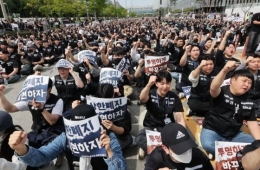
On the 31st, residents decided to continue their indefinite strike at Seoul National University Hospital in Jongno-gu, Seoul. Due to the increased clinical burden on professors caused by the strike of residents and fellows, Seoul National University Hospital decided to reduce outpatient internal medicine services for one week starting from that day. Photo by Moon Honam munonam@
View original image[Asia Economy Reporter Seo So-jeong] On the 31st, the 11th day since residents began a collective strike opposing major medical policies such as increasing medical school quotas and establishing public medical schools, the conflict between the government and the medical community is deepening. When the government reported 10 residents for failing to comply with the work commencement order to the police, the medical community immediately protested. The Korean Medical Association, which conducted the second general doctors' strike from the 26th to the 28th, pulled out the strong card of an 'indefinite general strike' starting from the 7th of next month, and on the 30th, residents decided after internal discussions to continue the indefinite strike. In response, the government decided to issue work commencement orders to residents and fellows who went on strike at 10 non-metropolitan training hospitals starting from the 31st and took a firm stance.
Subsequently, on the afternoon of the 31st, the government initially planned to proceed with the practical exam of the medical licensing examination scheduled for the next day (September 1st) but stepped back by announcing a one-week postponement after accepting the medical community's position. However, the Korean Association of Medical Colleges and Medical Graduate Schools Students (KAMC) maintained a hardline stance, stating, "Despite the postponement announcement, we will continue to refuse the exam," escalating the confrontation between the government and the medical community.
◆ Seoul National University Hospital Residents and Fellows Submit Resignation Letters One After Another = The Korean Intern Resident Association (KIRA) has intensified its struggle by deciding on an indefinite strike, and at large hospitals, residents and fellows are submitting resignation letters one after another. On the morning of the 31st, residents and fellows at Seoul National University Hospital collectively submitted resignation letters in defiance of the government's work commencement order. The Seoul National University Hospital Residents Association reported that out of 953 residents, 895 participated in submitting resignation letters, and out of 281 fellows, 247 did so. They stated, "We will continue to provide COVID-19 treatment as promised to the public," and "Apart from work stoppage, we will continue medical support in the form of volunteer service."
The government's additional issuance of work commencement orders to residents and fellows who went on strike has intensified residents' backlash. The KIRA emergency committee held a vote the previous day to confirm whether to suspend or continue the strike, but it was rejected as it failed to secure the majority consent. However, after a re-vote, they decided to proceed with the collective strike. In the first vote, 96 out of 193 voting members chose to continue the strike, but it was rejected due to lack of quorum. In the re-vote, 134 out of 186 voted to continue the strike, deciding to proceed. The KIRA emergency committee strongly urged the government to "return to the starting point and renegotiate" regarding the expansion of medical school quotas and the establishment of public medical schools, rather than vague agreements like "keeping all possibilities open." The committee stated, "The government forcibly pushed through major policies such as expanding medical school quotas without consulting the medical community. We do not know how they will act again once the COVID-19 crisis ends," and "Since trust between the medical community and the government has not been built, it is difficult to stop the strike based solely on the government's words."
The Ministry of Health and Welfare expressed that it cannot understand KIRA's decision to continue the strike at all. A ministry official said, "Didn't the medical-government consultative body, composed of the medical community centered on the Korean Medical Association and the Ministry of Health and Welfare, agree to actively discuss the expansion of medical school quotas and the establishment of public medical schools from the 'starting point'?" and "Elders in the medical community even 'guaranteed' participation in the strike if the government did not implement the agreement, but it is incomprehensible that residents are pushing ahead with the strike." The government also pulled out the 'public debate' card that day. Yoon Tae-ho, head of the Central Disaster and Safety Countermeasures Headquarters' quarantine team, said, "We have confirmed the facts about the public medical school several times, but malicious or false information is rampant on social network services (SNS). We plan to actively accept debates to provide accurate information and build social consensus."
![[Image source=Yonhap News]](http://www.asiae.co.kr/news/img_view.htm?img=2020082814220050279_1598592119.jpg)
◆ Government Postpones Medical Licensing Practical Exam by One Week = Amid the escalating confrontation, the government on the afternoon of the 31st abruptly announced a one-week postponement of the 2021 85th Medical Licensing Examination practical exam, scheduled to start the next day. Initially, the government planned to hold the practical exam as scheduled on the 1st. Despite repeated calls from the Korean Association of Medical Colleges (KAMC) to postpone the exam due to the spread of COVID-19, the government maintained its position until the morning of that day to proceed as planned.
According to the Korea Health Personnel Licensing Examination Institute, as of the 28th, about 89% (2,823 out of 3,172) of applicants had canceled their applications. If the government proceeded with the medical licensing exam as scheduled, the mass cancellation could cause a shortage of medical personnel next year, leading to a medical service gap.
Considering this situation, the government made a concession. On the afternoon of the same day, Kim Kang-lip, Vice Minister of Health and Welfare, said in an online briefing regarding the response to residents' refusal to provide medical services, "To minimize the damage to medical students, the practical exam of the medical licensing examination scheduled for the 1st of next month will be postponed by one week and held from the 8th." Kim explained, "There was insufficient time to accurately confirm the intention to cancel the exam, raising concerns about unnecessary harm to many students' futures. Also, if such problems occur, it could affect hospitals' medical capabilities and the public's access to medical services."
Hot Picks Today
 Cerebras Soars 70% on IPO Debut: Is Nvidia's Reign Ending as a New AI Semiconductor Power Emerges?
- "He's Handsome, It's Such a Pity?"... Lawyer Responds to Bizarre 'Appearance Evaluation' of High School Girl Murder Suspect
- "After Vowing to Become No. 1 Globally, Sudden Policy Brake Puts Companies’ Massive Investments at Risk"
- "Mom, Isn't It Comfortable Living With Me?"... 'Unexpected Result' Shows Increased Drinking Out of Frustration
- "Nothing Has Changed": Union Rejects Samsung's Proposal... Further Talks Fail as Strike Proceeds
However, the Korean Association of Medical Colleges and KAMC maintain a hardline stance, stating, "Despite the postponement announcement, we will continue to refuse the exam," indicating that the confrontation between the government and the medical community is expected to continue. Jo Seung-hyun, president of KAMC, said, "What the government announced is not a policy change but just a one-week postponement of the exam date," and "Unless there is a policy change, we will not stop collective action."
© The Asia Business Daily(www.asiae.co.kr). All rights reserved.