Agreement Reached Between Government and Medical Community... Resident Doctors Proceed with Strike Despite Opposition
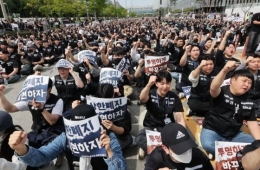
![Students affiliated with the Korean Intern Resident Association held a collective protest on the 7th against the government's plan to increase the number of medical residents. [Image source=Yonhap News]](http://www.asiae.co.kr/news/img_view.htm?img=2020082510133842696_1598318018.jpg)
Students affiliated with the Korean Intern Resident Association held a collective protest on the 7th against the government's plan to increase the number of medical residents. [Image source=Yonhap News]
View original image[Asia Economy Reporter Kim Heung-soon] The government prepared an agreement stating that it would "halt the policy of expanding medical school quotas and establishing public medical schools" to avoid conflict with the medical community, which began a three-day collective strike starting on the 26th. However, it has been confirmed that the government failed to prevent the collective action due to last-minute opposition from resident doctors.
Park Neung-hoo, Minister of Health and Welfare, said at a briefing held at the Government Seoul Office that morning, "There was a time when we reached an agreement with the Korean Medical Association to halt the contentious policy implementation and collective strike, and to resolve the issue through dialogue and consultation," adding, "It is deeply regrettable that the Korean Intern Resident Association reversed its position following their decision to fight."
At the briefing, the Ministry of Health and Welfare disclosed detailed contents of the consultations between the Minister and the Medical Association following the Prime Minister-Medical Association meeting on the 24th. During talks that continued until the early hours of the 25th, both sides agreed that ▲ the Ministry of Health and Welfare would suspend the expansion of medical school quotas and the establishment of public medical schools until the spread of COVID-19 in the metropolitan area stabilizes, and after stabilization, all possibilities would be kept open for consultation with the Korean Medical Association. During the consultation period, unilateral policy implementation such as notifying medical school quotas would not be enforced; ▲ the Ministry and the medical community would prepare an agreement to discuss developmental measures for the four major policies raised by the Korean Medical Association within a consultative body.
This marked a step forward from the government's previous stance of "policy suspension" to "policy halt" regarding the expansion of medical school quotas. However, it is reported that the agreement was not reached because the Korean Intern Resident Association rejected it. Residents are doctors undergoing training to obtain specialist qualifications at university hospitals and other institutions, commonly referred to as interns or residents. The Korean Intern Resident Association, mainly composed of young doctors, reportedly concluded at a general assembly held the previous day that the contents of the agreement effectively only postponed the expansion of medical school quotas and implied continued promotion in the future, thus deeming it unacceptable.
Minister Park criticized, "Both the Medical Association and the Intern Resident Association rejected all government mediation proposals and insisted only on the withdrawal or fundamental re-examination of policies with the consent of medical organizations," adding, "Ultimately, they reversed the agreed contents, showed no sincerity or responsibility in consultations, and insisted on collective actions that threaten the lives and safety of the public."
The medical community demands the withdrawal of the government's four major medical policies: expansion of medical school quotas, establishment of public medical schools, pilot project for coverage of herbal medicine prescriptions, and promotion of non-face-to-face medical consultations. The government has held a total of six working-level meetings with the Medical Association, the Intern Resident Association, and others since the 5th.
Hot Picks Today
 Cerebras Soars 70% on IPO Debut: Is Nvidia's Reign Ending as a New AI Semiconductor Power Emerges?
- "Help Me"... Teacher Assaulted for 20 Minutes While Restraining Elementary Student; Ended Only After 5 Teachers Arrived
- "Nothing Has Changed": Union Rejects Samsung's Proposal... Further Talks Fail as Strike Proceeds
- "Mom, Isn't It Comfortable Living With Me?"... 'Unexpected Result' Shows Increased Drinking Out of Frustration
- "After Vowing to Become No. 1 Globally, Sudden Policy Brake Puts Companies’ Massive Investments at Risk"
The Korean Medical Association stated, "We recognize the sincerity of the Ministry of Health and Welfare, which earnestly engaged in the intense working-level negotiations," and added, "There is also regret that if such sincerity had been shown during the process of promoting the four policies, the situation would not have reached this point." They further demanded, "The medical community's collective action is to urge the government to change. Please create a foundation to transform the long-entangled relationship into one of trust and respect. The medical community is always open to discussing all possibilities with the government."
© The Asia Business Daily(www.asiae.co.kr). All rights reserved.