Doctors' Second General Strike for Three Days Starting Today... Emergency Medical Care Centered on Public Health Centers

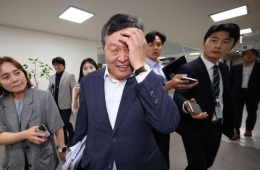
Residents opposing the government's expansion of medical school quotas are holding a 24-hour silent picket protest on the 23rd at Seoul St. Mary's Hospital, Catholic Central Medical Center in Seoul. Photo by Dongju Yoon doso7@
View original image[Asia Economy Reporter Kim Heung-soon] Doctors opposing government medical policies such as the expansion of medical school quotas and the establishment of public medical schools will go on a collective strike for three days from the 26th to the 28th.
The second nationwide doctors' strike organized by the Korean Medical Association will be conducted online through the YouTube channel (KMA-TV) under the theme "Together is Hope," without outdoor rallies or gatherings involving large numbers of people to prevent the spread of the novel coronavirus infection (COVID-19).
Unlike the collective strike by residents on the 7th or the first nationwide doctors' strike on the 14th, this second collective strike is expected to include interns, residents who have already entered an indefinite strike, fellows, and private practitioners.
Some large hospitals are already experiencing medical staff shortages, causing delays in surgery schedules and resulting in gaps in medical services. Samsung Seoul Hospital has postponed more than 100 surgeries scheduled from the 24th to the present day.
The KMA demands the withdrawal of four government medical policies: increasing medical school quotas, establishing public medical schools, coverage of herbal medicine prescriptions, and promoting telemedicine. The government has recently continued discussions, including unofficial behind-the-scenes negotiations with the KMA on the 25th, but it is reported that they have not been able to narrow their differences. However, since the KMA stated that they had "frank talks" with the government, the possibility of reaching an agreement remains open.
Meanwhile, according to the Ministry of Health and Welfare, as of the previous day, among 200 resident training institutions, 163 were confirmed, and out of 10,277 residents, 5,995 were not working, resulting in a strike rate of 58.3%. Among 2,639 fellows, 162 stopped working, with a strike rate of 6.1%.
Hot Picks Today
 Given Grants, Then Says "No Launch" ... Innovative Korean Technology Ultimately Forced Overseas
- "Rather Than Endure a 1.5 Million KRW Stipend, I'd Rather Earn 500 Million in the U.S." Top Talent from SNU and KAIST Are Leaving [Scientists Are Disappearing] ①
- [Breaking] Chairman Park Sookeun: "Possibility of Agreement Instead of Samsung Electronics Labor-Management Mediation Proposal"
- "If That's the Case, Why Not Just Buy Stocks?" ETFs in Name Only, Now 'Semiconductor-Heavy' and a Playground for Short-Term Traders
- "No Cure Available, Spread Accelerates... Already 105 Dead, American Infected"
The government has established an emergency medical system centered on public health centers in cooperation with local governments to prepare for possible medical service gaps due to increased strike rates at local clinics. Son Young-rae, head of strategic planning at the Central Disaster and Safety Countermeasure Headquarters, explained, "There may be some inconveniences, but we are making efforts to minimize medical service gaps as much as possible."
© The Asia Business Daily(www.asiae.co.kr). All rights reserved.
![Cheaper Than Candy, Yet Impossible to Find... Fears of a 'Pediatric Medical Crisis' as Pharmaceutical Companies Halt Production [Why&Next]](https://cwcontent.asiae.co.kr/asiaresize/307/2026051910065268365_1779152813.jpg)