COVID-19, Calm or Calm Before the Storm... Authorities Say "Difficult to Conclude Trend Has Turned" (Comprehensive)
COVID-19 Central Disease Control Headquarters Regular Briefing
New Cases Below 300 for Two Consecutive Days
Kwon Jun-wook "Nationwide Spread Is the Calm Before the Storm, Need to Watch Closely"

[Asia Economy Reporter Choi Dae-yeol] The number of new confirmed cases of the novel coronavirus infection (COVID-19) has fallen below 300 for two consecutive days, showing a slowdown compared to the end of last week. However, health authorities have expressed the view that it is difficult to say the spread has been curbed. This is because it is not reasonable to assess the overall situation based on the occurrence status over just a day or two.
At a briefing on the 25th, Kwon Jun-wook, Deputy Director of the Central Disease Control Headquarters, said, "Although the number of confirmed cases appears to have plateaued for two consecutive days on the surface, the health authorities consider this to be the calm before the storm of nationwide spread," adding, "We need to observe a little longer to see how significantly and quickly the social distancing measures initiated in the metropolitan area early last week will be reflected."
According to the health authorities, the number of new confirmed cases was 266 the previous day and 280 on the day. Compared to the three consecutive days over the past weekend when the number exceeded 300 and approached 400, this has led to speculation that the spread trend might have been curbed. The Central Clinical Committee for Emerging Infectious Diseases, responsible for treating COVID-19 patients, also expressed a similar view at a press conference on the same day.

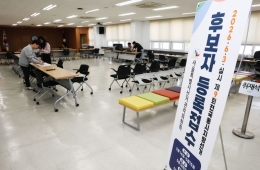
On the 25th, the COVID-19 screening clinic set up at Seongbuk-gu Public Health Center in Seoul is showing a quiet scene. Photo by Hyunmin Kim kimhyun81@
View original image"The pattern differs from the Shincheonji and Itaewon Club outbreaks"
Excess deaths may increase and healthcare system could become overwhelmed
Regarding the recent situation, Deputy Director Kwon said, "It is a very serious and explosive situation ahead," and added, "Unlike the Shincheonji situation in February or the metropolitan area nightlife facilities-centered situation in May, various outbreaks are continuously occurring both in the metropolitan and non-metropolitan areas." He continued, "It is a rather hasty judgment to say the upward trend of (new confirmed cases) has been curbed," adding, "Currently, there are considerable risk factors for continued increase."
Social distancing was raised to level 2 nationwide starting early this week, but he noted that the effectiveness depends on how well individuals, groups, facilities, and institutions on the front lines comply. Since outbreaks overseas have sometimes continued for a month or more before peaking, it is difficult to make a premature judgment. Although he did not disclose specific figures, Deputy Director Kwon explained that even looking at the nationwide new confirmed cases counted over 12 hours from midnight to noon on the day, "the situation is by no means easy."
He emphasized, "If we fail to suppress the current critical point, our healthcare system could reach a level that is difficult to handle," adding, "This could cause disruptions in treating patients other than COVID-19, leading to 'excess deaths' and increasing victims for various reasons, which could deal a severe blow to our society and economy."
Hot Picks Today
 "Do We Need to Panic Buy Again?" War Drives 30% Price Surge... Even the Bedroom Feels the Impact
- "Is a 10,000 KOSPI Breakthrough Possible?" Target Index Raised by 40%... Securities Firms Release Outlook [Weekend Money]
- "Contact Me First If Houses Are Built": Wealthy Clients Eyeing... Will Ultra-High-End Residences Worth 20 Billion Won Be Developed? [Real Estate AtoZ]
- "Anyone Who Visited the Room Salon, Come Forward"… Gangnam Police Station Launches Full Staff Investigation After New Scandal
- Trump's Remark on "Detailed Talks with Xi Jinping on Taiwan Arms Sales" Sparks Controversy... Taiwan Moves to Defuse Tensions (Comprehensive)
© The Asia Business Daily(www.asiae.co.kr). All rights reserved.