Stock Market, Will It Be Held Back Again by COVID-19?
Possibility of Short-Term Adjustment in KOSPI
Fluctuating Around 2400 Level with Mixed Trends
Experts Say "Uptrend Likely to Continue"

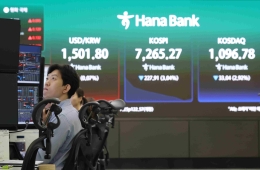
On the 18th, the KOSPI index opened at 2405.84, down 1.65 points (0.07%) from the previous trading day. Dealers are working in the Hana Bank dealing room in Jung-gu, Seoul. Photo by Jinhyung Kang aymsdream@
View original image[Asia Economy Reporter Song Hwajeong] The KOSPI has been rising almost every day this month except for one day, causing growing concerns among investors. This is due to fatigue from the short-term surge and increased worries about a correction amid the resurgence of COVID-19.
As of 10:35 a.m. on the 18th, the KOSPI stood at 2,399.41, down 0.34% (8.08 points) from the previous day. The KOSPI started the day lower, then reversed to an upward trend, but fell back again, showing a mixed pattern.
After rising for nine consecutive trading days this month, the KOSPI recorded a decline of over 1% on the 14th, prompting investors to be on high alert about a possible correction. The KOSPI has risen more than 7% this month alone and is up 65.16% compared to the March 19 low, which was the lowest point during the COVID-19 pandemic.
The sharp rise in the KOSPI has increased valuation pressure. Lee Kyungmin, a researcher at Daishin Securities, said, "The KOSPI has entered a somewhat extreme overvaluation phase not only in terms of the 12-month forward price-to-earnings ratio (PER) but also the price-to-book ratio (PBR) considering return on equity (ROE)." He analyzed, "It is overvalued by 17.4% compared to the appropriate PBR of 0.78 times, which reflects a forward ROE of 7.17%." Lee added, "Without a significant improvement in corporate earnings, upward revisions in earnings forecasts, or ROE level-up, short-term valuation level-up will be difficult," and suggested "a conservative investment strategy to prepare for increased short-term volatility."
The rapidly spreading COVID-19 again is also a variable. Lee Jaeseon, a researcher at Hana Financial Investment, explained, "In Vietnam, daily confirmed cases surged sharply from the second week of July, effectively entering a second wave, causing the stock market to undergo a short-term correction." He added, "It is necessary to keep open the possibility that the domestic stock market could also experience a short-term correction due to fatigue from the recent rally and the spread of COVID-19."
Hot Picks Today
 After Topping 8,000 Instead of Hitting 10,000... KOSPI Plunges—When Will It Rebound?
- "Samsung and Hynix Were Once for the Underachievers"... Hyundai Motor Employee's Lament
- [Breaking] Court Rules Against Samsung Electronics Union...1 Billion Won per Day Penalty for Exceeding Strike Scope
- 'Real Strike' Looms as Samsung Union Grows More Hardline... How the 2024 Strike Process Compares
- "That? It's Already Stashed" Nightlife Scene Crosses the Line [ChwiYak Nation] ③
Although short-term corrections due to increased volatility may occur, many expect the upward trend to remain unchanged. An Soeun, a researcher at IBK Investment & Securities, said, "The stock market may temporarily correct due to uncertainties such as the COVID-19 resurgence and US-China tensions, but this will not change the overall upward trend of the stock market." She explained, "Liquidity is currently bridging the gap between fundamentals and stock prices, and the financial market liquidity conditions are unlikely to turn unfavorable for the stock market in the near term."
© The Asia Business Daily(www.asiae.co.kr). All rights reserved.