"From Today, Pan-Government Metropolitan Emergency Response Team Activated... Inspection of Religious Facilities and Restaurants"
Cooperation with the National Police Agency... Prompt Isolation for Individuals with Inaccurate Registry Information
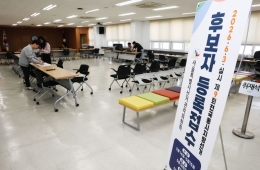
![[Image source=Yonhap News]](http://www.asiae.co.kr/news/img_view.htm?img=2020081711484828837_1597632527.jpg)
[Asia Economy Reporter Jang Sehee] The government has decided to activate an inter-ministerial emergency response team to address the COVID-19 crisis in the Seoul metropolitan area. This decision is understood to have been made following recent cluster infections linked to churches in the metropolitan area.
The Central Disaster and Safety Countermeasure Headquarters (CDSCH) under the Ministry of Health and Welfare reported this joint response plan for COVID-19 in the metropolitan area at the CDSCH meeting on the 17th.
The emergency response team, which will begin operations from today, will analyze the transmission routes and epidemiological investigation details of cluster infections occurring in the metropolitan area and support related administrative procedures. It will also handle responses to illegal and improper interference or violations of epidemiological investigations.
With the recent rapid increase in confirmed cases centered around churches in the metropolitan area and the expected surge in epidemiological investigation demand due to the large-scale rally on Liberation Day, the CDSCH plans to conduct contact tracing focusing on confirmed patients' families, workplaces, schools, nursing facilities, and religious facilities. The investigation will be conducted considering the high infectivity period from two days before symptom onset to five days after, aligning with this timeframe.
In Seoul and Gyeonggi regions, four central epidemiological investigators each, along with local government public health center quarantine personnel, will conduct in-depth epidemiological investigations of confirmed cases and facility risk assessments.
Local governments will operate emergency support teams by city and province zones and additionally install and operate walk-in and mobile car screening clinics. For elderly and disabled individuals who find it difficult to get tested at screening clinics, home specimen collection will be carried out.
The CDSCH and emergency support teams will additionally install and operate walk-in and mobile car screening clinics and conduct home specimen collection for elderly and disabled individuals who have difficulty getting tested at screening clinics.
To manage those under self-quarantine, the CDSCH will cooperate with the National Police Agency and others to promptly isolate and guide individuals with inaccurate information on the registry to get tested.
Furthermore, dedicated public officials will be assigned one-on-one to those under self-quarantine to monitor symptom onset and any violations via the self-quarantine app, and any breach of quarantine will be met with a zero-tolerance policy.
Hot Picks Today
 "Do We Need to Panic Buy Again?" War Drives 30% Price Surge... Even the Bedroom Feels the Impact
- [Breaking] Lee Jae-yong: "All Samsung members are united as one... We must pool our wisdom and move in a single direction"
- "Is a 10,000 KOSPI Breakthrough Possible?" Target Index Raised by 40%... Securities Firms Release Outlook [Weekend Money]
- "Anyone Who Visited the Room Salon, Come Forward"… Gangnam Police Station Launches Full Staff Investigation After New Scandal
- "Student ID Rentals Reach 500,000 Won... Black Market and Line-holding Services Surge"
Kim Kang-lip, the first chief coordinator of the Central Disaster and Safety Countermeasure Headquarters, stated, "We plan to conduct special inspections not only on entertainment facilities where close contact in confined spaces is unavoidable but also on religious facilities and restaurants."
© The Asia Business Daily(www.asiae.co.kr). All rights reserved.





![[Breaking] Lee Jae-yong: "All Samsung members are united as one... We must pool our wisdom and move in a single direction"](https://cwcontent.asiae.co.kr/asiaresize/307/2026010108513575608_1767225095.png)