Hong Nam-ki "Real Estate Prices Need Adjustment Beyond Stability"... Reluctant on 4th Supplementary Budget Proposal (Comprehensive)
October Official Price Realization... Reduced Property Tax Rate for Mid-Low Priced Housing
Public Rental Housing Supply Target at 10%, Exceeding OECD Average
Increased 'Floor Area Ratio' from Allowing High-Density Reconstruction Considered a Type of 'Public Good'
Reviewing Lowering 'Monthly Rent Conversion Rate to 4%' to Ease Housing Burden

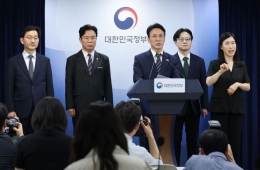
Hong Nam-ki, Deputy Prime Minister for Economic Affairs and Minister of Economy and Finance, is explaining the "Key Points of Real Estate Tax Reform" and "Comparison between Current Reconstruction and Public Participation High-Density Reconstruction" during a press briefing held at the Government Complex Sejong on the afternoon of the 10th.
View original image[Asia Economy reporters Kwangho Lee and Hyunjung Kim] Hong Nam-ki, Deputy Prime Minister and Minister of Economy and Finance, recently stated regarding the government's successive real estate stabilization measures that "there needs to be an adjustment phase for parts that have risen excessively." Regarding the strongly demanded 4th supplementary budget (supplementary budget) bill formation by the political circles to respond to nationwide flood damage, he indirectly expressed reluctance by mentioning various options such as using contingency funds and forming next year's main budget. He also expressed that the tax law revision is intended to block speculative funds from entering the market and protect actual demanders, in response to criticism that it is a tax bomb including actual demanders.
On the afternoon of the 10th, Deputy Prime Minister Hong held a press conference at the Government Complex Sejong regarding real estate policy and spoke as above. When asked about the specific policy goals related to the Moon Jae-in administration's successive real estate measures, he explained, "The government's primary goal is to eliminate market instability," adding, "As a policy official, I hope not to be satisfied with just stabilizing real estate prices, but to go through an appropriate adjustment phase for parts that have risen excessively." He further added, "It does not always go as intended, and the market will judge based on supply and demand."
When asked whether the recent rapid rise in real estate prices in a short period is due to policy failures of the previous administration, as explained by Kim Hyun-mi, Minister of Land, Infrastructure and Transport, he replied, "Real estate policy is not something that can be neatly divided by administration like cutting tofu; there is a time lag, and it takes time for effects to appear after policy announcements," adding, "Rather than judging it as the responsibility of a particular government, some spillover effects carry over."
Regarding the ongoing controversy over the whereabouts of officials who resigned en masse from the Blue House staff after taking 'comprehensive responsibility' for real estate, he repeatedly emphasized, "I am not attached to my position." Deputy Prime Minister Hong said, "If there is responsibility for policy, the cabinet should be responsible rather than the Blue House (BH)," adding, "Especially in economic policy, I, as Deputy Prime Minister, bear a very heavy sense of responsibility."
When asked about the effectiveness of mandatory housing sales for high-ranking officials, he said, "There are fewer than 2,000 high-ranking officials in our country, so even if they sell their houses, it does not significantly contribute to housing supply," but added, "However, in a situation where the public is struggling with housing issues, it is desirable for even high-ranking officials to take the lead." He mentioned, "I hope that among executives at the high-ranking level, a participatory atmosphere will emerge."
Regarding criticism that the tax law revision is a tax bomb including actual demanders, he emphasized, "The government has significantly strengthened the tax burden at acquisition, holding, and transfer stages, focusing on multi-homeowners and speculative transactions aiming for short-term profits," adding, "This is to block speculative funds from entering the market and protect actual demanders by greatly lowering the expected return on housing through fair taxation." He continued, "Considering the instability of the housing market and the resulting social costs, strengthening tax burdens on these groups is inevitable," and noted, "On the other hand, for actual demanders with one house, comprehensive real estate tax is slightly increased, but acquisition tax rates and property tax rates remain unchanged." He also added, "To protect one household one house owners for actual residence, we plan to announce a property tax rate reduction plan for mid-to-low priced houses along with the October public price realization."
Regarding the criticism that the tax law revision is for tax increase purposes, he explained, "It is expected that the comprehensive real estate tax will increase by about 900 billion won due to this housing-related tax reform, but this is only 0.3% of the total national tax revenue of 290 trillion won," adding, "Moreover, the comprehensive real estate tax is fully transferred to local governments as real estate transfer tax, so the central government cannot use it for securing fiscal revenue."
Deputy Prime Minister Hong also addressed concerns that the 3 Lease Laws have worsened the jeonse (key money deposit) shortage and accelerated the shift to monthly rent, saying, "The government is considering lowering the current 4% conversion rate from jeonse to monthly rent to prevent a rapid shift to monthly rent and alleviate housing burdens for the public." Regarding concerns about new land supply, he stated, "Public rental housing should never be a facility to be avoided," and expressed, "We will strive to achieve a supply target of 10%, exceeding the OECD average (8%), for public rental housing to stabilize housing for vulnerable groups."
Separately from real estate policy, Deputy Prime Minister Hong expressed reluctance regarding the 4th supplementary budget formation, which political circles are fueling to respond to recent nationwide flood damage. He emphasized, "Currently, there are 1.9 trillion won in earmarked contingency funds and about 700 billion won in general contingency funds, totaling 2.6 trillion won in contingency funds," adding, "Not all can be used for heavy rain countermeasures, but there are several supplementary measures to bear debt in special disaster situations." Deputy Prime Minister Hong said, "Even if the budget for long-term restoration work such as embankment or bridge repair is secured next year, it will not cause major disruption," and mentioned, "It is also very helpful that sufficient earmarked contingency funds were secured through the 1st and 3rd supplementary budgets."
Hot Picks Today
!["Not Everyone Can Afford This: Inside the World of the True Top 0.1% [Luxury World]"](https://cwcontent.asiae.co.kr/asiaresize/93/2026051507261063923_1778797570.png) "Not Everyone Can Afford This: Inside the World of the True Top 0.1% [Luxury World]"
"Not Everyone Can Afford This: Inside the World of the True Top 0.1% [Luxury World]"
- While All Eyes Were on Samsung and Hynix, This Company Surged 50% to New Highs in Four Days [Weekend Money]
- "Now Our Salaries Are 10 Million Won a Month" Record High... Semiconductor Boom Drives Performance Bonuses at Major Electronic Component Firms
- "Sold Out Everywhere" The Surprising Story of the 'Purple Gold' Philippine Yam That Has Captivated the World [Delicious Stories]
- Experts Already Watching Closely..."Target Price Set at 970,000 Won" Only Upward Momentum Remains [Weekend Money]
Finally, Deputy Prime Minister Hong raised his voice, saying, "Since last Wednesday, the government has established and operated the 'Real Estate Market Inspection Ministerial Meeting' to accelerate policy implementation and strive for early results," adding, "Through this meeting, we plan to meticulously check the progress of weekly real estate market supply and demand measures and measures to block market disruption."
© The Asia Business Daily(www.asiae.co.kr). All rights reserved.