[Global Issue+] 'Pax Atomica' Revisited in the New Cold War Era
![[Image source=EPA Yonhap News]](http://www.asiae.co.kr/news/img_view.htm?img=2020062511235825657_1593051837.jpg)
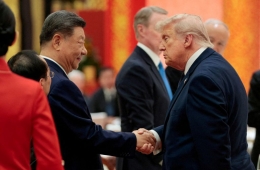
[Asia Economy Reporter Hyunwoo Lee] As tensions deepen between the United States and China and Russia, the nuclear arms race reminiscent of the Cold War era between the U.S. and the former Soviet Union is intensifying once again. In particular, U.S. President Donald Trump has emphasized the need to develop and modernize new nuclear weapons in response to the nuclear capabilities of China and Russia.
On the 16th (local time), the U.S. issued a commemorative statement marking the 75th anniversary of the Trinity nuclear test in 1945, the world's first nuclear test, once again underscoring the importance of nuclear weapons. In this statement, President Trump said, "Nuclear weapons contributed to ending World War II and still play a central role in our national defense," adding, "They also play a key role in the security of our allies who rely on America's nuclear deterrent."
This belief that nuclear power protects security and peace is shared by Russian President Vladimir Putin as well. According to TASS news agency, when asked at a press conference in June last year about the possibility of World War III breaking out due to conflicts between the U.S. and the West, Putin responded, "The fear of mutual destruction restrains extreme actions by major military powers and forces them to respect each other, and a strategic balance among major military powers has been established, allowing the world to live peacefully since World War II." He reiterated the existing argument that a balance of power through nuclear weapons maintains world peace and stated that Russia will continue developing new ballistic missiles.
Like Presidents Trump and Putin, the fear of mutual destruction through nuclear weapons, known as the "balance of terror," is believed to maintain peace. This concept of nuclear peace is referred to as "Pax Atomica," likened to America's Pax Americana. This nuclear peace theory, which was mentioned during the Cold War in the 1960s, is now being brought up again.
![[Image source=AP Yonhap News]](http://www.asiae.co.kr/news/img_view.htm?img=2020071909305868275_1595118659.jpg)
Ironically, the nuclear weapons used for the first and last time in actual combat during World War II are also credited with contributing to world peace. In August 1945, as Japan declared its intention to continue fighting until all 100 million residents of the mainland perished, the U.S. and Allied forces planned an operation to encircle and annihilate the Japanese mainland. Although the operation was expected to result in tens of millions of deaths, Japan surrendered without mainland resistance after the nuclear bombs were dropped on Hiroshima and Nagasaki, resulting in far fewer casualties than anticipated.
The strategic balance and peace through nuclear weapons began to appear on the international diplomatic stage during the Cold War in the 1960s. In 1964, the French government led by President Charles de Gaulle embarked on nuclear development to counter the Soviet nuclear threat and announced a new nuclear strategy called the "proportional deterrence strategy." This theory held that although France could not possess nuclear weapons on the same scale as the U.S. and the Soviet Union, which already had nearly 10,000 nuclear warheads, having a small number of nuclear weapons capable of destroying the enemy's capital or major cities would make it difficult for the enemy to initiate war. This proportional deterrence strategy later became a major justification for nuclear development in countries like North Korea and Iran.
Hot Picks Today
 Cerebras Soars 70% on IPO Debut: Is Nvidia's Reign Ending as a New AI Semiconductor Power Emerges?
- "Help Me"... Teacher Assaulted for 20 Minutes While Restraining Elementary Student; Ended Only After 5 Teachers Arrived
- [Why&Next] 'Atria AI' with 400 Trillion Calculations per Second Races to Catch Up with Tesla's FSD
- "Mom, Isn't It Comfortable Living With Me?"... 'Unexpected Result' Shows Increased Drinking Out of Frustration
- "After Vowing to Become No. 1 Globally, Sudden Policy Brake Puts Companies’ Massive Investments at Risk"
Nevertheless, American scientists are concerned about President Trump's policy to strengthen nuclear forces. Shortly after President Trump's statement, over 70 American scientists issued a statement in the journal Science expressing concern about moves to resume nuclear testing in the U.S. They clearly opposed the strengthening of nuclear forces among countries that already possess nuclear weapons, arguing that it only increases the threat of nuclear war and is meaningless, while giving countries like North Korea, Pakistan, and India justification for nuclear development. As anti-China and anti-Russia sentiments and nuclear arms competition continue within the U.S., domestic controversy is expected to persist.
© The Asia Business Daily(www.asiae.co.kr). All rights reserved.