[Q&A] Bang Gi-seon, Deputy Minister of Economy and Finance: "Korean New Deal, Positive Growth Rate... No Legislation Planned"
"2025nyeon Daeum Jeongbu-ui Il, Beopjehwa An Handa"
![[Image source=Yonhap News]](http://www.asiae.co.kr/news/img_view.htm?img=2020071416534160621_1594713222.jpg)
[Asia Economy Reporter Jang Sehee] The government stated that the Korean New Deal will be a positive factor in boosting the economic growth rate.
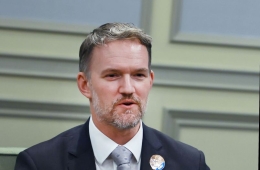
Bang Gi-seon, Deputy Minister of the Ministry of Economy and Finance, held a briefing on the comprehensive plan for the Korean New Deal at the Government Seoul Office on the 14th, saying, "We expect the potential growth rate trajectory to be revised upward."
The following is a Q&A with Deputy Minister Bang.
▲ The number of jobs has increased significantly to 1.9 million. Is this figure based on the 2018 employment inducement coefficient?
= The 550,000 jobs presented through the supplementary budget include both direct and private sector jobs. This is somewhat different from the current 1.9 million. The 1.9 million figure applies the employment inducement coefficient and adds some supply-side numbers from the employment safety net. Since there is about a two-year time gap, we had no choice but to use that data for the employment inducement coefficient. If the employment inducement coefficient changes in the future, there may be some changes in the number of jobs. However, rather than targeting a specific number of jobs, we consider this as a benchmarking figure.
▲ Is the job creation target too high?
= We made considerable efforts to be very conservative. When multiplying the budget by the employment inducement or job inducement coefficients, the results tend to be somewhat exaggerated. We have tried to be as conservative as possible in practical terms.
▲ What is the proportion of direct public sector jobs versus private sector jobs?
= It is not easy to divide jobs according to investment plans. It is actually difficult to precisely distinguish jobs created in the public sector from those in the private sector. We will review this practically, but it is expected to be challenging.
▲ Most projects are long-term until 2025. Are there plans to promote legislation for the Korean New Deal to ensure project continuity?
= Since 2025 is the next administration's responsibility, we have not included legislation. Currently, we are not considering legislation. Although the explanatory materials include issues related to revising relevant laws, we are not reviewing legislation specifically for the Korean New Deal itself.
▲ What are the short- and medium-term effects of the Korean New Deal on economic growth?
Hot Picks Today
 "Samsung and Hynix Were Once for the Underachievers"... Hyundai Motor Employee's Lament
- "Plunged During the War, Now Surging Again"... The Real Reason Behind the 6% One-Day Silver Market Rally [Weekend Money]
- After Losing Her Only Daughter, a Mother in China Gave Birth to Twins at 60... Reinventing Life at 76
- [PollPollNews] President Lee’s Approval Rating at 60.5%... Rises for Second Consecutive Week, Returns to 60% Range
- "That? It's Already Stashed" Nightlife Scene Crosses the Line [ChwiYak Nation] ③
= We cannot provide specific figures on economic growth rates. However, through the Digital New Deal and Green New Deal, the potential growth rate trajectory will be revised upward. Ultimately, it is expected to act as a positive factor for economic growth.
© The Asia Business Daily(www.asiae.co.kr). All rights reserved.