[First-term Survey] United Party "Corporate Tax and Inheritance Tax Should Be Reduced"

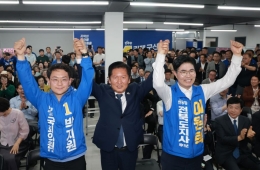
Jeon Ju-hye, a member of the United Future Party, is attending the 'Chosunmanri,' a meeting of first-term lawmakers held at the National Assembly on the 16th, delivering a general speech. Photo by Yoon Dong-joo doso7@
View original image[Asia Economy Reporter Park Cheol-eung] More than 60% of first-term members of the National Assembly evaluated the economic crisis caused by the novel coronavirus infection (COVID-19) as more severe than the International Monetary Fund (IMF) foreign exchange crisis. They overwhelmingly supported deregulation of new industries such as the sharing economy regardless of party affiliation, and showed strong agreement on the need for labor market reforms such as the expansion of flexible working hours. Conservative opposition first-term lawmakers mostly expressed the opinion that corporate tax and inheritance tax should be lowered, while ruling party members mostly responded that they should rather be increased.
According to the results of a survey of first-term lawmakers by Asia Economy on the 16th, 63.0% answered that the current economic situation is "more serious than the IMF foreign exchange crisis" when asked to evaluate the current economic situation compared to the past. Among members of the United Future Party, the figure was even higher at 77.8%.
33.7% responded that the situation is "more serious than the global financial crisis but less serious than the IMF foreign exchange crisis." Half of the Democratic Party members diagnosed the situation this way. Only two respondents said it was "less serious than the global financial crisis," and both were Democratic Party members.
This indicates that first-term lawmakers from the United Future Party perceive the current economic situation as more severe. Unlike past economic crises where financial sector insolvencies erupted, this time the direct impact is on the real economy and international trade, making the situation significantly different. Consequently, finding remedies is inevitably more difficult.
The Organisation for Economic Co-operation and Development (OECD) forecasted in its "2020 Economic Outlook" released on the 10th that South Korea's economic growth rate will fall to -1.2% this year. If a second wave of COVID-19 occurs, it is expected to drop to -2.5%.
As part of the "post-COVID" response measures, deregulation is actively being discussed. The government has declared regulatory reforms such as "reshoring" to encourage overseas companies to return.
When asked about necessary areas for regulatory innovation (multiple responses allowed), 80.4% supported "deregulation of new industries such as the sharing economy and fintech." The Democratic Party reached 90.5%, and the United Future Party also responded at 77.8%.
Among all first-term lawmakers, 47.8% said that "labor market reforms such as easing restrictions on flexible working hours" are necessary. 77.8% of first-term United Future Party lawmakers agreed. However, only 9.8% of all first-term lawmakers responded that "deregulation of the metropolitan area such as factory total volume system" is necessary. Opinions that "the current regulatory environment should be maintained overall" accounted for 5.4%, and "deregulation of environmental regulations such as chemical substances" was a minority at 3.3%.
Regarding corporate taxes, the opinion that "both corporate tax and inheritance tax should be lowered" was the highest at 39.1%, influenced largely by responses from United Future Party lawmakers. On the other hand, 26.0% answered that "both corporate tax and inheritance tax should be increased." Among Democratic Party members, 47.6% responded this way, and 31.0% said "maintain the current level."
The views of first-term United Future Party lawmakers align with expert opinions surveyed by the business community. According to a survey conducted by the Korea Employers Federation (KEF) last month targeting 222 professors of economics and business administration, the top priority policy tasks for the 21st National Assembly were "regulatory innovation such as abolishing entry regulations and deregulating new industries" and "labor market reforms such as labor market flexibility."
Regarding the highest corporate tax rate, 55.4% responded "lowering to secure international competitiveness," while 11.7% said "raising to secure tax revenue." For the highest inheritance tax rate, 54.1% responded "lowering to ensure the continuity of corporate management."
Hot Picks Today
!["Not Everyone Can Afford This: Inside the World of the True Top 0.1% [Luxury World]"](https://cwcontent.asiae.co.kr/asiaresize/93/2026051507261063923_1778797570.png) "Not Everyone Can Afford This: Inside the World of the True Top 0.1% [Luxury World]"
"Not Everyone Can Afford This: Inside the World of the True Top 0.1% [Luxury World]"
- While All Eyes Were on Samsung and Hynix, This Company Surged 50% to New Highs in Four Days [Weekend Money]
- "Now Our Salaries Are 10 Million Won a Month" Record High... Semiconductor Boom Drives Performance Bonuses at Major Electronic Component Firms
- "Sold Out Everywhere" The Surprising Story of the 'Purple Gold' Philippine Yam That Has Captivated the World [Delicious Stories]
- Experts Already Watching Closely..."Target Price Set at 970,000 Won" Only Upward Momentum Remains [Weekend Money]
Real estate policy also showed distinctly different views between the ruling and opposition parties. Among first-term Democratic Party lawmakers, 90% said "the existing government's stability policy should be maintained," whereas 46.7% of the United Future Party said "the pace of previously announced policies should be slowed," and 35.6% called for a "comprehensive course correction to prevent a sharp drop in housing prices."
© The Asia Business Daily(www.asiae.co.kr). All rights reserved.