Pompeo, "Allied Cooperation Needed with Korea and Others to Counter Communist Party's Xi Jinping"
Following President Trump, Overt Indication of Forming an Anti-China Alliance
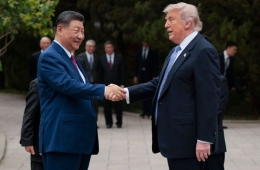
![President Donald Trump of the United States and Secretary of State Mike Pompeo (left) <br>[Image source=EPA Yonhap News]](http://www.asiae.co.kr/news/img_view.htm?img=2020060107150767446_1590963308.jpg)
President Donald Trump of the United States and Secretary of State Mike Pompeo (left)
[Image source=EPA Yonhap News]
[Asia Economy New York=Correspondent Baek Jong-min] U.S. Secretary of State Mike Pompeo on the 31st (local time) defined China's military capability expansion as a 'threat' and emphasized partnerships with allies to counter it, mentioning South Korea.
One day before Pompeo, President Donald Trump also mentioned a major 10-country (G10) or 11-country (G11) system to replace the Group of Seven (G7), expressing hope for South Korea's inclusion, which is interpreted as the start of overt diplomatic alignment between the U.S. and China.
On the same day, Pompeo appeared on Fox News and said, "Regarding the Chinese Communist Party's military development, it is a reality," directly targeting Chinese President Xi Jinping, stating, "General Secretary Xi is focused on enhancing his military capabilities."
It is an unusual change that Pompeo referred to Xi Jinping as General Secretary instead of President. This suggests an intention to highlight the conflict between democracy and the Communist Party in the U.S.-China tensions. Pompeo actively uses the term "Chinese Communist Party" (CCP) when referring to the Chinese government.
He continued, "Under President Trump, our Department of Defense, our military, and our national security agencies are confident that we can protect the American people and truly maintain good partnerships with our allies worldwide, including India, Australia, South Korea, Japan, Brazil, and Europe."
He emphasized, "We can be good partners with them and ensure that the next century continues to be a Western (led) century, exemplified by the freedoms we enjoy here in the United States."
Among the allies Pompeo mentioned that day, South Korea, Australia, and India were also countries mentioned by President Trump the day before when discussing the expansion and reorganization of the G7.
He sharply criticized, saying, "Today's Chinese Communist Party is different from ten years ago," and that the current CCP is dedicated to destroying Western beliefs, democracy, and values. He added, "This endangers the American people."
He further stated, "Therefore, I believe this is something the United States must pursue together with partners worldwide who love Western democracy. We will be dealing with this issue for some time," highlighting the confrontation between communism and liberal democracy and repeatedly emphasizing the formation of an anti-China front.
Regarding China's forced passage of the Hong Kong National Security Law (Hong Kong Security Law), Pompeo stressed that if China treats Hong Kong the same way as the mainland, the U.S. no longer has grounds to treat Hong Kong differently from mainland China. President Trump had earlier announced the initiation of procedures to revoke Hong Kong's special status. Pompeo also said an investigation will be launched into Chinese students in the U.S. who may be linked to the Chinese military, and sanctions against individuals who destroyed freedom in Hong Kong will also be considered.
Hot Picks Today
 "Do We Need to Panic Buy Again?" War Drives 30% Price Surge... Even the Bedroom Feels the Impact
- "Suspicious Timing?"...Trump Traded Stocks After Praising Wartime Capabilities
- There Is a Distinct Age When Physical Abilities Decline Rapidly... From What Age Do Strength and Endurance Drop?
- "Anyone Who Visited the Room Salon, Come Forward"… Gangnam Police Station Launches Full Staff Investigation After New Scandal
- "Contact Me First If Houses Are Built": Wealthy Clients Eyeing... Will Ultra-High-End Residences Worth 20 Billion Won Be Developed? [Real Estate AtoZ]
© The Asia Business Daily(www.asiae.co.kr). All rights reserved.