[Window] Sitting with one space before and after is not the solution

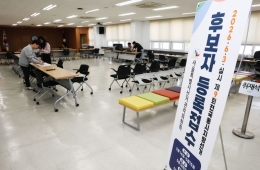
On the 8th, the third day since the transition to daily quarantine, a movie theater in Gangnam-gu, Seoul, is quiet. Photo by Mun Ho-nam munonam@
View original imageThe Korean Film Council recently formed a COVID-19 Safety Management Committee and supplemented detailed guidelines for 'social distancing in daily life.' There are two main rules requested of the audience: wearing masks inside the screening rooms (refraining from eating and drinking) and sitting one seat apart in a zigzag pattern. Jeon Byeong-yul, head of the Graduate School of Health Industry at CHA University, said, "If audience members without fever symptoms wear masks and completely avoid talking, the possibility of infection is almost zero," adding, "Watching movies while sitting one seat apart in a zigzag pattern is safe."
This clearly signals that it is safe to visit movie theaters. However, many multiplexes express reluctance. Besides the decrease in concession sales, they find the zigzag one-seat-apart seating burdensome. Multiplexes are currently implementing one-seat-apart seating in front and back rows, restricting reservations to either odd or even-numbered rows. This reflects their intention not to give up allowing families, couples, and friends to sit together.
Several insiders agreed, saying, "We cannot expect a rebound in audience numbers with zigzag one-seat-apart seating. It may even cause confusion due to movement during the movie." Multiplexes lack the capacity to prevent viewers from sitting in seats other than those reserved. The average number of part-time workers per branch is only about eleven. Usually, two shifts operate with three to four workers each. Due to severe financial difficulties, additional hiring is practically impossible.
Then, has the one-seat-apart front and back seating eased operations? The number of moviegoers last month was 972,576, which is only 7.3% of 13,338,963 in the same month last year. The seat occupancy rate remained at 3.7%. This month’s situation is not much different, standing at 4.3% as of the 17th. Although the postponement of releases of medium to large-scale films is a major factor, the perception that movie theaters are vulnerable to infection remains true.

The Korean Film Archive Cinematheque could be a clue to dispelling distrust. They open 100 seats out of 317 with zigzag seating. Sixty seats allow two-seat reservations. This provides opportunities for families, couples, and friends to watch movies together while maintaining sufficient distance from others. Audience members sitting in seats other than those reserved are asked to leave.
Hot Picks Today
 "Do We Need to Panic Buy Again?" War Drives 30% Price Surge... Even the Bedroom Feels the Impact
- "Suspicious Timing?"...Trump Traded Stocks After Praising Wartime Capabilities
- There Is a Distinct Age When Physical Abilities Decline Rapidly... From What Age Do Strength and Endurance Drop?
- "Anyone Who Visited the Room Salon, Come Forward"… Gangnam Police Station Launches Full Staff Investigation After New Scandal
- "Contact Me First If Houses Are Built": Wealthy Clients Eyeing... Will Ultra-High-End Residences Worth 20 Billion Won Be Developed? [Real Estate AtoZ]
An official said, "There has never been any complaint about meticulously applying the 'social distancing in daily life' guidelines," adding, "On the contrary, we have heard many thank-you messages for paying attention to safety." Audiences continue to visit steadily. Since reopening on the 16th, the average seat occupancy rate is 55%. Applying this to the existing 317 seats results in 17.3%, more than four times higher than multiplexes.
© The Asia Business Daily(www.asiae.co.kr). All rights reserved.