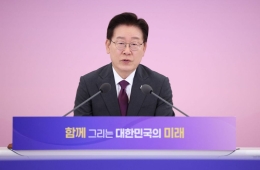
Kim Jaewon: "Ruling party and government can't even persuade, yet insist on giving 100%... Are they giving to the rich by borrowing?"
![[Image source=Yonhap News]](http://www.asiae.co.kr/news/img_view.htm?img=2020042109121786767_1587427937.jpg)
[Asia Economy Reporter Lee Ji-eun] Kim Jae-won, chairman of the Future United Party's Policy Committee and chair of the National Assembly's Budget and Accounts Committee, criticized the ruling party's stance, saying, "The ruling party is trying to issue government bonds to provide disaster relief funds to the top 30% income households, even though they have failed to persuade the government side."
On the 21st, Kim appeared on YTN Radio's 'Noh Young-hee's Start of a New Morning' and said, "It is unacceptable to incur national debt to give disaster relief funds to the top 30% income households who have sufficient purchasing power."
He pointed out, "Currently, there is a plan to secure about 7.6 trillion won in funds to provide disaster relief funds to the bottom 70% of the population, and the president has sent the supplementary budget bill to the National Assembly through the Cabinet meeting. However, the ruling party suggests issuing government bonds if the budget is insufficient to also provide funds to the remaining top 30% income households."
Unlike the ruling party, the Future United Party advocates reallocating existing budgets without issuing government bonds to provide COVID-19 disaster relief funds to the bottom 70% income group. Some speculate that this is a reversal from former leader Hwang Kyo-ahn's pre-election statement of "giving 500,000 won to every citizen."
However, Kim clarified, "That is completely untrue. At that time, our party proposed reallocating 100 trillion won from the government's 512 trillion won budget to be used for the COVID-19 crisis, and if that 100 trillion won budget was secured, then disaster relief funds of 500,000 won per citizen would be provided." This was based on the premise of reallocating 100 trillion won in the budget.
Kim said, "If sufficient budget adjustments had been made to provide disaster relief funds, there might not have been such controversy. However, the government side is currently opposing (the issuance of government bonds). The ruling party failed to persuade the government side, and even the president opposes issuing government bonds, yet they sent the supplementary budget bill to the National Assembly. Is it wrong for the opposition party to take a slightly different stance from the ruling party?"
Kim added, "No one knows how long the current COVID-19 crisis will last. Our country has already prepared a super-large budget, and fiscal soundness has significantly deteriorated. If we simply distribute 1 million won each and the crisis ends, the government might feel relieved, but the government must always prepare for the possibility of a worse situation."
Hot Picks Today
 At President Lee's Call to "Give Enough to Shock," Whistleblower Rewards Become a Real Lottery
- If a Samsung Electronics Employee with a 100 Million Won Salary Receives a 600 Million Won Performance Bonus, Taxes Total 247.19 Million Won
- Lived as Family for Over 30 Years... Daughter-in-Law Cast Aside After Husband's Death
- "Who Is Visiting Japan These Days?" The Once-Crowded Tourist Spots Empty Out... What's Happening?
- "4.15 Million Won Prada Jacket Shows White Spots After One Wear"...Korea Consumer Agency Orders Full Refund
Kim's term as chair of the Budget and Accounts Committee ends at the end of next month. If no agreement is reached by then, the remaining issues will be passed on to the next National Assembly, delaying the distribution of disaster relief funds further. Kim said, "We are willing to pass the government budget, but if the ruling party ultimately opposes the government proposal, this budget cannot be passed. In that case, the ruling party would be opposing the government's submitted budget, and then it would be appropriate to resubmit and discuss it in the 21st National Assembly."
© The Asia Business Daily(www.asiae.co.kr). All rights reserved.