Recovery Above 1900... Will It Dash to the 2000 Mark?
KOSPI Continues Strong Rally
Foreign Selling Stops, Uncertainty Drops
Global Economic Normalization Measures Favorable
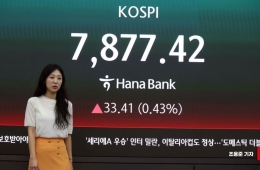
[Asia Economy Reporter Song Hwajeong] As the KOSPI recovers above the 1900 level, attention is focused on whether it will continue to rise further. Signs show that foreign investors, who had been continuously selling, are turning around, and uncertainties are gradually decreasing, strengthening the outlook that the upward trend will continue for the time being.
As of 9:50 a.m. on the 20th, the KOSPI recorded 1923.74, up 0.48% (9.21 points) from the previous day. Following the recovery above 1900 on the 17th, it has maintained a slight two-day consecutive rise. The KOSPI has risen 9.11% based on closing prices of previous trading days this month and surged 31.34% from the low recorded on the 19th of last month.
Having rebounded from the plunge caused by the novel coronavirus disease (COVID-19), the KOSPI quickly recovered the 1600 and 1700 levels, then soon raised the index to 1800 and 1900 levels. Despite concerns about short-term corrections due to the burden of rapid index increases, the market appears to be regaining stability. The persistent selling pressure from foreign investors has also eased, and with reduced uncertainty following economic indicator releases, forecasts suggest the stock market's upward trend will continue.
On the 17th, foreign investors stopped their 30 consecutive trading days of net selling since the 5th of last month by net buying 322.6 billion KRW in the KOSPI market. Although selling continued on a weekly basis, the scale of sales significantly decreased. Last week, foreign investors net sold 451.2 billion KRW in the domestic stock market. Considering that foreign investors had been selling in the trillion KRW range over the past few weeks, this is a substantial reduction. Notably, Samsung Electronics, which had been persistently sold during the selling streak, was the most purchased stock for two consecutive weeks.
Analysis suggests that uncertainty is actually decreasing after the release of poor economic indicators due to COVID-19. Seojunghoon, a researcher at Samsung Securities, explained, "As poor economic indicators continued, investors' expectations significantly lowered, and subsequent indicators came out at these lowered levels, turning vague anxiety into measurable risk." He added, "Also, the conclusion of election events has reduced political uncertainty, which acts as a positive factor."
Hot Picks Today
 At President Lee's Call to "Give Enough to Shock," Whistleblower Rewards Become a Real Lottery
- "If Both Spouses Work There, How Much Would They Make?" "They Earn More Than Me, and I'm a Doctor"... Envy Erupts Over Samsung Electronics' Bonus
- Lived as Family for Over 30 Years... Daughter-in-Law Cast Aside After Husband's Death
- "Who Is Visiting Japan These Days?" The Once-Crowded Tourist Spots Empty Out... What's Happening?
- Park Minshik Shaves Head: "I Will End Han Donghoon's Predatory and Parasitic Politics"... Ongoing Calls for Conservative Consolidation in Busan Buk-gu Gap within PPP
As the spread of COVID-19 slows, governments worldwide are gradually moving to normalize their economies, which is favorable for the market. Kim Yeeun, a researcher at IBK Investment & Securities, said, "Normalization measures do not immediately revive the contracted economy, but they help gradually ease fear psychology." She added, "Since the economic slowdown caused by COVID-19 is an unavoidable fact, the market is responding positively, and ultimately, the liquidity released as the COVID-19 spread eases will act as a factor driving the index upward."
© The Asia Business Daily(www.asiae.co.kr). All rights reserved.