[Good Morning Stock Market] KOSPI Reaches Mid-1800s... "Entering a Breather"

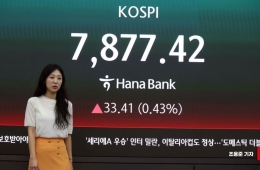
On the afternoon of the 10th, when the KOSPI closed at 1860.70, up 24.49 points (1.33%), an employee is working in the dealing room of Hana Bank in Jung-gu, Seoul. (Photo by Yonhap News)
View original image[Asia Economy Reporter Kum Boryeong] Despite widespread uncertainty in the domestic stock market due to concerns over the novel coronavirus infection (COVID-19), the KOSPI index rose to the mid-1800s on the 10th. However, since the index rose rapidly, there is a level burden, and it is analyzed that the market will take a breather.
◆ Kim Yae-eun, Researcher at IBK Investment & Securities = Mixed feelings of anxiety and expectation coexisted regarding the OPEC+ (OPEC and non-OPEC oil-producing countries coalition) production cut agreement, causing fluctuations, but the impact on the stock market was limited. The OPEC+ meeting almost reached a production cut agreement but faced obstacles again due to Mexico's withdrawal. Although the meeting continued afterward, no final agreement was reached, and only a fundamental agreement was derived at the G20 meeting.
Nevertheless, due to the Federal Reserve's large-scale liquidity injection, the index continued its upward trend. Since the intraday low of 1439.43 on the 19th of last month, the index has risen by 29.27% as of the closing price on April 10. Considering that uncertainty still exists, it is judged that there will be a burden regarding the level.
In the short term, since the index has risen sharply, it is expected to take a breather at least once. Concerns about economic slowdown still persist, and the OPEC+ meeting process, which differs from market expectations, along with the resulting uncertainty, is expected to provide an excuse for a correction. Additionally, China's first-quarter growth rate to be announced this week is also unlikely to avoid sluggishness, which is judged to negatively affect investor sentiment.
After the correction, the index will rebound again due to abundant liquidity, but the rebound is not expected to last as risks submerged temporarily will be highlighted. Strategies will differ depending on whether the market is approached from a short-term or mid-to-long-term perspective, but focusing on sectors with solid earnings and preparing for the post-COVID-19 era is an appropriate strategy.
◆ Choi Yoo-jun, Researcher at Shinhan Financial Investment = The domestic stock market entered the first-quarter earnings season starting with Samsung Electronics' preliminary earnings announcement on the 7th. Samsung Electronics recorded a preliminary operating profit of 6.4 trillion KRW in the first quarter, an earnings surprise. The semiconductor industry's resilience was confirmed, but the earnings momentum for the second quarter is expected to weaken due to the shock from the spread of COVID-19 in developed countries. As of the 10th, the expected net profit for KOSPI this year is 104.4 trillion KRW, down 16.8% compared to three months ago. As the earnings season progresses, earnings of sectors with weak performance will be announced, and further downward revisions of earnings estimates are expected. With the 12-month forward price-to-earnings ratio (PER) rising to 10.3 times, the earnings season will act as an obstacle to the stock price path.
Hot Picks Today
 At President Lee's Call to "Give Enough to Shock," Whistleblower Rewards Become a Real Lottery
- If They Fail Next Year, Bonus Drops to 97 Million Won... A Closer Look at Samsung Electronics DS Division’s 600M vs 460M vs 160M Performance Bonuses
- Lived as Family for Over 30 Years... Daughter-in-Law Cast Aside After Husband's Death
- "If Both Spouses Work There, How Much Would They Make?" "They Earn More Than Me, and I'm a Doctor"... Envy Erupts Over Samsung Electronics' Bonus
- "Who Is Visiting Japan These Days?" The Once-Crowded Tourist Spots Empty Out... What's Happening?
Securities deposits increased by about 12 trillion KRW in March, and at the same time, individual net buying continued. As the KOSPI entered the 1700s, securities deposits began to decrease, dropping by about 3.5 trillion KRW from the peak as of the 9th. It is believed that some individual investors who bought at the low point after the rapid price rebound are taking profits and withdrawing funds. Some individuals seem to feel burdened at the current index level. Partial withdrawal of the main supply-demand players is detected, and with uncertainty remaining, the KOSPI is expected to enter a consolidation phase. It is necessary to observe the situation and carefully time the buying rather than rushing in.
© The Asia Business Daily(www.asiae.co.kr). All rights reserved.