China Reports 54 New COVID-19 Cases Imported from Abroad in One Day... Foreigners Banned from Entry Starting the 28th (Comprehensive)
![[Image source=AP Yonhap News]](http://www.asiae.co.kr/news/img_view.htm?img=2020032710242745036_1585272268.jpg)
[Asia Economy Beijing=Special Correspondent Park Sun-mi] China will ban the entry of foreigners starting from the 28th to block the inflow of the novel coronavirus infection (COVID-19). This sudden announcement of the foreigner entry ban comes amid a situation where most of the overseas imported COVID-19 confirmed cases are Chinese nationals.
The Chinese Ministry of Foreign Affairs and the National Immigration Administration issued a notice late at night on the 26th, announcing that considering the rapid global spread of COVID-19, foreigners will be banned from entering China starting from 0:00 on the 28th. They also stated that foreigners holding valid visas and residence permits will be prohibited from entry.
Entry of foreigners holding APEC Business Travel Cards (business visas to expand economic exchanges among APEC member countries) will also be banned, and visa-free transit and entry for 24, 72, and 144 hours will be suspended. However, foreigners holding diplomatic, official, courtesy, or C (crew member, etc.) visas are exempt from this measure. Those who need to visit China for economic and trade, scientific and technological activities, or other humanitarian reasons must apply separately for a visa at Chinese embassies or consulates in their respective countries. Entry is allowed with visas issued after the announcement.
Although there are some exceptions such as holders of diplomatic and official visas being unaffected, this is effectively a comprehensive ban on foreign entry, including foreigners who have already obtained visas or residence permits. Due to the sudden announcement one day before implementation, Korean residents who temporarily entered Korea to avoid COVID-19 while living in China will find it difficult to re-enter China for the time being.
It is unknown how long this measure will last. The Chinese government only stated that this is a temporary measure and did not specify when the entry ban will be lifted. They said, "We will announce adjustments to the measures depending on the COVID-19 situation."
China’s foreigner entry ban coincides with restrictions on airlines operating routes to China.
China has limited all foreign airlines to operate only one route to China per week. Chinese airlines are also allowed to operate only one route per country, with flight frequency limited to once a week. Seat occupancy rates cannot exceed 75%. The Chinese aviation authorities stated that to firmly suppress the risk of COVID-19 inflow from abroad, they have reduced the number of international flights according to the State Council’s work guidelines, and if the COVID-19 situation worsens, they may further restrict international flights. This will take effect from the 29th.
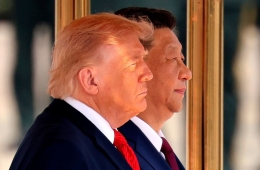
At the end of January, when U.S. President Donald Trump announced a ban on entry for Chinese nationals, China criticized it as an "excessive measure that only stokes fear." China’s current measure shows a changed attitude from previously criticizing foreigner entry bans imposed by countries around the world as "excessive measures." Chinese President Xi Jinping emphasized at the G20 special video summit held the day before that the world must cooperate to overcome COVID-19 and that countries must build the strongest possible joint prevention and control network.
Although China implemented this measure to drastically reduce the number of people entering the country from foreign countries with severe COVID-19 outbreaks, it is uncertain how effective this will be given that 90% of overseas imported COVID-19 patients are Chinese nationals.
China currently states that 90% of the COVID-19 confirmed cases imported from abroad hold Chinese passports, and among them, 40% are Chinese students studying overseas. Luo Zhaohui, Vice Minister of the Chinese Ministry of Foreign Affairs, explained at a press conference in Beijing the day before, "We understand that students are eager to return home, but if they stay locally, they can avoid infection during the return process or difficulties caused by strengthened quarantine measures in transit countries," urging them to carefully consider their return.
Hot Picks Today
!["Even If I Lose My Investment, the Government Will Cover It"... The Fund Attracting Retail Investors' Attention [Weekend Money]](https://cwcontent.asiae.co.kr/asiaresize/93/2026051609052165501_1778889921.jpg) "Even If I Lose My Investment, the Government Will Cover It"... The Fund Attracting Retail Investors' Attention [Weekend Money]
"Even If I Lose My Investment, the Government Will Cover It"... The Fund Attracting Retail Investors' Attention [Weekend Money]
- Taking Annual Leave and Adding "Strike" to Profiles, "It Feels Like Samsung Has Collapsed"... Unsettled Internal Atmosphere
- AI Said to Eliminate Jobs, but This Role Sees 800% Surge in Hiring [Tech Talk]
- There Is a Distinct Age When Physical Abilities Decline Rapidly... From What Age Do Strength and Endurance Drop?
- On Teacher's Day, a Student's Gifted Cake Had to Be Cut into 32 Pieces... Why?
Meanwhile, the day before, 55 new COVID-19 confirmed cases and 5 deaths were added in one day. On the 27th, the National Health Commission of China (NHC) announced that as of midnight, 55 new confirmed COVID-19 cases were added. Except for one additional confirmed case in Zhejiang Province, 54 cases were infected overseas and entered China. The total number of overseas imported confirmed cases recorded in China so far is 595.
© The Asia Business Daily(www.asiae.co.kr). All rights reserved.