[Asia Approach] Company Struggling... Choosing Between Wage Return vs Wage Reduction
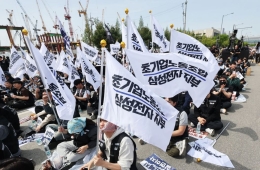
![A labor union at a Joseon company is conducting a partial strike in opposition to the company's voluntary retirement plan. [Image source=Yonhap News]](http://www.asiae.co.kr/news/img_view.htm?img=2018091213400484512_1536727203.jpg)
A labor union at a Joseon company is conducting a partial strike in opposition to the company's voluntary retirement plan. [Image source=Yonhap News]
View original image[Asia Economy, Lee Kyungho, Head of Editorial Planning Team] In April 2017, when the shipbuilding industry was in crisis, Daewoo Shipbuilding & Marine Engineering (DSME) pushed for wage returns from all employees until normalization. They collected consent forms for wage returns from all employees, and within one day of starting the procedure, 98% of the entire workforce agreed. Some wage returns had already been made by certain employees one or two years earlier. At that time, the president worked without pay, returning all wages, executives returned 30% to 40%, and employees returned about 10% to 15% of their wages. Labor costs, which were 1.14 trillion won in 2015, decreased to 850 billion won in 2016 and 640 billion won in 2017. Comparing 2015 and 2017, labor costs were reduced by about half in two years. Of course, many employees left the company during that period. DSME posted a profit in 2017 and started receiving normal wages from 2018.
During management crises, sharing pain between labor and management is necessary. During the 2009 financial crisis, many companies' labor and management pushed for wage freezes and returns. As COVID-19 directly impacted the real economy, wage returns and cuts have been continuously implemented with the intention of "saving the company first and avoiding a path where everyone fails." The aviation and travel industries, hit hard by COVID-19, are experiencing the worst times with wage returns, unpaid leave, and mass closures, while large companies in key industries are not only reducing labor costs but also conducting voluntary retirements.
Although sometimes used interchangeably, wage returns and wage cuts are vastly different. Wage return means that the worker receives wages as compensation for labor from the company and then returns part of it to the company or a designated entity (such as a donation organization). The agreed wage level with the company does not change. On the other hand, wage cuts mean that the company cannot properly pay wages, so instead of paying first and then returning, the wage amount is reduced at the time of payment. If agreed to a wage cut, the wage level remains lower for a certain period.
To be more specific, according to the Korea Employers Federation, wage return refers to returning already accrued wage claims (wages, bonuses, etc.) based on the individual worker's voluntary consent. It is distinguished from wage cuts, which reduce wages to be received for future labor provision. To implement wage returns, individual consent from each worker is required, so each worker must recognize the purpose of the wage return and individually complete consent or application forms. Secondly, wage return agreements through collective agreements have no effect because wage returns pertain to wages already belonging to individual union members, and the labor union cannot force members to give up their personal property rights. Thirdly, prior consent to return retirement pay is invalid, and returned wages are included in the calculation of average wages.
![[Asia Approach] Company Struggling... Choosing Between Wage Return vs Wage Reduction](http://www.asiae.co.kr/news/img_view.htm?img=2020032409005937760_1585008060.jpg)
Wage cuts are promoted through collective agreements or changes to employment rules. Wage cuts mean changing working conditions to pay lower wages than before from a certain future point, including reducing bonus payment rates or decreasing the amounts of base pay or various allowances. Here, it is important to note that collective consent from those subject to collective agreements or employment rules is required. Also, changes in the salary system can be considered wage cuts, such as reducing base pay while increasing performance bonuses. Unlike wage returns, cut wages are not included in the average wage calculation, so average wages are calculated based on the changed standard when calculating retirement pay.
What happens to taxes and where does the returned money go if wages are returned or cut? Assuming a monthly salary of 1 million won and returning 10% (100,000 won), let's look at the National Tax Service's explanation. First, if the worker receives the full 1 million won and then returns 100,000 won as a donation, the company withholds income tax on the full 1 million won as employee income tax, but the 100,000 won donated to a donation organization is eligible for a tax credit during year-end tax settlement.
Second, if the worker receives 1 million won and returns 100,000 won to the company, the company withholds income tax on the full 1 million won (the worker also bears income tax on the returned 100,000 won). The company includes the returned 100,000 won as income (miscellaneous income, etc.) and, if it uses this fund to hire new employees through job sharing or spends it as donations, it can recognize it as labor costs or donations for tax purposes.
Third, if 100,000 won is returned by wage cut (here, a cut), the company withholds income tax on the actual payment of 900,000 won (the worker does not bear income tax on the returned 100,000 won). The 900,000 won accounted for by the company is recognized as a corporate expense (labor cost), and the company sets retirement benefit reserves based on 900,000 won and separately recognizes it as an expense. If the company uses the cut 100,000 won to hire new employees through job sharing or spends it as donations, it is recognized as labor costs or donations for tax purposes.
Hot Picks Today
 No Bacteria Detected in Arisu After 24 Hours of Repeated Drinking from a Tumbler
- "I Feel Uncomfortable Being Filmed"... Cheerleaders Distressed by Commercial Fan Cam Practices
- High-Net-Worth Investors Increase Stock Holdings: "Samsung and SK hynix Are Basic, Now Searching for the Next Opportunity" [Investment Strategies of the Wealthy] ⑧
- "Not Just Fuel Prices: Whale Collision Risks Surge as Hormuz Blockade Reroutes Ships"
- Police Officer Cycling on Day Off Rescues Woman Attempting to Jump from Hangju Bridge
The easiest solution when a company is struggling is to reduce labor costs. They may accept voluntary retirements or, if necessary, conduct layoffs. Wage returns and cuts are similar measures. However, if these are implemented without considering all factors such as pain-sharing between labor and management, consensus for normalization and crisis overcoming, and potential legal disputes, it can lead to a crisis of trust and accelerate the management crisis.
© The Asia Business Daily(www.asiae.co.kr). All rights reserved.