Global Stock Market Fear Hits Hard... KOSPI Starts at 1640
KOSDAQ Also Falls Below 500 Level

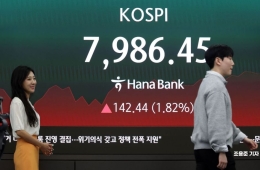
Due to the impact of the novel coronavirus infection (COVID-19) pandemic, the global stock markets plummeted, and the KOSPI index opened at 1640.84 on the 17th, down 74.02 points (4.32%) from the previous trading day (1714.86). Dealers are busy working in the Hana Bank dealing room in Jung-gu, Seoul. On the same day, the won-dollar exchange rate opened at 1231.0 won, up 5.0 won from the previous trading day (1226.0 won). Photo by Kim Hyun-min kimhyun81@
View original image[Asia Economy Reporter Minwoo Lee] The impact of the sharp declines in overseas stock markets, including the United States, was directly reflected in the domestic stock market. Both the KOSPI and KOSDAQ opened below the 1700 and 500 levels, respectively.
According to the Korea Exchange on the 17th, the KOSPI opened at 1640.84, down 4.32% (74.02 points) from the previous day. Although the U.S. Federal Reserve (Fed) introduced stimulus measures such as a rate cut and an additional $500 billion repo (repurchase agreement) supply to counter the fear of COVID-19, the plunge in the U.S. stock market appears to have continued to affect the domestic market. As of 9:30 a.m., the index was at 1655.33, down 3.47% (59.53 points) from the previous day.
Earlier, on the 15th (local time), the Fed cut the benchmark interest rate by 1 percentage point from 1.00%-1.25% to 0.00%-0.25% and decided to purchase $700 billion (approximately 866 trillion KRW) worth of government bonds and mortgage-backed securities (MBS) to expand liquidity supply. Subsequently, an additional $500 billion repo supply was announced. However, the Dow Jones Industrial Average plunged 12.94%, marking the second-largest single-day drop in history.
Looking at trading trends by market participants in the domestic market, foreigners sold a net 35.1 billion KRW in the KOSPI market. Meanwhile, individuals and institutions bought net amounts of 11.2 billion KRW and 19.7 billion KRW, respectively.
All sectors showed a downward trend. The banking sector experienced the largest drop at 7%. This was followed by insurance (6.15%), finance (5.04%), securities (4.88%), transportation equipment (4.53%), and machinery (4.01%).
All of the top 10 market capitalization stocks also declined. LG Chem fell the most, down 4.64%, followed by NAVER (4.19%), Hyundai Motor (4.10%), and Samsung C&T (3.68%).
The KOSDAQ also reflected the fear spreading from the U.S. stock market. It opened at 488.02, down 3.27% (16.49 points) from the previous day. As of 9:30 a.m., it was at 495.58.
In the KOSDAQ market, individuals were net sellers of 157.8 billion KRW, while foreigners and institutions were net buyers of 138.9 billion KRW and 21.2 billion KRW, respectively.
By sector, all sectors except pharmaceuticals (0.82%) and distribution (0.19%) were declining. Other manufacturing experienced the largest drop at 3.81%, followed by metals (3.74%), IT components (3.39%), and information devices (3.06%).
By sector, food and beverages, pharmaceuticals, and medical precision equipment were rising, while insurance, finance, and services were falling.
The top 10 market capitalization stocks showed mixed trends. Seegene (7.41%), Pearl Abyss (2.91%), and Celltrion Healthcare (1.27%) rose, while CJ ENM (3.71%) and EcoPro BM (1.28%) declined.
Hot Picks Today
 No Bacteria Detected in Arisu After 24 Hours of Repeated Drinking from a Tumbler
- "My Wife Is Missing"... Woman in Her 50s Still Unaccounted for Nearly a Month After Climbing Bukhansan Mountain
- "Available Only in Korea": Pokémon Card Prices Surge 2,532% Due to Rarity, Becoming Investment Assets
- High-Net-Worth Investors Increase Stock Holdings: "Samsung and SK hynix Are Basic, Now Searching for the Next Opportunity" [Investment Strategies of the Wealthy] ⑧
- Police Officer Cycling on Day Off Rescues Woman Attempting to Jump from Hangju Bridge
Seosangyoung, a researcher at Kiwoom Securities, explained, "As the number of confirmed COVID-19 cases surged in the U.S. and Europe, global stock markets declined, affecting the domestic market as well. In particular, the panic-driven psychological sell-off is highly likely to prevent market stabilization despite the Bank of Korea's emergency rate cuts and other active responses." However, he added, "Since central banks and governments worldwide, including the Fed, have announced active support policies and hinted at additional measures, the risk of widespread concern is not high. Fear currently dominates all financial markets, making market adjustments inevitable for the time being. However, it can be seen as the beginning of a battle against time, so it is now time to step back from overly pessimistic forecasts."
© The Asia Business Daily(www.asiae.co.kr). All rights reserved.