'Ineffective Remedies' Global Stock Markets Plunge Despite Central Bank Intervention
Despite Liquidity Supply from US, Japan, and EU, 10% Plunge
Limits to Overcoming Crisis Triggered by Trump
Growing Need for Fed Quantitative Easing
![[Image source=AP Yonhap News]](http://www.asiae.co.kr/news/img_view.htm?img=2020031312583920412_1584071919.jpg)
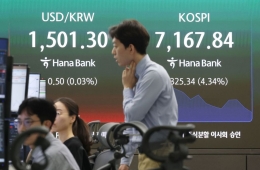
[Asia Economy New York=Correspondent Baek Jong-min] Central banks in the United States, Europe, and Japan have simultaneously responded to the spread of the novel coronavirus infection (COVID-19) with interest rate cuts and liquidity supply, but these measures had no effect on the stock market crash.
On the 12th (local time), the major indices of the New York Stock Exchange (NYSE) and stock markets across Europe plunged simultaneously, followed by the Japanese stock market joining the downward trend, which is shocking given the central banks' responses. In particular, U.S. President Donald Trump’s announcement of a ban on entry from Europe the day before to prevent the spread of COVID-19 has instead increased economic damage, leading to lamentations that "all remedies are ineffective."
Central banks worldwide simultaneously took stimulus measures as global stock markets plunged the previous day. The European Central Bank (ECB) introduced a long-term lending program and temporarily expanded quantitative easing (QE) by an additional $120 billion until the end of the year. Then, the New York Federal Reserve unexpectedly announced it would inject $1.5 trillion into the short-term funding market liquidity stabilization by the 13th. However, the market collapsed helplessly. The ECB did not use the interest rate cut card that the market had expected. On that day, the ECB kept the benchmark interest rate at 0.0% and the deposit rate at -0.5%.
The New York Fed explained the liquidity measures as "to correct the unusual and excessive distortions in the Treasury market related to COVID-19." In fact, immediately after the announcement of the fund injection, the stock market’s decline narrowed, raising expectations of a positive effect, but the situation returned to its original state. The index could not avoid a plunge close to 10%.
As the collapse of U.S. and European stock markets extended to Asian markets on the 13th, Asian countries also took stimulus measures. According to Nihon Keizai Shimbun and NHK broadcasts, the Bank of Japan (BOJ) announced that as the Tokyo stock market plunged, it would supply 500 billion yen (approximately 5.83 trillion won) to the financial market by purchasing government bonds from financial institutions within two weeks. The BOJ explained that this was to support financial institutions as the spread of COVID-19 was affecting corporate activities, personal consumption, and financial markets. Along with this, the Japanese government and BOJ held an emergency meeting that morning to discuss how to respond to financial market turmoil. Nevertheless, the Tokyo stock market showed a sharp decline close to 10%.
Steven Dudashi, CEO of IHT Asset Management, described the situation as "experiencing a perfect exaggeration due to an unknown fear." He also diagnosed that "in the current situation, it is difficult to intervene in the market through logical responses."
There are claims that the Fed must ultimately step in to reverse the crash. The market is expecting the possibility of additional interest rate cuts and quantitative easing (QE) after the Federal Open Market Committee (FOMC) meeting scheduled for the 18th-19th. The Wall Street Journal mentioned, "The Fed cannot stop the spread of COVID-19, but it can help prevent a financial epidemic."
Hot Picks Today
 "Samsung and Hynix Were Once for the Underachievers"... Hyundai Motor Employee's Lament
- "Plunged During the War, Now Surging Again"... The Real Reason Behind the 6% One-Day Silver Market Rally [Weekend Money]
- "They Said It's Impossible to Get—Already Selling for Triple the Price: Crowds Worldwide Line Up for $600 Luxury Watch"
- Korea and ASEAN to Strengthen Supply Chain Cooperation... FTA Digital Rules to Be Revised
- "That? It's Already Stashed" Nightlife Scene Crosses the Line [ChwiYak Nation] ③
On the other hand, ECB President Christine Lagarde said at a press conference that "we should not expect central banks to respond first, and fiscal policy should take precedence," criticizing the complacent response of member countries to prevent economic damage in the Eurozone (19 countries using the euro). President Lagarde expressed concern about "the complacent and slow actions shown by Eurozone fiscal authorities" and called for active fiscal policies.
© The Asia Business Daily(www.asiae.co.kr). All rights reserved.