8 Years Since Korea-US FTA Enforcement 'D-1'... Unextinguished 'US Section 232' Spark
Ministry of Industry "Consistent Contact with US Department of Commerce"
Expert "COVID-19 Acts as Brake on Trade Friction"

[Asia Economy Reporter Moon Chaeseok] As the 8th anniversary of the Korea-US Free Trade Agreement (FTA) approaches tomorrow, the spark of the United States' 'Trade Expansion Act Section 232' has not been completely extinguished. While the South Korean government judges that the possibility of the US immediately applying the relevant provisions is limited, it is steadily maintaining contact with the US Department of Commerce and closely monitoring the situation. This provision allows the US to urgently restrict imports or impose high tariffs if it determines that imported products threaten national security.
According to the Ministry of Trade, Industry and Energy on the 14th, it was expected that the US would announce whether to apply Section 232 to the automobile industry last November, but even after about four months, no particular news has been delivered. While the US was using Section 232 on automobiles as a bargaining chip in negotiations with the European Union (EU), the discussion seems to have subsided as the novel coronavirus disease (COVID-19) spread into a global pandemic.
The Ministry of Trade, Industry and Energy still holds the position that it cannot be complacent. With the revised Korea-US FTA coming into effect last year and the US citing security reasons, it is judged that the relevant provisions can be invoked at any time. The US trade deficit with South Korea last year increased by $2.8 billion from $17.8 billion the previous year to $20.6 billion, which is also a burden.
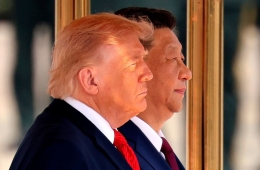
Experts diagnose that due to the spread of COVID-19 shaking the global economy, US President Donald Trump faces a situation where applying Section 232 is burdensome. Since President Trump has touted the FTA revision as his achievement, the possibility of drastically changing the current Korea-US FTA framework is also considered low.
Professor Jeong In-gyo of Inha University’s Department of International Trade said, "Now is a time to cooperate to keep the global economy running rather than exposing each other's problems," and predicted, "The COVID-19 situation will partially act as a kind of 'brake' on trade friction."
Hot Picks Today
!["Even If I Lose My Investment, the Government Will Cover It"... The Fund Attracting Retail Investors' Attention [Weekend Money]](https://cwcontent.asiae.co.kr/asiaresize/93/2026051609052165501_1778889921.jpg) "Even If I Lose My Investment, the Government Will Cover It"... The Fund Attracting Retail Investors' Attention [Weekend Money]
"Even If I Lose My Investment, the Government Will Cover It"... The Fund Attracting Retail Investors' Attention [Weekend Money]
- AI Said to Eliminate Jobs, but This Role Sees 800% Surge in Hiring [Tech Talk]
- "One Person Bets 13.5 Billion Won to Have Lunch with the Investment Guru"
- There Is a Distinct Age When Physical Abilities Decline Rapidly... From What Age Do Strength and Endurance Drop?
- On Teacher's Day, a Student's Gifted Cake Had to Be Cut into 32 Pieces... Why?
He added, "President Trump delayed the announcement timing of the relevant measures to utilize Section 232 during trade negotiations with the EU, and this phase may continue further due to the spread of COVID-19," and said, "Since the EU finds it difficult to implement aggressive trade policies against the US and China also finds it hard to confront the US as before COVID-19, the Section 232-related issue is expected to remain quiet for the time being."
© The Asia Business Daily(www.asiae.co.kr). All rights reserved.