US Financial Market 'Chaos'... Shortest Bear Market Transition in History
Dow Jones Takes One Month to Fall 20% from Peak
Safe Haven 10-Year Treasury Yields Surprisingly Weaken
Buffett: "COVID-19 Crisis Not as Severe as 2008" Consensus
[Asia Economy New York=Correspondent Baek Jong-min] The fear created by the novel coronavirus infection (COVID-19) is plunging the U.S. financial market into extreme chaos.

On the 11th (local time), the Dow Jones Industrial Average fell by 20% from its peak in just one month, marking an exceptionally rapid shift from a bull market to a bear market. According to The Wall Street Journal (WSJ), it took an average of 136 trading days for the Dow to transition from a bull market to a bear market in the past. Although the stock market plunged sharply, the yield on the U.S. 10-year Treasury bond, which had surged as a safe haven asset, reversed to a decline, making market forecasts even more difficult.
There is a consensus that this turmoil is not a financial crisis. On the same day, U.S. financial company CEOs who met with President Trump on Wall Street emphasized the soundness of the financial market. Michael Corbat, CEO of Citigroup, firmly stated that this situation is not a financial crisis. He emphasized, "This is not a financial crisis," explaining that the current situation is due to the infectious disease COVID-19, not caused by the financial system. Billionaire investor Warren Buffett also said that the turmoil caused by COVID-19 fear does not compare to the 1987 Black Monday or the 2008 financial crisis.
This highlights the difference from the 2008 situation when financial companies collapsed one after another and the U.S. government had to provide massive bailouts. It can be seen as meaning that financial companies are now in a position to support the real economy. Treasury Secretary Steven Mnuchin also emphasized that support for industries affected by COVID-19 is not a bailout and stressed the importance of loans to small and medium-sized enterprises. This indicates that the meeting focused more on industrial support by the financial sector rather than stock market stimulation.
The problem is that the real economy and financial markets are inevitably linked. Stock market rises unsupported by corporate earnings or economic indicators are a "house of cards." The possibility that the real economy crisis could spill over into the financial sector cannot be ruled out. Earnings warnings are already continuing, especially among companies in the airline, travel, and retail sectors. Former Federal Reserve Vice Chairman Alan Blinder argued that the U.S. economy has already entered a recession due to COVID-19 fears. In an interview with CNBC, Blinder said, "I would not be surprised at all if it is concluded that the recession started in March."
The Fed and the U.S. administration's measures focus on both economic stimulus and financial stability. The New York Federal Reserve announced on the same day that it would increase the limit on repurchase agreement (Repo) transactions supplying ultra-short-term liquidity from $150 billion to $175 billion. This move came just two days after deciding to expand the Repo limit. This can be seen as an example of the Fed closely monitoring the current market situation. Additional interest rate cuts are also expected after the Federal Open Market Committee (FOMC) meeting on the 18th-19th of this month. President Donald Trump has been continuously pressuring the Fed for further rate cuts, as lowering the benchmark interest rate is a condition to prepare ammunition for fiscal policy. The Washington Post reported that President Trump pressured Fed Chair Jerome Powell to respond to COVID-19 through Treasury Secretary Mnuchin.
Hot Picks Today
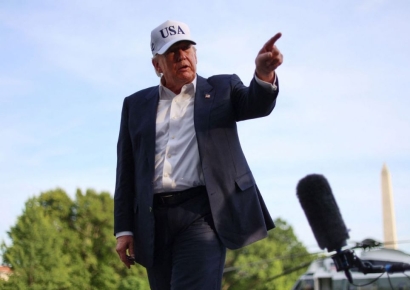 "Suspicious Timing?"...Trump Traded Stocks After Praising Wartime Capabilities
- "I Went to 10 Convenience Stores and Still Couldn't Buy It": The Bread Sensation That Sold 100 Million Units Already [The Way We Shop Now]
- Trump Pressures Taiwan to Relocate Semiconductor Industry to U.S., Says "Taiwan Took Away America's Semiconductor Industry"
- There Is a Distinct Age When Physical Abilities Decline Rapidly... From What Age Do Strength and Endurance Drop?
- "Contact Me First If Houses Are Built": Wealthy Clients Eyeing... Will Ultra-High-End Residences Worth 20 Billion Won Be Developed? [Real Estate AtoZ]
The U.S. administration is reportedly considering real economy stimulus measures such as paid leave for daily workers, postponement of income tax filing, and loans to self-employed and small businesses, in addition to payroll tax cuts. This is interpreted as an active willingness to stimulate the economy to save both finance and the real economy.
© The Asia Business Daily(www.asiae.co.kr). All rights reserved.