Economic Downturn Leads to Reduced Supply... Ssangyong Cement's Profits Also Decline

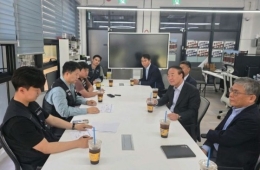
Hong Sa-seung, Chairman and CEO of Ssangyong Cement (left), and Lee Hyun-jun, Vice President and CEO
View original image[Asia Economy Reporter Kim Daeseop] Ssangyong Cement Industrial, which has played the role of the eldest in the domestic cement industry, is experiencing a decline in its operating performance. Although it has adopted a dual CEO system to separate management duties and initiate changes for sustainable management, it is struggling to overcome the impact of the construction market downturn.
According to the industry on the 11th, Ssangyong Cement's consolidated financial statements for last year showed provisional operating results of KRW 1.5446 trillion in sales and KRW 228.4 billion in operating profit. While sales slightly increased, operating profit decreased by 7.5% compared to KRW 246.9 billion the previous year. Net profit also fell by 10.5%, from KRW 147 billion in 2018 to KRW 131.6 billion in 2019.
A Ssangyong Cement official explained, "The decrease in cement sales volume due to the construction market slump affected the decline in profitability."
Ssangyong Cement's annual domestic cement shipment volume increased from 10.69 million tons in 2016 to 11.27 million tons in 2017 but decreased to 10.03 million tons in 2018. It is expected to have declined further last year and this year.
Since its establishment in 1962, Ssangyong Cement has maintained the industry's number one position (based on domestic shipment volume) for a long time. It was acquired by the private equity fund Hahn & Company in 2016. Although the top position has effectively been lost amid major industry mergers and acquisitions (M&A) in 2017, it remains a traditional powerhouse in the industry. Since the end of December 2017, it has adopted a dual CEO system to respond to rapidly changing environmental changes and market competition.
At the time of introducing the dual CEO system, the return of Chairman Hong Saseung, known as the 'Strong Ssangyong Man,' as well as the appointment of Executive Director Lee Hyunjun, who has excellent internal and external communication skills, as co-CEO attracted industry attention. However, the company has not succeeded in reversing its operating performance over several years.
Chairman Hong, born in 1948, joined Ssangyong Cement as an accountant in 1967 and served as head of finance, managing director, CEO, and chairman before leaving the company in 2011. He returned to Ssangyong Cement in 2017. Chairman Hong is highly regarded for his outstanding ability to improve business structure competitiveness through cost reduction, financial structure improvement, and building a global network.
Co-CEO Lee Hyunjun, born in 1962, joined Ssangyong Cement in 1985 and has held key positions across major departments including management planning, logistics, production plants, legal affairs, public relations, and audit. He was promoted to CEO and vice president in December 2019. He currently also serves as the chairman of the Korea Cement Association.
The prolonged downturn in the construction industry is negatively affecting the entire sector. According to the Korea Cement Association, annual domestic cement shipment volumes increased from 55.76 million tons in 2016 to 56.71 million tons in 2017 but have been declining every year since. The figures are 51.24 million tons in 2018, an estimated 48.4 million tons in 2019, and expected to be 45 million tons this year.
Hot Picks Today
 There Is a Distinct Age When Physical Abilities Decline Rapidly... From What Age Do Strength and Endurance Drop?
- "After Vowing to Become No. 1 Globally, Sudden Policy Brake Puts Companies’ Massive Investments at Risk"
- [Breaking] Trump: "I Don't Think There Is a Conflict in Taiwan... Made No Promises"
- Cerebras Soars 70% on IPO Debut: Is Nvidia's Reign Ending as a New AI Semiconductor Power Emerges?
- On Teacher's Day, a Student's Gifted Cake Had to Be Cut into 32 Pieces... Why?
An industry insider said, "Ssangyong Cement is making many efforts to strengthen competitiveness, such as restructuring affiliates unrelated to cement and expanding the recycled resource business," adding, "The decrease in operating profit over several years should be seen as a result of the poor construction market conditions."
© The Asia Business Daily(www.asiae.co.kr). All rights reserved.