An "I Go My Way"... Future Korea Party Rejects Merger Proposal
![[Image source=Yonhap News]](http://www.asiae.co.kr/news/img_view.htm?img=2020030910310611078_1583717466.jpg)
[Asia Economy Reporters Lee Ji-eun and Kim Hye-min] The Future Korea Party, which attracted over 500 applicants for proportional representation nominations, hinted at expanding its reach through a merger with Ahn Cheol-soo, leader of the People’s Party, but Ahn rejected the proposal, maintaining his stance on 'pragmatic centrism.'
On the 11th, Ahn’s side stated regarding Han Seon-gyo, leader of the Future Korea Party’s merger proposal, "I am volunteering with medical resources in Daegu and am not in a position or situation to meet anyone politically. I will steadfastly continue on the path of pragmatic centrist politics." This effectively dismissed the Future Korea Party’s offer.
People’s Party lawmaker Kwon Eun-hee also strongly criticized the merger proposal on Facebook that day, saying, "Where was Leader Han drinking to have such a dream?" and called the merger proposal 'stalking.' She added, "On the 27th of last month, Leader Ahn clearly promised the public that there would be no merger with the United Future Party or the Future Korea Party," and "Proposing a merger to Leader Ahn is nothing but stalking. I clearly warn Leader Han that stalking is a crime."
Earlier, Leader Han had stated in an interview with media outlets that he would soon go down to Daegu to propose a merger to Leader Ahn and that he might even hand over his leadership position if Ahn desired. This is interpreted as an attempt to broaden the party’s base through a merger with Ahn. The underlying strategy is that if the Future Korea Party wins more than 20 seats in this general election, it could become a parliamentary negotiation group.
However, the merger push faltered from the start due to Ahn’s rejection. Political circles point out that even if Leader Han tries to re-engage with Ahn in the future, the chances of success are slim. An aide from Ahn Cheol-soo’s faction said, "It seems Leader Han brought this up because the People’s Party and the Future Korea Party are cannibalizing each other’s proportional representation votes, but the Future Korea Party does not align at all with Ahn’s centrist political rationale," adding, "If they were thinking of merging, it would have been with the United Future Party."
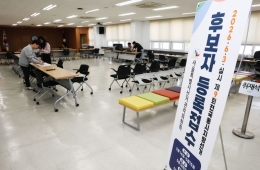
As of the day before, the Future Korea Party closed applications for proportional representation candidates, with a total of 531 applicants, including 97 undisclosed. The list included lawyer Yoo Young-ha, a close aide to former President Park Geun-hye; lawyer Hwang Seong-wook, who acted as a representative in Park’s impeachment trial; former KBS president Gil Hwan-young; and former MBC president Kim Jae-chul, all of whom were active during the Park Geun-hye administration.
Hot Picks Today
 "Do We Need to Panic Buy Again?" War Drives 30% Price Surge... Even the Bedroom Feels the Impact
- "Is a 10,000 KOSPI Breakthrough Possible?" Target Index Raised by 40%... Securities Firms Release Outlook [Weekend Money]
- There Is a Distinct Age When Physical Abilities Decline Rapidly... From What Age Do Strength and Endurance Drop?
- "Anyone Who Visited the Room Salon, Come Forward"… Gangnam Police Station Launches Full Staff Investigation After New Scandal
- "Contact Me First If Houses Are Built": Wealthy Clients Eyeing... Will Ultra-High-End Residences Worth 20 Billion Won Be Developed? [Real Estate AtoZ]
Also applying were former Independence Hall director Yoon Joo-kyung; North Korean defector and human rights activist Ji Seong-ho; Kim Eun-hee, the first whistleblower in the sports world’s MeToo movement; Kim Bo-ram, former Chief Content Officer at Insight; People’s Party recruit Jeong Un-cheon, who switched from the New Conservative Party; former MBC reporter Kim Se-ui of the conservative YouTube channel 'Garosero Research Institute'; and visually impaired pianist Kim Ye-ji. Based on the list of applicants tallied that day, the nomination committee will complete screening and finalize candidate rankings by the 15th. The Future Korea Party’s nomination committee plans to complete the election unit’s approval vote, ratification, and supreme council resolution by the 16th of this month.
© The Asia Business Daily(www.asiae.co.kr). All rights reserved.