Korean Economy Caught in 'Corona'... Realization of Simultaneous Hits on Exports and Domestic Demand

On the 10th, amid ongoing concerns about the spread of the novel coronavirus infection (COVID-19), the domestic departure floor at Gimpo Airport in Seoul appeared quiet. Photo by Hyunmin Kim kimhyun81@
View original image[Asia Economy Reporter Moon Chaeseok] The novel coronavirus infection (COVID-19), which has struck the world, has also engulfed the Korean economy. Both exports and domestic demand in South Korea were simultaneously hit during the month of domestic COVID-19 spread. The government is making every effort to minimize the negative economic impact.
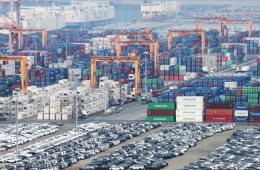
According to the government on the 16th, the average daily export amount from the 1st to the 10th of this month decreased by 3.2%, from $1.58 billion to $1.53 billion.
In January, the average daily exports had turned to an increase of 4.8%, marking a rise for the first time in 14 months, but then shifted back to a decline.
The government had specifically pointed to "the promised February" as the turning point to a positive (+) in last year's year-end press briefing, but it could not avoid the impact of COVID-19.
According to the industry, Hyundai Motor Company had sequential factory shutdowns from the 4th to the 11th, and Ssangyong Motor entered shutdowns from the 4th to the 12th.
This was due to a shortage of parts inventory caused by production stoppages at parts companies in China following the spread of COVID-19. It is inevitable that manufacturing production in February will be hit, and whether it can turn positive is uncertain.
Domestic demand is also serious. From the 24th to the 31st of last month, the number of Chinese tourists visiting South Korea decreased by about 11% per day compared to a year ago. This month, the decline is expanding further.
Chinese tourists accounted for 34.5% of all tourists visiting South Korea last year. The decrease in Chinese tourists is a direct blow to the travel industry, hotels, and duty-free shops.
Visits to restaurants and cafes by tourists have decreased, with sales at Myeongdong and Namdaemun Market down by 80%, and sales at Gwangjang Market down by 50 to 70%.
The government also assessed that the level of economic indicator changes caused by COVID-19 has surpassed that of the Middle East Respiratory Syndrome (MERS) five years ago.
Deputy Prime Minister and Minister of Strategy and Finance Hong Nam-ki explained on the 13th, "Looking at the changes in economic indicators, it is analyzed that the impact is greater than that of the MERS outbreak five years ago."
According to the Bank of Korea and others, the estimated decline in South Korea's economic growth rate due to SARS (Severe Acute Respiratory Syndrome) in 2003 and MERS in 2015 was about 0.1 percentage points and 0.3 percentage points annually, respectively.
Meanwhile, global economic analysis institutions are increasingly concerned that the Korean economy will experience negative (-) growth in the first quarter.
Morgan Stanley recently forecasted in a report that due to the COVID-19 shock, South Korea's first-quarter growth rate compared to the same period last year will fall by at least 0.8 to 1.1 percentage points.
If the scenario of a growth rate decline shock of around 1% materializes, considering the slowed growth momentum of the Korean economy, the quarter-on-quarter growth rate is expected to remain negative.
Hot Picks Today
 No Bacteria Detected in Arisu After 24 Hours of Repeated Drinking from a Tumbler
- "Not Even Expecting Gratitude, Just Hoping for No Complaints": Teachers' Sad Portrait on the Eve of Teacher's Day
- "Available Only in Korea": Pokémon Card Prices Surge 2,532% Due to Rarity, Becoming Investment Assets
- High-Net-Worth Investors Increase Stock Holdings: "Samsung and SK hynix Are Basic, Now Searching for the Next Opportunity" [Investment Strategies of the Wealthy] ⑧
- Police Officer Cycling on Day Off Rescues Woman Attempting to Jump from Hangju Bridge
Earlier, JP Morgan also projected that the Korean economy would contract by 0.3% quarter-on-quarter in the first quarter due to the COVID-19 shock.
© The Asia Business Daily(www.asiae.co.kr). All rights reserved.