Fear of 'New Coronavirus' Spreads... Aviation Industry at a Crossroads
Demand Decline on Short-Haul Routes Outside China Intensifies
Worsening Situation with Growing Calls to Expand 'Cancellation Fee Waivers'

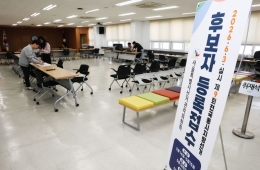
On the 10th, amid ongoing concerns about the spread of the novel coronavirus infection, the domestic terminal at Gimpo Airport in Seoul appeared quiet. Photo by Kim Hyun-min kimhyun81@
View original image[Asia Economy Reporter Yu Je-hoon] The aviation industry is the hardest hit by the novel coronavirus infection (Wuhan pneumonia) crisis. This comes amid ongoing issues such as the boycott of travel to Japan last year and supply-demand imbalances in the short-haul market, with another major adverse factor emerging.
According to Incheon International Airport Corporation on the 11th, the number of international passengers (based on paying passengers) at airports nationwide last month was approximately 7,881,507, down about 1.7% compared to the same period last year. Air cargo volume also decreased by 4.9% to 231,000 tons. The main reasons for the decline in air passenger and cargo demand are cited as the boycott of travel to Japan due to Korea-Japan tensions and a reduction in cargo volume caused by the global economic downturn.
In addition, the industry expects the impact of the novel coronavirus crisis to be reflected starting this month. This is because the suspension of flights on China routes due to the novel coronavirus crisis began in earnest from early this month. From the 1st to the 10th alone, the number of passengers at airports nationwide was 1,770,273, nearly 1 million fewer than the same period last year.
Particularly concerning the industry is that the demand contraction is spreading to other short-haul routes beyond China. This is due to the reality of 'third-country infections,' where travelers visiting Thailand and Singapore have been diagnosed with the novel coronavirus. For some popular Southeast Asian routes, the load factor (L/F) has reportedly dropped to around 20-30% recently.
Domestic routes are no exception. Recently, a Korean airline sold tickets for the Gimpo-Jeju route at 2,880 KRW. The Gimpo-Jeju route is a representative profitable route with a load factor exceeding 90% under normal circumstances. Professor Hee-Young Lee of Inha Technical College explained, "Consumers are reacting more sensitively because they have already experienced the 2003 Severe Acute Respiratory Syndrome (SARS) and the 2015 Middle East Respiratory Syndrome (MERS)."
Meanwhile, cancellations of flight reservations are continuing on routes other than China, leading to frequent disputes. The Korea Fair Trade Commission recently encouraged the airline and travel industries to expand the waiver of cancellation fees related to the novel coronavirus crisis. While Korean airlines are waiving cancellation fees for tickets to Greater China, consumer complaints are pouring in requesting the expansion of this policy to other routes as well. Airlines are thus facing a double burden following the demand contraction.
The industry, enduring losses due to the decline in demand on China routes, is in a difficult position. An industry official said, "For China routes, cancellation fees are being waived following the Ministry of Foreign Affairs' Level 2 travel advisory, but there is no clear basis for other regions."
Hot Picks Today
 "Suspicious Timing?"...Trump Traded Stocks After Praising Wartime Capabilities
- "I Went to 10 Convenience Stores and Still Couldn't Buy It": The Bread Sensation That Sold 100 Million Units Already [The Way We Shop Now]
- Trump Pressures Taiwan to Relocate Semiconductor Industry to U.S., Says "Taiwan Took Away America's Semiconductor Industry"
- There Is a Distinct Age When Physical Abilities Decline Rapidly... From What Age Do Strength and Endurance Drop?
- "Contact Me First If Houses Are Built": Wealthy Clients Eyeing... Will Ultra-High-End Residences Worth 20 Billion Won Be Developed? [Real Estate AtoZ]
Professor Hee-Young Huh of Korea Aerospace University stated, "As China's economic influence grows, the ripple effect on the aviation and travel industries has become significant," adding, "Even if the novel coronavirus crisis subsides this month or next, it will take time for demand to fully recover."
© The Asia Business Daily(www.asiae.co.kr). All rights reserved.