Temporary KRW Strengthening Due to US-China Trade Agreement... Largest Appreciation Among Major Countries in December
After the First Phase Trade Agreement, the USD-KRW Exchange Rate Fell 2.5% in 15 Days
Dollar Weakness Impact...Greater Appreciation Than Euro and Pound
More Affected by Trade War Than Yuan, a Trade War Party

[Asia Economy Reporter Kim Eunbyeol] The Korean won, which had shown weakness throughout last year, has recently exhibited a sharp strengthening over the past month. Among Asian currencies, it showed the strongest appreciation, and its rise was steeper than that of the euro and pound, which had strengthened amid momentum from Brexit (the United Kingdom's withdrawal from the European Union).
According to the Bank of Korea on the 3rd, the won-dollar exchange rate fell by about 1.82% in December 2019. A decline in the won-dollar exchange rate indicates an appreciation of the won. Considering that the won-dollar exchange rate had risen about 5% from January to November 2019, the won showed a rapid surge against the dollar within just one month. The strong won in December diluted the annual exchange rate increase, resulting in a 3.55% rise in the won-dollar exchange rate for the entire year.
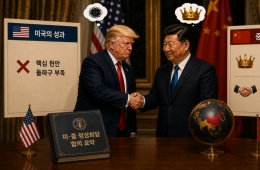
The won's particularly strong performance last month was largely influenced by the US-China Phase One trade agreement. The won-dollar exchange rate has shown sharp fluctuations depending on the outcome of the trade war. In August last year, when the trade war intensified, the won-dollar exchange rate rose to the 1,200 won level. Since the won's value had sharply declined due to external issues, it is interpreted that it also reacted strongly to positive developments. After the US announced on the 13th of last month (local time) that a Phase One trade agreement had been reached, the won-dollar exchange rate fell by about 2.59% over approximately two weeks.
In fact, the currency appreciation due to the dollar's weakness in December was not unique to Korea. Expectations for the Phase One trade agreement and forecasts of further progress in trade talks reduced the preference for safe-haven assets, causing the dollar to weaken. The dollar index, which threatened the 100 mark at the end of September last year, has now fallen to the 96 level.
As the dollar weakened, most major currencies also strengthened. In December alone, the euro appreciated by 1.78%, and the British pound also rose 1.59% against the dollar. The Japanese yen appreciated by 0.58%. The pound and euro were particularly influenced by Brexit-related issues. The Conservative Party's victory in the UK general election eased concerns over a so-called No Deal Brexit, where the UK would leave the EU without any agreement, and expectations grew that Brexit would accelerate.
Asian currencies, which move along with trade war issues, also mostly strengthened, causing their exchange rates against the dollar to fall simultaneously. The Malaysian ringgit fell 1.63% against the dollar, while the Indonesian rupiah (-1.17%), Singapore dollar (-1.26%), and Taiwan dollar (-1.14%) also declined against the dollar. The Chinese yuan, a party to the trade war, saw its official exchange rate against the dollar fall by 1.1% during the same period.
However, the appreciation of major currencies did not match that of the won. The reason the won moves particularly strongly in response to external issues such as the trade war is analyzed to lie in foreign exchange market interventions by countries like China. The People's Bank of China calculates and announces the reference exchange rate by considering the yuan exchange rate traded in the market and a basket of currencies of major trading partners. In contrast, Korea has adopted a market-average exchange rate system based on market principles. Since it reflects market principles more than a multiple currency basket, volatility due to external issues can appear more pronounced.
Experts believe that since the won-dollar exchange rate rose significantly last year, it is highly likely that the won-dollar exchange rate will continue to decline through the first quarter of this year. Kwon Amin, an analyst at NH Investment & Securities, said, "Following the end of last year, the global economic bottom is being confirmed early this year," and emphasized, "The Federal Reserve's policy will induce a global weak dollar." He added, "The trade war, which had burdened the won, has eased with the Phase One agreement, sustaining the strength of emerging market currencies." However, he noted that since issues such as the removal of already imposed tariffs remain unresolved, it is necessary to monitor the situation going forward.
Some also predict that the dollar's weakening trend may not last long. Thierry Wiseman, Global Rates and Currency Strategist at Macquarie Group, pointed out, "Generally, the dollar's weakening trend seen in December seems to have somewhat weakened since the new year," adding, "UK and European indicators have not been impressive, so concerns about the UK and European economies, which people expected a few weeks ago, may grow again." On this day, the won-dollar exchange rate opened at 1,158.5 won, up 0.4 won, in the Seoul foreign exchange market.
Hot Picks Today
 "Samsung and Hynix Were Once for the Underachievers"... Hyundai Motor Employee's Lament
- "Sold Everything Fearing Bankruptcy, Then It Soared 3,900 Times: How a Stock Once Feared for Delisting Became an AI Powerhouse"
- "All Major Corporations Could Leave"... Business Community Fears Overseas Factory Relocation Due to Strike Risks
- Man in His 50s Steals 71 Million Won From Former Coworker's Family Home Safe After Break-In 10 Years After Working Together
- "That? It's Already Stashed" Nightlife Scene Crosses the Line [ChwiYak Nation] ③
© The Asia Business Daily(www.asiae.co.kr). All rights reserved.