Leading companies in the domestic meal kit market are struggling as the industry enters a period of stagnation. Businesses that rapidly expanded during the COVID-19 boom are now facing dual pressures from slowing consumer demand and rising costs.
[Fresheasy]
Rapid growth during the COVID-19 boom, sharp demand decline post-endemic
Despite being industry leader, sales decline and continued losses worsen profitability Cost ratio increased above 81%, logistics costs burden solidify deficit structure
Expansion and M&A strategies lead to increased costs and setbacks
According to the Financial Supervisory Service’s electronic disclosure system as of April 15, the top meal kit company in Korea, Fresheasy, recorded standalone sales of 100.8 billion won last year, a 12.3% decrease from 114.9 billion won the previous year. Operating losses amounted to 23.7 billion won-an improvement from the previous year but still not enough to escape the red. Fresheasy has never posted a profit since its establishment in 2016. Net losses also exceeded 20 billion won.
Fresheasy, Deficit Structure Becomes Entrenched... Surviving on Debt
The company's financial structure has continued to deteriorate. Debt has surpassed 80 billion won, while equity has dropped to the 20 billion won range. Due to ongoing net losses since its founding, Fresheasy’s accumulated deficit has reached 654.3 billion won. With the deficit far outweighing equity, the company is now seen as being close to capital impairment. Short-term financial pressures have also increased. Short-term borrowings rose from 23.3 billion won to 42.2 billion won. Current liabilities (60.1 billion won) exceed current assets (25 billion won) by more than 35 billion won, further intensifying short-term repayment pressure. This means the company owes more in short-term obligations than it holds in assets.
Fresheasy has focused on B2C (business-to-consumer) meal kit sales, supplying products through OEM (original equipment manufacturing) and ODM (original design manufacturing) methods. The company was considered a major beneficiary when contactless consumption surged during COVID-19. Sales grew from 1.5 billion won in 2017 to 214.8 billion won in 2022. In the process, Fresheasy aggressively pursued mergers and acquisitions, acquiring related firms such as Line Logistics System, Doctor Kitchen, Heodak, and Tasty Nine, which expanded its production and logistics infrastructure. However, this expansion led directly to higher costs. Strategies like lowering sales prices to secure market share also contributed to weaker profitability.
Indeed, Fresheasy’s cost of goods sold ratio exceeded 81% last year-a high rate compared to the usual 50-60% for general food companies. When combined with selling and administrative expenses, the deficit structure has become entrenched.
'Endurance' at Mychef, Dependent on Capital Increases
The situation is challenging for the second-leading company, Mychef, as well. Sales increased from 45.4 billion won to 68.1 billion won, a rise of 22.7 billion won. Operating losses narrowed from 10 billion won to 4.4 billion won, and net losses were also cut by about half.
However, a closer look at the financials suggests the company is in “survival mode” rather than recovery. Equity remains around 20 billion won, but this is due to external capital infusions rather than internal profits. In fact, Mychef secured funds through paid-in capital increases of about 15 billion won in 2024 and about 5 billion won last year. Its accumulated deficit has also grown to around 74 billion won, indicating the deficit structure persists.
There have also been changes in the borrowing structure. Short-term borrowings dropped from 22.4 billion won to 4.4 billion won, while long-term borrowings increased from 5 billion won to 18 billion won. Although short-term burdens have been reduced, total debt remains at about 41 billion won. The company is still facing fundamental financial pressures.
Mychef has sought to secure relatively stable demand by expanding its B2B (business-to-business) segment. After being acquired by Korean Air C&D Service in 2022, it has strengthened its business structure by leveraging its group network.
Changes in Consumer Trends, Growing Preference for Instant Food
The difficulties faced by both companies stem from the inherent limitations of the meal kit industry. Due to the nature of fresh foods, the cost of goods sold is high, and there are significant costs for cold and frozen logistics. Additionally, short shelf life increases the risk of inventory disposal. The more types of products offered, the greater the costs for production and inventory management.
Shifts in consumer trends are also a burden. According to the Ministry of Food and Drug Safety, the domestic home meal replacement (HMR) market (measured by sales) grew from 3.6525 trillion won in 2020 to 6.3424 trillion won in 2024. The industry projects that the market will surpass 7 trillion won this year. Globally, the HMR market is also expanding. The global market is expected to grow at an average annual rate of 4.4%, reaching USD 228.1 billion (KRW 337.6336 trillion) by 2030.
In contrast, the presence of meal kits is diminishing. According to Euromonitor, the meal kit market surged from 34.5 billion won in 2018 to 382.1 billion won in 2023, but after the endemic era (periodic infectious disease outbreaks) and the recovery of dining-out demand, the market has stagnated at the 300 billion won level for the past five years.
Consumer choices are also shifting toward instant foods. According to a survey by global market research firm Mintel of 1,000 internet users aged 18 and older on the frequency of HMR consumption, 57% consumed frozen instant foods at least once a week (including 2-3 times a month). In contrast, only 43% consumed refrigerated meal kits.
Industry observers note that as consumers increasingly value both price and convenience, the position of meal kits is weakening. Demand is shifting from meal kits, which require cooking, toward instant foods and frozen HMR products that can be easily prepared in a microwave.
Price increases are also difficult. Consumers’ price sensitivity is high, and competition has intensified as large food companies and distribution platforms have entered the market.
An industry insider commented, “While meal kits have strengths in terms of convenience, structurally it is a business with inherently low margins,” adding, “It is difficult to improve profitability even by increasing scale.”
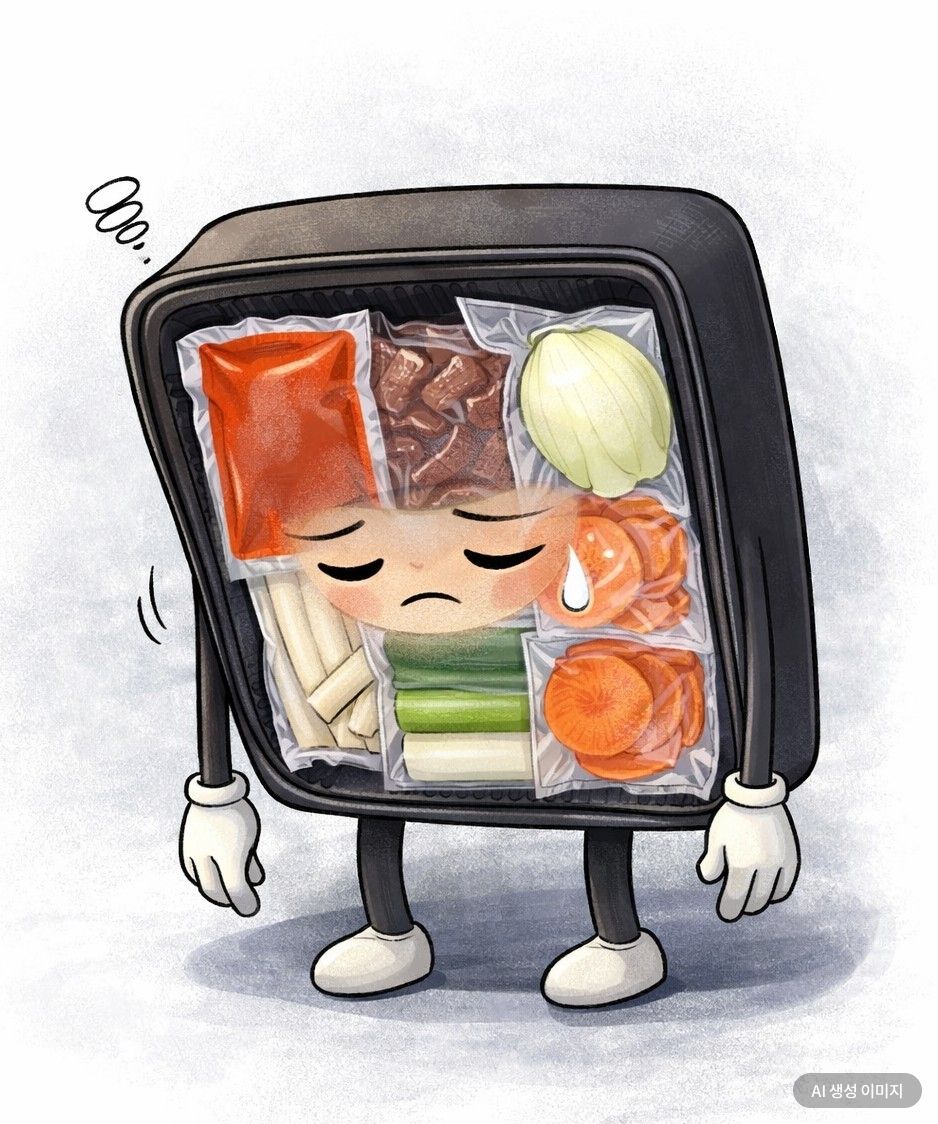
![[Fresheasy]Rapid growth during the COVID-19 boom, sharp demand decline post-endemicDespite being industry leader, sales decline and continued losses worsen profitabilityCost ratio increased above 81%, logistics costs burden solidify deficit structureExpansion and M&A strategies lead to increased costs and setbacks](https://cphoto.asiae.co.kr/listimglink/9/2021091408144228580_1631574882.jpg)





![[Report] "A Culinary Destination with a View of Gyeongbokgung"... Kim Dong-sun's High-End Dining Takes Over Gwanghwamun](https://cwcontent.asiae.co.kr/asiaresize/304/2026042114562634571_1776750985.jpg)
![[Gallery Stroll] Red Robe, Black Lines... Danjong Returns with the Face of Wounds](https://cwcontent.asiae.co.kr/asiaresize/304/2026042014183532691_1776662315.jpg)