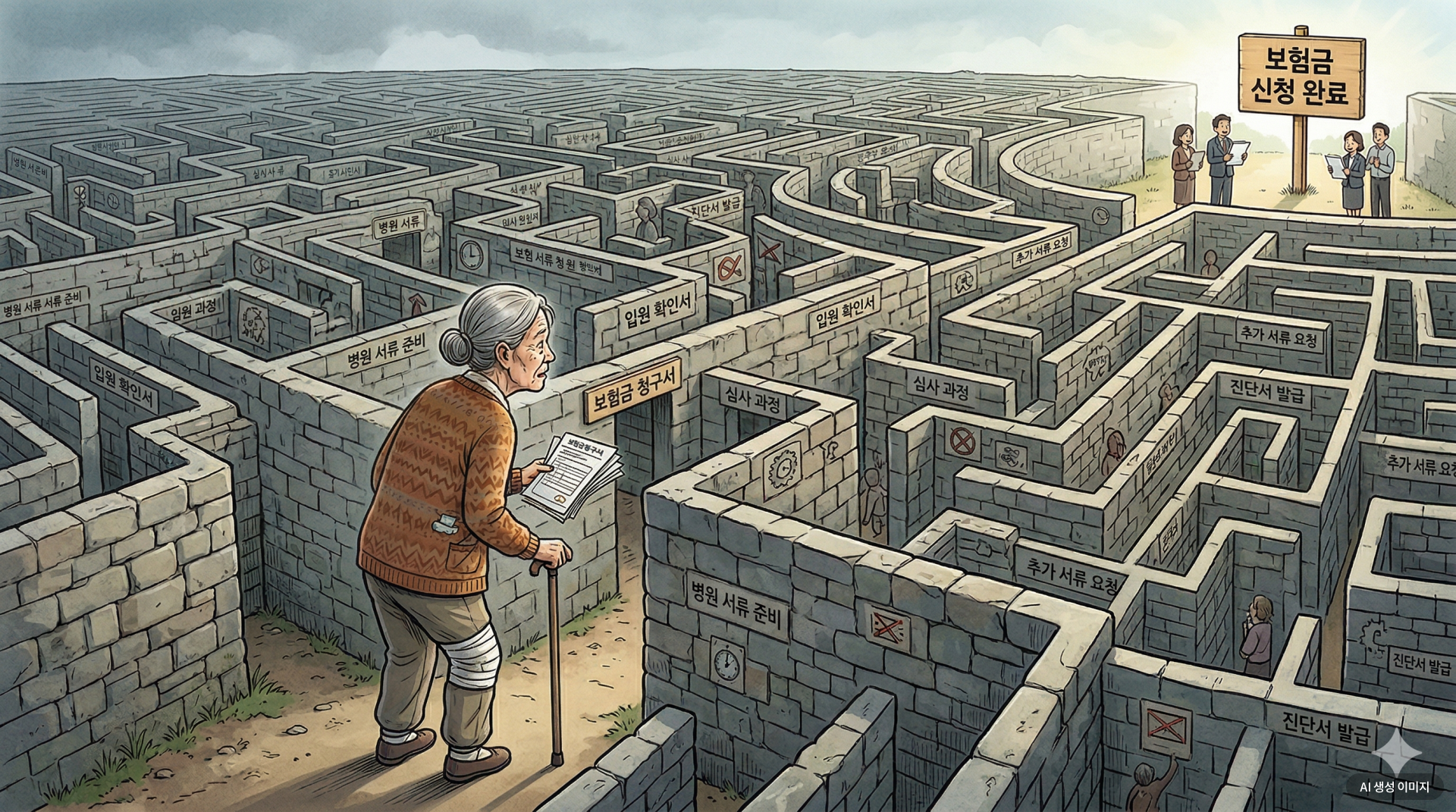
Kim Jeongae (70, female, pseudonym), who lives in Busan, was hospitalized for 12 days after injuring her back and knee in a sudden stop on a city bus in October 2025. After completing her outpatient treatment, Kim tried to claim her insurance payout, but eventually went to an insurance branch instead of using her smartphone. "I just couldn't do it. It's much more reassuring to meet someone in person, listen to their explanation, and get help."

Despite the Spread of Chatbots and Mobile Claims, Seniors Still Rely on Agents and Family..."Afraid of Making a Mistake"
As artificial intelligence (AI) and digital technologies become more widely adopted, digital solutions are rapidly permeating the entire insurance process-from sales and marketing to underwriting, claims, and payouts. With the rise of generative AI, the scope of applications is expanding rapidly to include chatbot consultations, mobile claim submissions, agent support, and internal work automation.

In practice, Kyobo Lifeplanet now handles more than half of its customer consultations remotely, and has shifted about 75% of its major work processes online. Samsung Life Insurance has introduced chatbot-based digital guidance services, and Hanwha Life has launched a mobile application as an integrated financial platform. The non-life insurance sector is also quickly increasing its share of mobile claim submissions and AI-powered consultations.
Insurers explain that these systems serve as mere supplementary tools and that people still oversee the entire process. They also emphasize the additional measures put in place for seniors, such as larger font sizes, strengthened guidance functions, and dedicated consultants.
However, the reality experienced in the field is different. For seniors who are not familiar with digital environments, the process of claiming insurance benefits still represents a major barrier. Many seniors give up trying altogether due to anxiety about making a mistake, unfamiliar user interfaces, and repeated authentication steps. Although there are now more options such as chatbot consultations and mobile submissions, they remain out of reach for those who need them most.
Shin Yongja (72, female, pseudonym), who lives in Yangyang, Gangwon Province, also tried to claim her insurance payout but ended up asking her daughter for help.
"I was afraid I would mess up the application by pressing the wrong button. So I just asked my child to do it for me."


Insurance agents who deal directly with customers in the field report similar situations. Jang Okja (pseudonym), a DB Insurance agent with 28 years of experience, said, "If children don't handle it for them, many seniors end up faxing or mailing their documents to the office. Even though they know mobile is more convenient, many customers hesitate to use it because they're afraid of making even a small mistake."
Complaints About Complicated Step-by-Step Consultations...60-80% of Insurance Complaints Are About Payouts
The problem is also evident in the changing structure of consultations. Recently, insurers have been expanding "step-by-step consultation structures," where customers must first go through AI chatbots, voice bots, or digital ARS (automated response systems) before reaching a human consultant. For seniors, this process itself becomes another obstacle.
For example, when trying to reach a consultant at the customer center of a foreign insurance company (Company A), it was far from easy. Calling the main customer center number, the instruction was, "Please use your phone screen to handle your work," and the call was immediately disconnected. To connect to a consultant, one must press a button at the top right of the screen, but seniors unfamiliar with devices often fail to notice this and simply hang up. As a result, the consultation process cannot continue, and confusion only increases.

These issues are also evident in the testimonies of consultants who directly assist seniors. Lee Dajeong (pseudonym), a call center consultant at a domestic insurance company, said, "Senior customers need step-by-step instructions on where to press." She added, "Since the introduction of AI, complaints about what's called 'going in circles'-where people either hang up because they don't know how to connect to a consultant or hear the same instructions repeated over and over-have been on the rise."
As AI replaces human consultants, the total number of call center staff is also declining. At one of Korea's top three non-life insurers (Company B), the number of call center staff has shown an overall downward trend over the past three years-falling from 981 in 2023 to 960 in 2024. Although the number increased slightly to 963 last year, this is still 18 fewer than two years ago.
Company B is also expanding its use of AI in automobile insurance tasks such as accident guidance and emergency dispatch requests. However, there are concerns that for seniors involved in car accidents, delays in connecting to a consultant-especially when already in a state of panic-could hinder their initial response.

Kim Yeonju, head of the Dundeunhan Call Center Branch, said, "In cases of accident reporting, customers are often calling while upset and stressed, but if the connection is not smooth, it can cause significant inconvenience in handling the accident." She added, "When customers have to go through AI consultations or face connection delays, complaints often become more serious."
The accumulation of complaints among seniors is also reflected in insurance complaint statistics. According to the General Insurance Association of Korea, insurance payout-related complaints accounted for 60-80% of all complaints last year-a remarkably high proportion. Given that the insurance non-payment rate is below 1%, it is clear that payout delays or process-related inconveniences are the main drivers for these complaints.

Securing the trust of seniors who are not accustomed to machines or voice bots is also a crucial challenge. Park Soyoung, a professor at Seoul National University's Business School, stated, "Since the insurance industry is based on trust, the AI adoption process must include governance systems that ensure explainability and accountability." She added, "Consumers with low AI literacy or diminished cognitive ability are more vulnerable to incorrect AI advice, so it is important to implement safeguards to protect them."
-

Reporter Kim Minyoung argus@asiae.co.kr
-
Edit Choo Myeonghoon chox2mh@asiae.co.kr
© The Asia Business Daily(www.asiae.co.kr). All rights reserved.





![[Report] "A Culinary Destination with a View of Gyeongbokgung"... Kim Dong-sun's High-End Dining Takes Over Gwanghwamun](https://cwcontent.asiae.co.kr/asiaresize/304/2026042114562634571_1776750985.jpg)

![[Gallery Stroll] Red Robe, Black Lines... Danjong Returns with the Face of Wounds](https://cwcontent.asiae.co.kr/asiaresize/304/2026042014183532691_1776662315.jpg)