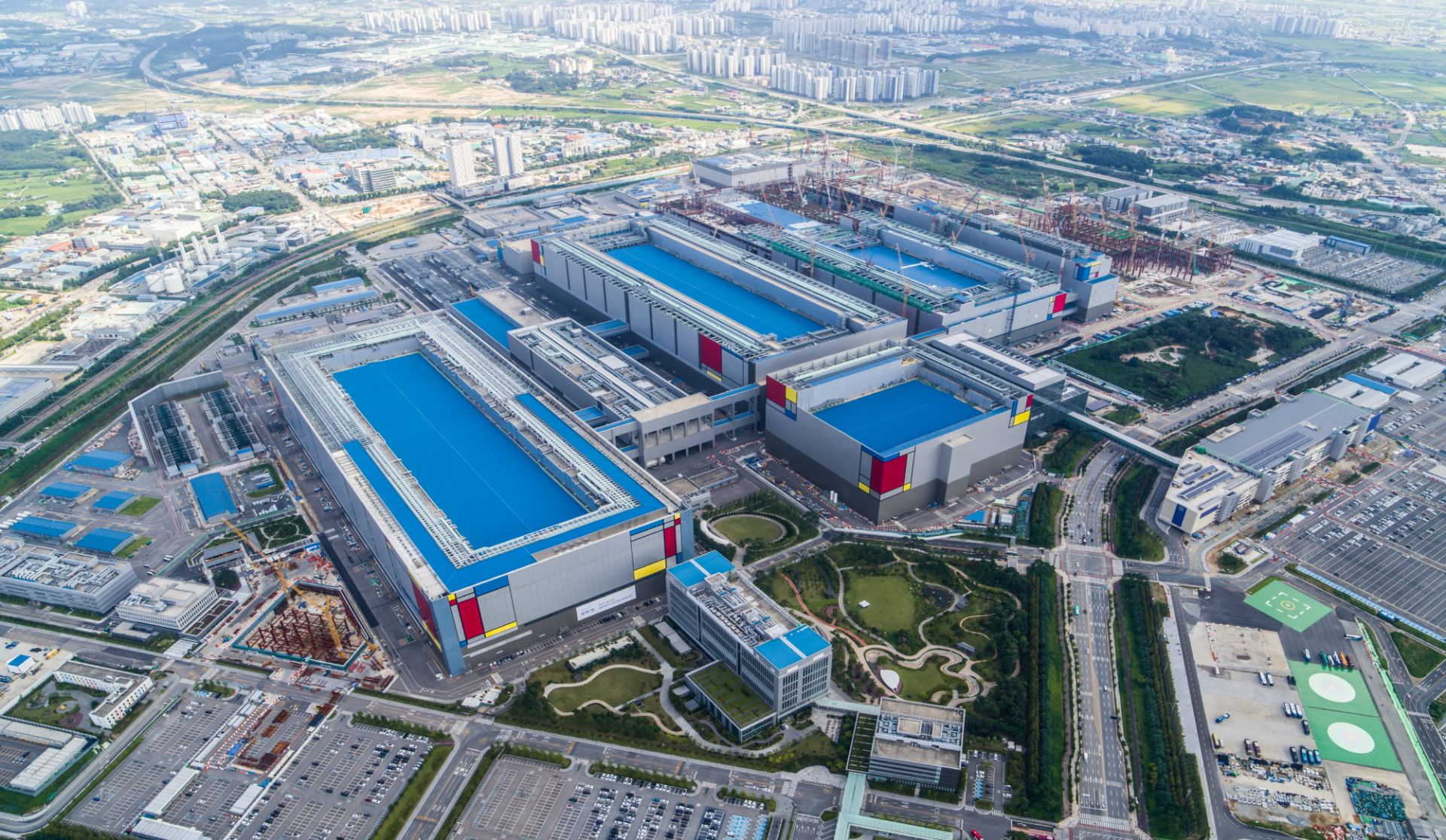
The decision by Samsung, SK, Hyundai Motor, and LG Group to invest 800 trillion won domestically over the next five years is intended not only to prevent industrial hollowing-out, but also to establish “super-gap factories.” Their strategy is to design the pinnacle of the manufacturing transformation-including artificial intelligence (AI), semiconductors, batteries, and robotics-within Korea, thereby laying the groundwork to outpace China’s technological pursuit.
Samsung to invest 450 trillion won by 2030, SK to invest over 128 trillion won by 2028
According to industry sources on November 17, Samsung plans to invest 450 trillion won by 2030, Hyundai Motor 125 trillion won, LG 100 trillion won, and SK will execute more than 128 trillion won by 2028. This round of investment announcements was made after the Korea-US tariff negotiations were finalized, with the aim of preventing industrial hollowing-out. It reflects the determination to secure future growth engines within Korea. As a result, large-scale investments are expected not only in the Seoul metropolitan area but also in regional areas.

Given that the fact sheet summarizing the results of the Korea-US negotiations is clearly intended to keep China in check, analysts say the goal is not merely to resolve domestic production hollowing-out. Industry insiders view this as a structural choice to establish a “super-gap K-factory” in Korea, which China would find difficult to catch up with in the short term, thereby securing a lead in manufacturing competitiveness.
Strategy to Strengthen Semiconductor Super-Gap Technological Advantage Through Large-Scale Investment
Samsung Electronics and SK Hynix’s decisions to make large-scale investments in domestic semiconductor production facilities are aligned with this approach. According to a survey on the competitive landscape and outlook for Korea, the US, Japan, and China released by the Federation of Korean Industries on the same day, Korea’s semiconductor technology is expected to be overtaken by China within five years. Samsung’s newly announced Pyeongtaek Campus Fab 5 will produce core memory for AI learning and inference, such as high-bandwidth memory (HBM) and server DRAM. Since this is a field where process complexity is high and the accumulation of production technology is critical, preemptive expansion alone can partially deter competitors. Solid-state batteries, next-generation organic light-emitting diodes (OLEDs), and high-value package substrates are also key foundational technologies for future industries. Samsung plans to focus its investments in these areas to reinforce its technological edge.

Visitors attending the '2025 Semiconductor Expo' held at COEX in Gangnam-gu, Seoul, are viewing SK Hynix's exhibition related to HBM4. Photo by Dongju Yoon
원본보기 아이콘SK Group’s investments are also focused on establishing a de facto “HBM-specialized manufacturing zone” centered on the Yongin semiconductor cluster. If all four fabs are completed, the total investment is estimated to reach 600 trillion won. The “Trinity Fab” project, promoted by SK Hynix in cooperation with the government, will support the semiconductor materials, components, and equipment ecosystem.
Hyundai Motor to Restructure as AI and Electrification-Centered “Mother Factory”… LG to Invest 100 Trillion Won
Hyundai Motor Group is directly challenging China’s dominance in robotics. With the goal of restructuring domestic plants as “mother factories” centered on AI and electrification, the company plans to directly link vehicle AI, software-defined vehicles (SDVs), autonomous driving, and robotics technologies to its manufacturing system. AI data centers, physical AI verification centers, and robot foundries designed in Korea are expected to become the foundation for the group’s competitiveness in finished vehicles. Hyundai Motor will also pursue strategies to stabilize its entire production process by advancing its electrification platform and battery technology. LG Group, which will invest 100 trillion won over the next five years, aims to strengthen its capabilities in batteries, automotive electronics, next-generation displays, and semiconductor materials, components, and equipment.

Many experts agree that the scale of investment itself will determine the future gap in competitiveness. To connect Korea’s technological assets with industrial competitiveness and development speed, quantitative investment is essential.
Lee Jonghwan, Professor of System Semiconductor Engineering at Sangmyung University, commented, “For Samsung’s semiconductor business, the time has come. With large-scale investments in memory and foundry, the company can make a leap forward and widen the gap.” Kim Yongseok, Distinguished Professor at Gachon University, said, “A semiconductor belt has been well established in southern Gyeonggi Province, including Yongin and Pyeongtaek. If investments are concentrated here, the world’s strongest production base can be built.”
Lee Taegyu, Senior Research Fellow at the Korea Economic Research Institute, stated, “The fact that companies can continue to make large-scale domestic investments is a positive sign for industrial competitiveness. Investments outside the Seoul metropolitan area are advantageous for power supply and will help prevent industrial hollowing-out and reduce concerns about regional decline.”
-
Reporter Jang Heejun junh@asiae.co.kr
-
Reporter Park Joonyi giver@asiae.co.kr
-
Edit Lee Kijae happylee17@asiae.co.kr
© The Asia Business Daily(www.asiae.co.kr). All rights reserved.
!["Please Help Us": How Much Do Those Bowing 90 Degrees These Days Actually Earn? [Data Pick]](https://cwcontent.asiae.co.kr/asiaresize/323/2026052010120870131_1779239528.png)