Following steel and displays, it is now projected that the competitiveness of all ten of South Korea's leading export sectors-including semiconductors, electrical and electronic products, and shipbuilding-will fall behind China within the next five years. This is because it is becoming increasingly difficult for domestic companies to effectively respond to the relentless advance of Chinese manufacturing, which leverages cost competitiveness and production innovation as its main strengths. In particular, there are growing concerns that the brand value of Korean companies and products, long symbolized by the 'K' label, could also be overtaken by China within a few years. As a result, maintaining the gap with China, which is rapidly enhancing its technological and production capabilities, is emerging as a key challenge.
Federation of Korean Industries Survey... Steel and Secondary Batteries Already Overtaken
There are also views that the decision by major groups such as Samsung and SK to invest hundreds of trillions of won in developing next-generation production capabilities-including semiconductors, artificial intelligence (AI), and robotics-will help secure an overwhelming lead over China.

According to the "Current Status and Outlook of Competitiveness in Korea, the US, Japan, and China" survey released on the 17th by the Federation of Korean Industries, which targeted the top 1,000 companies by sales in leading export sectors (with 200 companies responding), China has already surpassed Korea in five sectors: steel, general machinery, secondary batteries, displays, and automobiles and parts. Korea still holds an advantage in semiconductors, electrical and electronic products, shipbuilding, petrochemicals, and bio-health, but many respondents predicted that by 2030, China’s competitiveness in these sectors would also surpass Korea’s. The ten major export sectors included in the survey were selected based on export and import trends from the Ministry of Trade, Industry and Energy.
Semiconductors and Shipbuilding Still Lead, But China's Competitiveness Rising Rapidly
This survey was conducted to assess the actual level of competition that domestic companies feel, amid growing concerns about intensifying competition with Chinese companies in the global market. In the survey, 62.5% of respondent companies identified China as Korea’s top export competitor this year. The proportion selecting China as the top competitor for 2030 was even higher, at 68.5%. When asked to rate the competitiveness of rival countries on the assumption that Korea’s corporate competitiveness is '100', the responses for this year were: the United States at 107.2, China at 102.2, and Japan at 93.5. For 2030, the projections were: the United States at 112.9, China at 112.3, and Japan at 95.0.

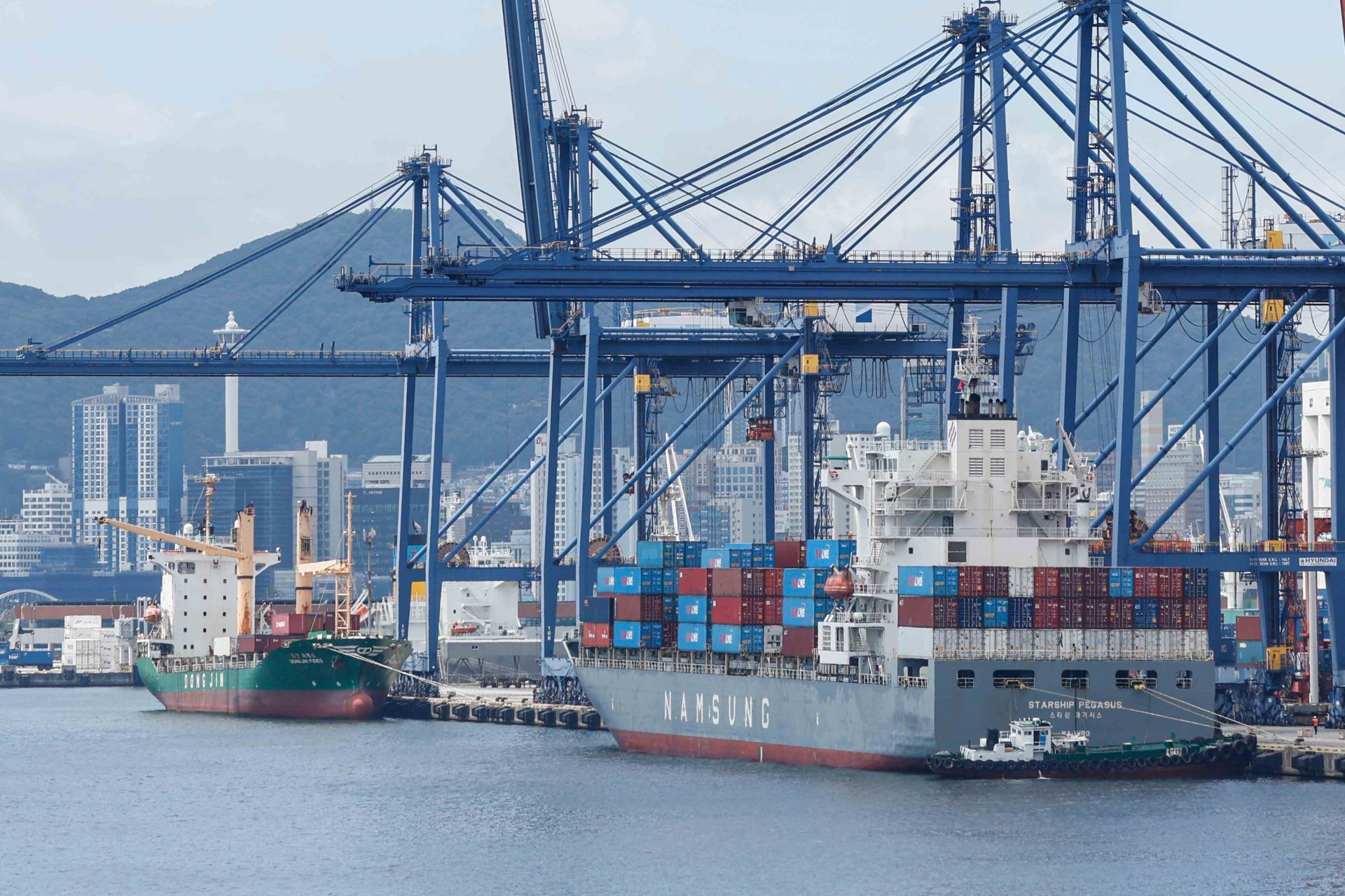
Steel products are piled up at Pyeongtaek Port in Pyeongtaek City, Gyeonggi Province. Yonhap News
원본보기 아이콘When comparing competitiveness by sector, China has already overtaken Korea in terms of price competitiveness and productivity, and respondents indicated that China is likely to surpass Korea in brand value by 2030 as well. The Federation of Korean Industries explained that, given the pace of technological innovation in China, the brand competitiveness of Korean companies could also be threatened.
'K-Brand' Value Also Under Threat... Companies Counter with Hundreds of Trillions in Investment
A separate survey of companies that identified China as their biggest competitor showed that, as of this year, China’s competitiveness compared to Korea by sector was as follows: price competitiveness (130.7), productivity (120.8), government support (112.6), skilled workforce (102.0), core technology (101.8), and product brand (96.7). By 2030, China was projected to overtake Korea in all areas: price competitiveness (130.8), productivity (123.8), government support (115.1), skilled workforce (112.4), core technology (111.4), and product brand (106.5).
Companies point out that, given the rapid pace of technological innovation in China, it will be difficult to maintain the gap with the current manufacturing and technological systems alone. The recent decisions by Samsung, SK, Hyundai Motor, and LG to invest hundreds of trillions of won in domestic semiconductors, AI, robotics, and other sectors as follow-up investments after Korea-US tariff negotiations are seen as part of efforts to keep China in check. Many experts believe that, considering the pace of China’s catch-up, quantitative investment in next-generation industries such as high-bandwidth memory (HBM), all-solid-state batteries, AI data centers, and robotics will be essential to secure an overwhelming lead. Professor Yoo Hoejoon of the Department of Electrical and Electronic Engineering at KAIST analyzed, "It is important to connect technology to industrialization," and added, "Expanding quantitative investment will increase the likelihood of maintaining a significant lead."
-
Reporter Jang Heejun junh@asiae.co.kr
-

Reporter Park Joonyi giver@asiae.co.kr
-
Edit Lee Kijae happylee17@asiae.co.kr
© The Asia Business Daily(www.asiae.co.kr). All rights reserved.