'Gyeongju Under the Sea' Off the Coast of Taean

Underwater Excavation Survey Status Map of Taean Mado Waters. National Institute of Maritime Heritage
원본보기 아이콘New traces of an ancient ship, believed to have sunk hundreds of years ago, have been discovered off the coast of Taean, Chungnam-an area often referred to as the 'Gyeongju Under the Sea.' Attention is now focused on whether another 'time capsule' that has been submerged for centuries will be opened.
On November 10, the National Institute of Maritime Cultural Heritage announced, "While investigating the Mado sea area in Taean, we found traces of a ship that appears to have sunk while transporting grain and ceramics."
The Most Treacherous Section of the West Sea 'Mado Sea Area'

The Mado sea area has long been considered the most treacherous section among the coastal routes of the West Sea. During the Goryeo and Joseon dynasties, it was a passage for ships heading to the capital. The area is notorious for its strong currents and numerous reefs, which have caused many ships to sink. According to the Annals of the Joseon Dynasty, about 200 vessels were wrecked in the Anheungnyang area of Taean over a period of roughly 60 years, from 1392 to 1455.
850-Year-Old Goryeo Dynasty 'Celadon Cluster' Discovered

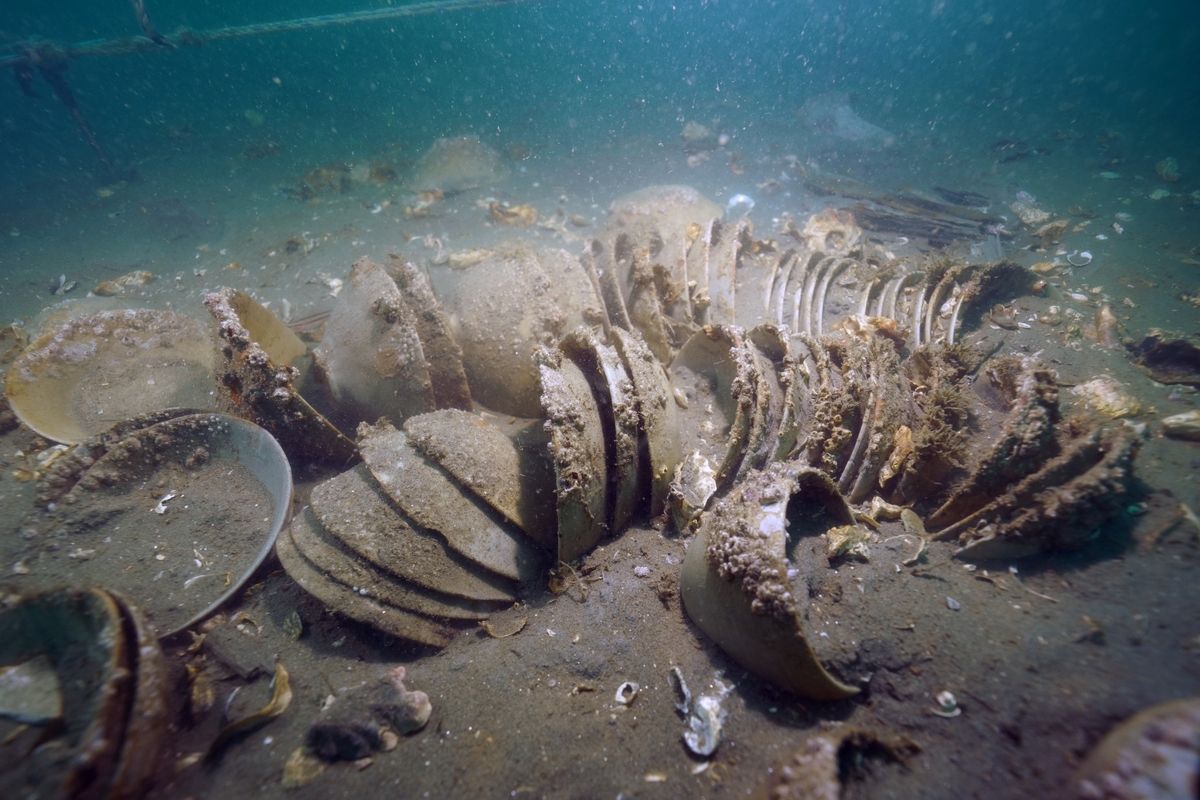
The institute detected new shipwreck traces while surveying the seabed using sonar equipment. Upon confirmation by divers, two bundles of celadon (87 pieces in total) were discovered, along with a wooden anchor, ropes, rice seeds, pieces of the hull, and log cargo supports.

Blue and white porcelain set (plates, bowls, cups) discovered off the coast of Taean. National Maritime Heritage Research Institute.
원본보기 아이콘
Close-up photo of a blue and white porcelain (flower pattern) National Maritime Heritage Research Institute.
원본보기 아이콘The excavated celadon consists of 65 plates, 15 bowls, and 7 cups. The institute stated, "Based on the shape and patterns of the celadon, it is estimated to have been produced during the Goryeo Dynasty, around 1150 to 1175."
'Mado Line No. 5' Could Be Next
The institute is focusing on the possibility that these artifacts could indicate the presence of another ancient ship, dubbed 'Mado Line No. 5,' lying dormant in the Mado sea area. An official explained, "The composition of the artifacts is similar to those found on Mado Line No. 1 and No. 2, so there is a high possibility that a new shipwreck is buried here."
Between 2009 and 2011, the Mado Line No. 1 to No. 3, believed to be Goryeo Dynasty ships, were discovered in the Mado sea area, followed by Mado Line No. 4 in 2014. Scholars estimate that these ships sank around 1208, 1210, and between 1265 and 1268, respectively.
The institute plans to conduct a detailed excavation next year based on the newly acquired data. The institute explained, "If the new Mado Line No. 5 is confirmed, it will be the oldest Goryeo Dynasty shipwreck discovered in the Mado sea area of Taean."

Meanwhile, last month the institute completed the salvage of the hull of 'Mado Line No. 4,' a Joseon Dynasty ship. A large quantity of grain, a wooden tag inscribed with 'Najugwangheungchang,' and buncheong ware were found on board, indicating it was likely a grain transport vessel. Radiocarbon dating revealed it sank around 1420, and it is the first ancient Korean ship on which evidence of iron nail usage has been confirmed.
Currently, the hull fragments have been moved to the Taean Conservation Center, where they are undergoing desalination, hardening, and drying processes. Preservation is expected to take several years to complete.
-

Reporter Park Jisoo parkjisu09@asiae.co.kr
-
Edit Lee Seonju sjlee109@asiae.co.kr
© The Asia Business Daily(www.asiae.co.kr). All rights reserved.
!["Please Help Us": How Much Do Those Bowing Deeply for Your Vote Really Earn? [Data Pick]](https://cwcontent.asiae.co.kr/asiaresize/323/2026052010120870131_1779239528.png)