Liquor Businesses Restricted from Registering as Merchants
No Limitations on Product Categories for Wholesale/Retail Registration
A "Liquor Mecca" Emerges Within Traditional Market Marts
Government Budget Paradoxically Subsidizes Luxury Consumption
"World whiskies all in one place! The lowest prices on various whiskies! Beware of sold-out items!"
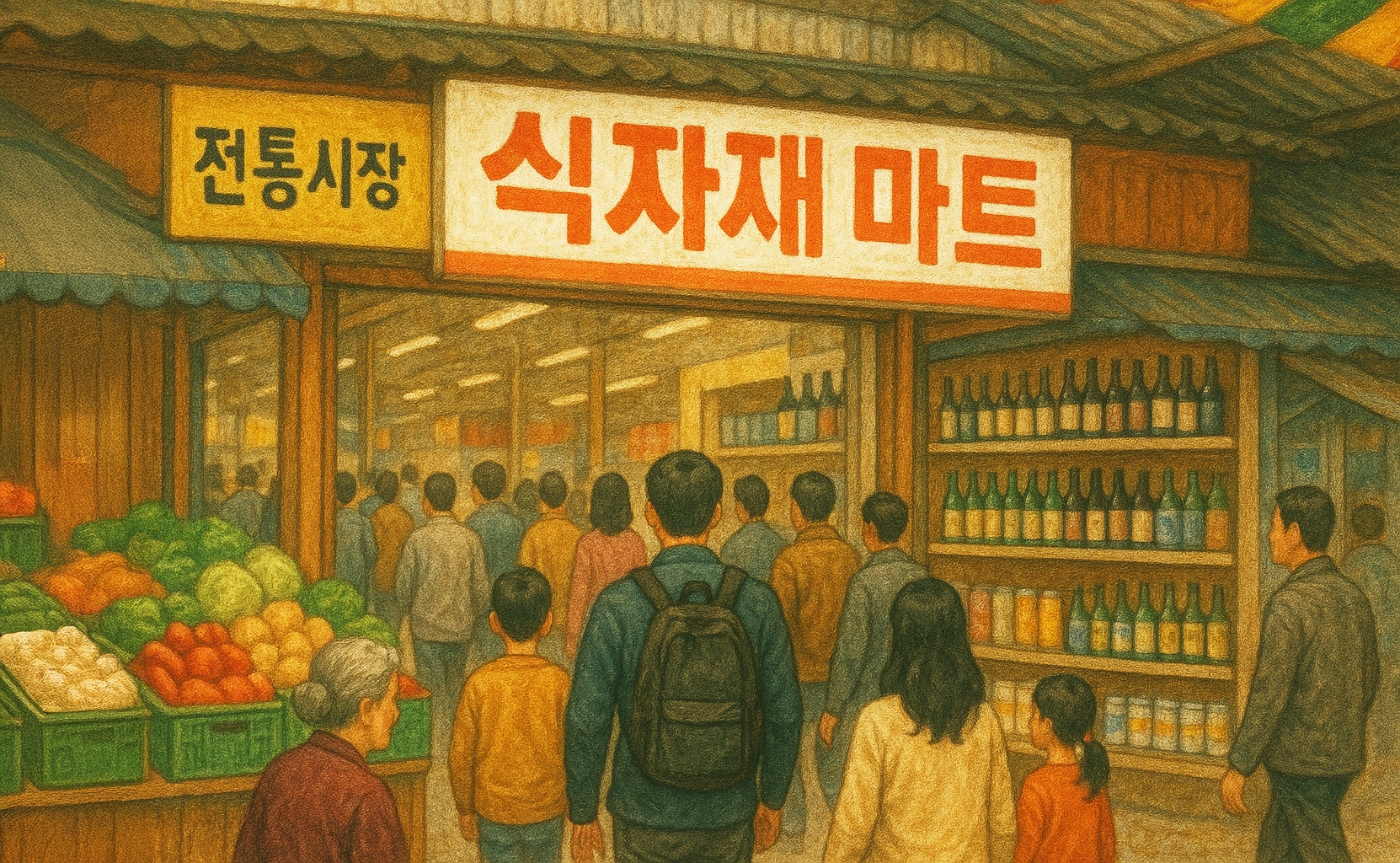
At J Mart, located inside a traditional market in Gwangjin-gu, Seoul, signs at the entrance advertising "Onnuri Gift Certificates Accepted" and "Lowest Price Guarantee on Whisky" immediately caught the eye. As the automatic doors slid open, customers were greeted first by high-end champagne. Shelves lined with hundreds of varieties of wine and whisky dominated the center of the store.
An office worker from the neighborhood, who said, "I often stop by after work because the prices are so low," purchased three bottles of Scotch whisky that day: Lagavulin 8 Years, Glenfiddich 15 Years, and Balvenie 12 Years DoubleWood.

A liquor corner in a food ingredient mart in Seoul, known as the "Mecca of Imported Alcohol," thanks to discounts on Onnuri gift certificates.
원본보기 아이콘He explained, "The lowest price for Lagavulin 8 Years on DailyShot (an online liquor purchasing platform) is 75,000 won, but here I can buy it for 62,200 won and get an additional 10% discount with Onnuri Gift Certificates. On top of that, there are extra 5% cashback promotions and store mileage point events, making the discounts even greater."
This mart has rapidly expanded since the COVID-19 pandemic, gaining a reputation as a "whisky mecca."

At the entrance of a food ingredient mart in Seoul, known as the "Holy Land of Imported Liquor" due to discounts on Onnuri gift certificates.
원본보기 아이콘According to NICE Information Service on the 5th, J Mart's sales last year reached 33.96 billion won, a 33.5% increase from 25.44 billion won the previous year and a 56.9% jump compared to 21.65 billion won two years ago. Operating profit also soared to 1.29 billion won last year, up 143.9% from 530 million won the previous year. Total sales, including liquor, have shown remarkable growth, thanks to attractive pricing driven by various discount benefits.
J Mart is not alone. Six food material marts in the Seoul metropolitan area, including M Mart in Ilsan, Goyang, Gyeonggi Province, have emerged as key liquor retailers among enthusiasts. At the heart of these food material marts, which have become known as the "Holy Land of Imported Liquor" in traditional market alleys, is the Onnuri Gift Certificate.
Original Purpose of Supporting Small Businesses Undermined... Distortion in the Liquor Market
Onnuri Gift Certificates are market-exclusive vouchers issued by the Ministry of SMEs and Startups and the Small Enterprise and Market Service since 2009, under the "Special Act on the Promotion of Traditional Markets and Shopping Districts" (Traditional Market Act), to boost sales in traditional markets and commercial districts and revitalize local economies.
Onnuri Gift Certificates are divided into paper vouchers and online vouchers (Digital Onnuri). The paper type can be purchased up to 500,000 won per month at a 5% discount, while Digital Onnuri Gift Certificates can be charged and used at a 10% discount, with a maximum balance of 1 million won. In practice, using Onnuri Gift Certificates allows customers to buy liquor at a basic 10% discount. During holidays like Lunar New Year and Chuseok, discounts can rise to 15%, and "payback events" returning about 10-15% of the purchase amount are frequently held.

The emergence of "liquor meccas" fueled by discounts from Onnuri Gift Certificates, originally intended to revitalize traditional markets and neighborhood economies, is possible because there are no restrictions on what products can be purchased with the certificates-a legal blind spot. The current Traditional Market Act restricts merchant registration for certain business types, with liquor wholesale and retail being a primary example.
However, there are no specific regulations limiting product categories. As a result, as long as a business registers as a merchant under a non-restricted business type, customers can purchase any product at a discounted price using the certificates. Food material marts that are increasing liquor sales with Onnuri Gift Certificates are officially registered as "wholesale/retail/food and general goods stores" and are actively selling high-priced liquor.
Onnuri Gift Certificates Expanded to Tobacco and Obesity Drugs
This loophole in the system is drawing criticism for allowing high-priced luxury goods like liquor to be subsidized by government funds, which deviates significantly from the original intent of the program. Nevertheless, in September last year, the government further relaxed business type restrictions to promote the system. For example, tobacco wholesale/intermediary businesses and healthcare (hospitals, clinics, dental, and oriental medicine) were removed from the restricted business types.
As a result, the certificates are now being used to purchase tobacco and obesity treatment injections like Wegovy, leading to criticism that they have become a means for discounted tobacco purchases-placing a heavy burden on national health insurance spending-and a subsidy for diet products.

Due to these loopholes, a few businesses are reaping enormous profits, distorting the liquor market. Some food material marts are leveraging tax-funded price competitiveness and aggressively expanding, while nearby liquor retailers-restricted from registering as merchants-are losing their competitive edge and facing threats to their livelihoods. Although the original intent of the certificates was to support small businesses, the current situation is that gaps in the system are instead increasing the burden on small business owners in restricted sectors.
Most liquor retailers operating near food material marts report facing similar difficulties. Within a 3-kilometer radius of J Mart alone, there are 13 liquor retailers, and the number rises to 77 when including the six main food material marts. One business owner said, "We're selling the same products, but just because these marts are inside a traditional market, they enjoy unfair benefits. It feels like a form of reverse discrimination." He added, "A 10% price difference is never insignificant."
An industry insider commented, "The current system is essentially enabling some merchants to make excessive profits by allowing them to sell products at distorted prices with government support. Their operations are now having a nationwide impact, inflicting widespread damage not only on nearby small merchants but also on small-scale liquor retailers across the country."
Government Limits Onnuri Gift Certificate Usage to Stores with Less Than 3 Billion Won in Annual Sales

Amid criticism that some large businesses in traditional markets are unfairly benefiting due to the lack of a sales cap for merchants, the government announced in September a reform to limit Onnuri Gift Certificate merchant eligibility to small businesses with annual sales of 3 billion won or less. The government stated that by restricting usage to stores with annual sales below 3 billion won, about 10,000 stores-0.5% of the 200,000 merchants nationwide-would be affected, and this would naturally restrict high-priced luxury and specialty food businesses. This measure is currently pending in the National Assembly, sponsored by Assemblyman Lee Jaegwan.
However, there is skepticism among local merchants about the effectiveness of the government's stricter merchant criteria. Some large food material marts are already circumventing the regulations by "splitting up" their businesses and reducing store sizes to under 3,000 square meters. An industry insider said, "The problematic stores are likely to maintain their merchant status through legal entity separation and other means. The sales cap may need to be lowered even further."
Restricting eligible product categories is also considered impractical. With merchants selling a variety of items, it is nearly impossible to limit payment methods for specific products. For example, if a customer buys both liquor and groceries at a food material mart, it is virtually impossible to require separate payment methods for the liquor only.
An official from the Ministry of SMEs and Startups said, "Whether merchants sell liquor or obesity treatment drugs in their stores ultimately depends on the merchant's duty of care. It is difficult to monitor usage restrictions by product category in real time." However, the official added that a review of which business types should be restricted or permitted for merchant registration is under discussion.
-

Reporter gooeunmo@asiae.co.kr
-
Edit Choi Yujeong yjchoi@asiae.co.kr
© The Asia Business Daily(www.asiae.co.kr). All rights reserved.
!["Please Help Us": How Much Do Those Bowing Deeply for Your Vote Really Earn? [Data Pick]](https://cwcontent.asiae.co.kr/asiaresize/323/2026052010120870131_1779239528.png)