A young general from the highest ranks of Silla passed away 1,600 years ago.
The attendant who was beside the general had to die to serve his master even in the afterlife.
The attendant's place was the burial box where grave goods were kept. It was a cramped space where one could not even lie down properly.
First Discovery of 'Human Remains'... Even Death Was Governed by Order

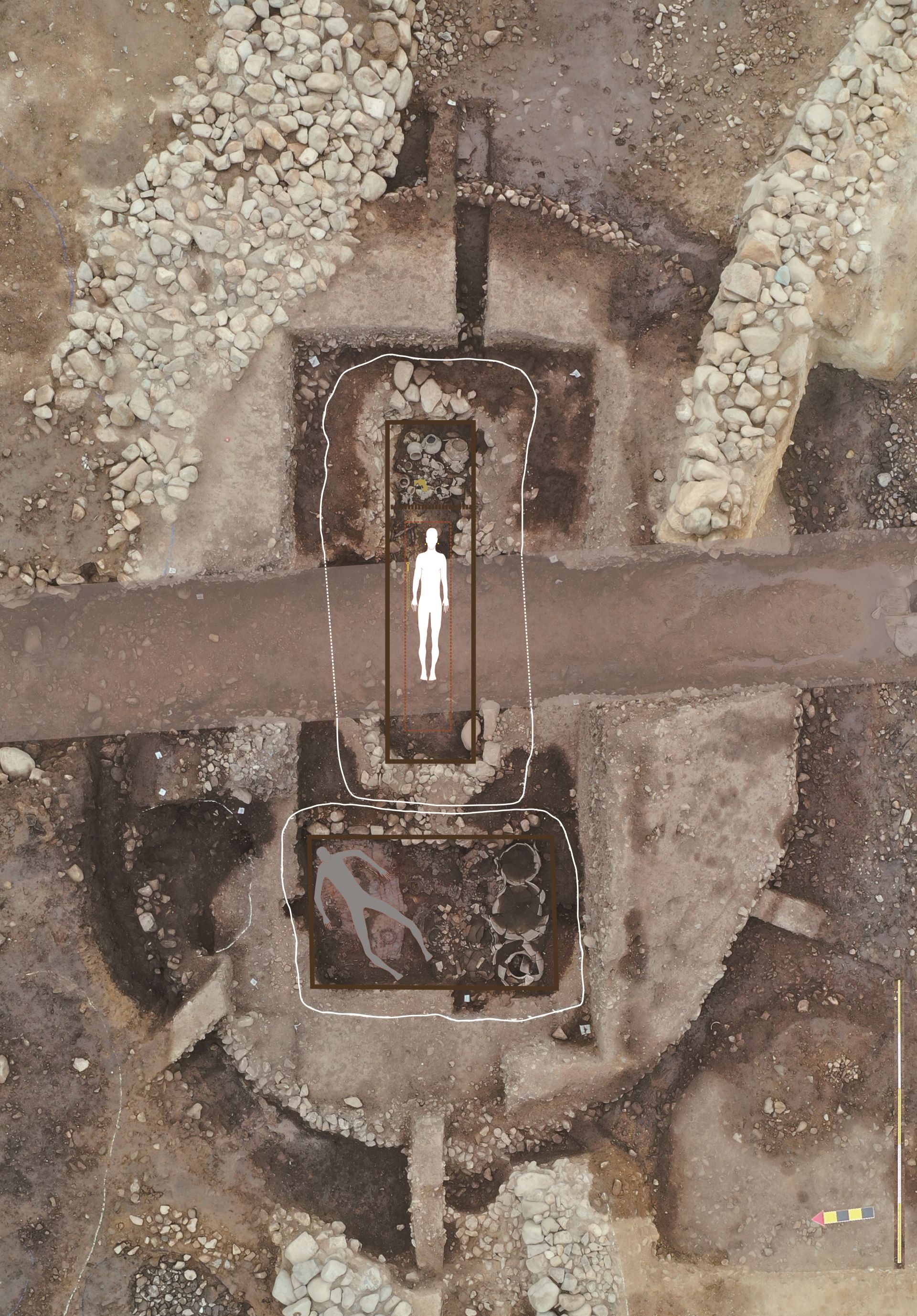
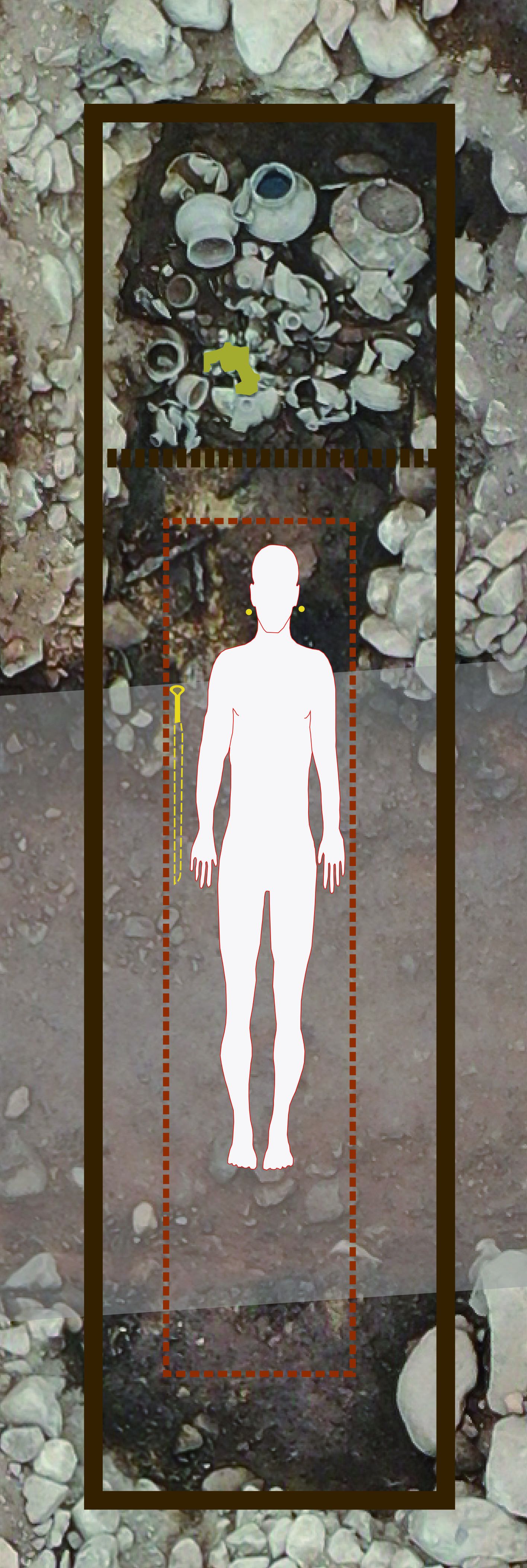
Unlike the owner who was buried in an extended position, the sacrificial victim in the Gyeongju Hwangnam-dong No. 1 wooden coffin tomb was buried in a diagonal posture with legs spread apart.
원본보기 아이콘The National Heritage Administration made the first public disclosure of the 'Gyeongju Hwangnam-dong No. 1 Wooden Coffin Tomb' on October 20. At the time of excavation, human remains were found in the subsidiary coffin, buried with legs spread apart. It is presumed to be a retainer of the Silla general who was laid to rest in the main coffin. A single gold earring remained on the head.
"The body was laid diagonally, arms spread, and the legs were also splayed in an 'O' shape."
This is how Lee Minhyeong, team leader at the Silla Cultural Heritage Research Institute, described the scene.
This is the first time that the actual bones of a sacrificial victim have been confirmed. According to the Samguk Sagi, Silla had a custom of human sacrifice, but it was banned during the reign of King Jijeung (500-514). No actual human remains had ever been found before, as the bones had all decayed and disappeared.
How Was It Discovered After '1,600 Years'?

Armor and helmet of a person excavated from the sub-chamber of Wooden Coffin Tomb No. 1 in Hwangnam-dong, Gyeongju
원본보기 아이콘The same applies to the owner of this tomb. Only teeth and some bones remain. However, the sacrificial victim was buried on top of horse armor, which allowed the oxidized iron to combine with the bones and preserve the remains. However, due to the poor state of preservation, it was not possible to accurately estimate the gender or age at the time of death.
Unusual 'O-Shaped' Leg Position... Evidence of a Planned Death

Excavation view of burial goods and sacrificial human bones from the subsidiary coffin of Wooden Coffin Tomb No. 1 in Hwangnam-dong, Gyeongju
원본보기 아이콘Kim Heonseok, curator at the National Gyeongju Research Institute of Cultural Heritage, described the sacrificial burial as "evidence of a planned death." "The space for the subsidiary coffin was dug in advance, grave goods were arranged, and then, at the final stage, the sacrificial victim was placed inside. However, the space was so cramped that a fully extended burial was not possible, resulting in a diagonal posture with the legs spread apart. While the sacrificial burial itself was planned, it is possible that the exact location and manner of burial were decided later."
In other words, due to the lack of space, the body of the sacrificial victim was wedged between the grave goods. For this reason, it was determined to be a post-mortem sacrificial burial, not a live burial. The deceased was not buried alive, but rather, a body that had already lost life was consciously laid to rest. Kim Heonseok emphasized the significance: "The fact that the body was buried with legs spread apart is not just a matter of posture, but provides a clue to how that society dealt with death."
Who Was the Owner of the Tomb?


The tomb was constructed between the late 4th and early 5th centuries. The owner of the tomb is identified as a man in his early 30s, wearing parts of a gilt-bronze crown and a large sword. He is presumed to have been a Silla heavy cavalry commander. Lee Minhyeong explained, "Considering the presence of parts of a gilt-bronze crown engraved with patterns used in early Silla, lightweight armor worn by commanders or higher ranks, horse armor, a pair of gold earrings, and a large sword, it is highly likely that this individual held a very high social status and performed a military role."
The fact that a sacrificial victim was buried alongside him indicates that the hierarchical relationship between lord and retainer continued even after death. Death, in this context, served as a mechanism for maintaining order rather than marking the end of an individual. Shim Hyuncheol, professor of history at Keimyung University, interpreted this as "a symbolic scene that reveals the true nature of Silla's power structure." "Although historical records state that human sacrifice was banned, there were almost no actual cases. This excavation is the first to provide tangible evidence of sacrificial burial, and is significant in that it visualizes the power relations of the time through funerary rituals."
In the end, sacrificial burial was a tool of governance for the Silla ruling class.
When the lord died, his retainers were buried with him, thus completing the order of power through death. Although they lay in the same tomb 1,600 years ago, one was the master, while the other was the subject of ritual. The remnants of that order still remain in the soil today.
!["Please Help Us": How Much Do Those Bowing 90 Degrees These Days Actually Earn? [Data Pick]](https://cwcontent.asiae.co.kr/asiaresize/323/2026052010120870131_1779239528.png)