Differences Over U.S. Investment Fund Approach, Trump Stresses "Up Front" Payment
"100% Tariff on All Pharmaceuticals Except for Companies Building Factories in the U.S. Starting October 1"

President Lee Jae-myung and U.S. President Donald Trump are holding a summit at the White House in Washington DC, USA, on the 25th of last month (local time). 2025.8.26 Yonhap News Agency
원본보기 아이콘Why Is Trump Emphasizing "Up Front" Payment Amid an Already Difficult Situation?
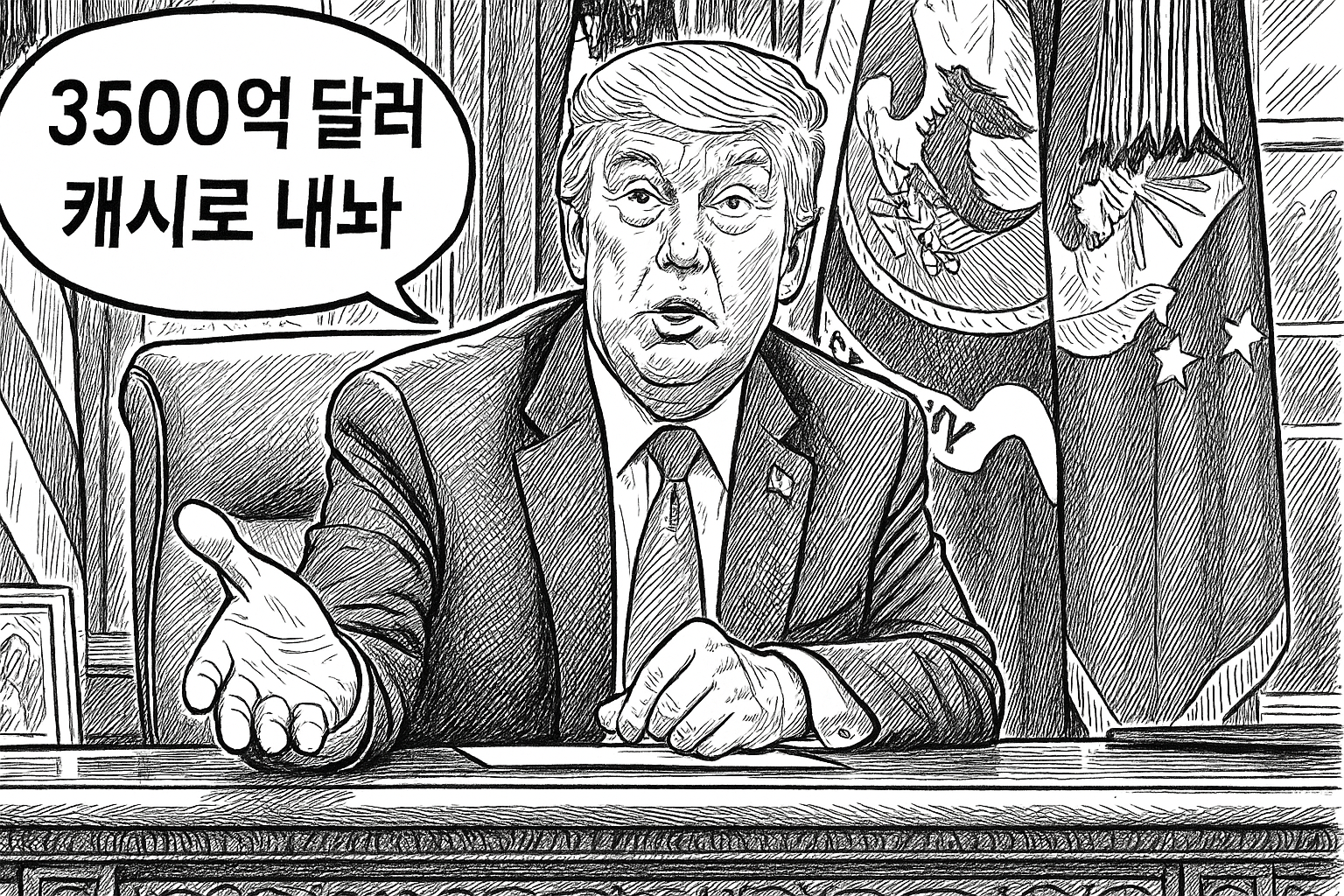
On September 25 (local time), U.S. President Donald Trump referred to the $350 billion (about 493 trillion won) investment fund that Korea has agreed to invest in the United States, stressing, "That is up front." This remark is interpreted as an attempt to pressure Korea into agreeing to the terms preferred by the United States, by suddenly making "up front" payment a prerequisite for tariff reductions, at a time when negotiations have stalled due to differences between the two countries over how the investment should be implemented.
Adding to this, local media reports that the United States has demanded Korea increase its investment have raised concerns that trade negotiations between the two countries could become even more challenging.
After signing an executive order at the White House regarding the sale of the U.S. operations of the Chinese video platform TikTok, President Trump told reporters, "We were not treated properly by other countries during the four years of the previous Joe Biden administration, but now things are going well. We've never done this well before."

On the 12th, Korean workers who had been detained in Georgia by U.S. immigration authorities returned home, and a civic group holding a banner with the face of U.S. President Donald Trump protested at the arrival hall of Terminal 2 at Incheon International Airport. 2025.9.12 Yonhap News Photo by Yonhap
원본보기 아이콘Trump Boasts, "Japan Is Providing $550 Billion, Korea $350 Billion"
He stated that trade negotiations with several countries, including China, are progressing smoothly, saying, "Tariff revenues are coming in and new agreements are being signed," and emphasized, "In some cases, $950 billion is coming in."
He then mentioned Korea and Japan, saying, "As you know, $550 billion is coming from Japan and $350 billion from Korea," adding, "This is up front." He stressed, "We are earning enormous amounts through tariffs, on an unprecedented scale."
The $950 billion figure cited by President Trump appears to refer to the case of the European Union (EU). Howard Rutnick, the U.S. Secretary of Commerce who led the trade agreements with Korea and Japan, previously announced a plan to create a U.S. National Economic Security Fund using foreign investment, which would then be used to rebuild domestic infrastructure.

Trump's Signature Strategy: Using Pressure to Drive a Deal
President Trump's remarks came as the two countries have failed to narrow their differences over the $350 billion investment fund, a key issue in recent U.S.-Korea trade negotiations. In particular, his mention of "up front" payment is seen as a move to increase pressure on Korea and force an agreement on investment implementation in the way the United States wants.
At the end of July, the two countries agreed that the United States would lower reciprocal and auto tariffs on Korean imports to 15%, in exchange for Korea investing $350 billion in the United States. However, the two sides are at odds over the method of investment: the United States prefers direct investment, while Korea favors a guarantee and loan-based approach. As a result, the United States continues to impose a super-high tariff of 25% on Korean automobiles. In contrast, the 15% tariff reduction on automobiles from Japan and the European Union has already taken effect under their respective trade agreements.
The Korean government has requested a Korea-U.S. currency swap agreement, arguing that a large-scale cash investment could shock the foreign exchange market. President Lee Jaemyung, who visited New York for the United Nations General Assembly High-Level Week, also met with U.S. Treasury Secretary Scott Besant the previous day to directly explain the need for a currency swap agreement. However, it is reported that the U.S. side remains negative on this issue.

President Lee Jae-myung is meeting with U.S. Treasury Secretary Janet Yellen at the Permanent Mission of the Republic of Korea to the United Nations in New York, USA, on the 24th (local time). 2025.9.25 Photo by Yonhap News
원본보기 아이콘Foreign Media: "Trade Negotiations Are Unstable"... No Clear Path Forward
Meanwhile, The Wall Street Journal (WSJ) reported that Secretary Rutnick has requested Korea to slightly increase its U.S. investment amount from the previously agreed $350 billion. The outlet reported that the two countries are at odds, stating, "Trade negotiations with Korea are on shaky ground."
On the same day, President Trump announced on his social media platform Truth Social that, "Starting October 1, 2025, a 100% tariff will be imposed on all branded or patented pharmaceuticals, except for companies that are building pharmaceutical factories in the United States." He added, "'Building' is defined as 'breaking ground' and 'under construction,' so if construction has started, those pharmaceuticals will not be subject to the tariff."
Prior to his recent state visit to the United Kingdom, President Trump compared automobiles, semiconductors, and pharmaceuticals subject to tariffs, and stated that higher-margin items could face higher tariffs.
He also announced new tariffs on furniture and trucks. Starting next month, a 50% tariff will be imposed on kitchen cabinets, bathroom vanities, and related products, and a 30% tariff on upholstered furniture such as sofas covered in fabric or leather. In addition, a 25% tariff will be imposed on large trucks.
-
Reporter Kwon Haeyoung roguehy@asiae.co.kr
-
Reporter Oh Suyon syoh@asiae.co.kr
-
Edit Sung Kiho kihoyeyo@asiae.co.kr
© The Asia Business Daily(www.asiae.co.kr). All rights reserved.
!["Please Help Us": How Much Do Those Bowing 90 Degrees These Days Actually Earn? [Data Pick]](https://cwcontent.asiae.co.kr/asiaresize/323/2026052010120870131_1779239528.png)