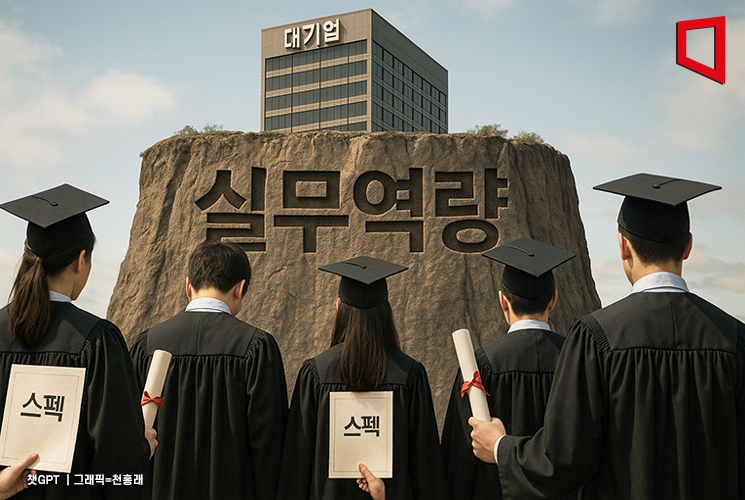
Major domestic companies have diagnosed that university education and the college admissions system are failing to keep pace with the workforce demands of the industrial sector. Due to insufficient cultivation of talent with creativity and practical skills, a structure has taken hold in which extensive retraining is inevitable before graduates can be deployed to the field. As a result, the mismatch in the youth job market is intensifying, and the burden on corporate competitiveness is increasing. In particular, there is a strong demand for universities to supply creative talent to companies.
Survey of Top 30 Companies: Only 6.7% Say University Education Nurtures Ideal Talent
According to a survey conducted by Asia Economy from September 15 to 19, 2025, targeting HR and recruitment managers at the top 30 domestic companies, only 2 companies (6.7%) responded that "university education contributes to nurturing the ideal talent needed by companies." Of the remaining 28 companies (93.3%), 19 (63.3%) said it was "average," while 9 (30.0%) evaluated it as "not helpful." This suggests that the mismatch between university education and industrial workforce demand is becoming entrenched.
Most Say College Admissions System Is Ineffective... Uniform Selection Process Is an Obstacle
Perceptions of the college admissions system were not much different. Not a single company responded that "university admissions contribute to nurturing the talent needed by companies." Nineteen companies (63.3%) said it was "average," nine (30.0%) said it "does not contribute," and two (6.7%) said it "contributes not at all." The uniform, score-centered selection process fails to reflect students' aptitudes and abilities in detail and is even seen as an obstacle to selecting talent with creativity and practical skills. There is an interpretation that the emphasis on fairness in admissions has resulted in a structural problem in the education system, preventing it from reflecting the diverse abilities required by industry.
The gap between universities and the field was also evident in the evaluation of major-related competencies. While 20 companies (66.7%) indicated that their workforce needs are concentrated in science, engineering, and information technology, only 6 companies (20.0%) believed that graduates' major-related abilities are immediately applicable in the field. In contrast, 23 companies (76.7%) answered "average," highlighting that the knowledge acquired at university does not directly align with industry requirements.
Over a Year of Retraining Needed Before New Hires Can Be Deployed: "Lack of Practical Skills"
The time required before new hires can be independently deployed to the field was also lengthy. Half of the responding companies, 15 (50.0%), said "about one year of retraining and training is needed," while 10 (33.3%) said "it takes more than two years." Responses indicating that at least one year of retraining is necessary accounted for 83.3% of the total, revealing that a university diploma does not immediately guarantee job performance. For young people, this means they must undergo a lengthy adjustment process even after employment, raising concerns that this could lead to career interruptions and reduced labor efficiency.
The main areas where retraining is concentrated are "problem-solving and project execution abilities" (14 companies, 46.7%) and "basic practical skills" (10 companies, 33.3%). This indicates that while students may learn major-related knowledge at university, they lack basic abilities such as solving complex tasks encountered in actual work or operating equipment and programs. Some companies directly criticized university education, saying, "University education still focuses too much on exams and theory, so students do not gain real problem-solving experience."
If There Is No Shift Toward 'Practical Education,' the 'University Is Useless' Debate Will Spread
Companies emphasized that fundamental changes in university education are necessary to overcome these limitations. An HR manager at a large corporation said, "It is not enough to have solid major knowledge; practical, work-oriented education that can be immediately applied in the field must be strengthened," adding, "It is necessary to systematically cultivate problem-solving and collaboration skills through company-linked field training." Another company official pointed out, "University education remains stuck in past theories and fails to foster creative problem-solving abilities," and stressed, "Education should be changed so that students can understand industry trends and real company needs, and prepare for essential qualities such as character and leadership for organizational life."
This survey revealed that Korean universities, by focusing on academic achievement, are failing to play their part in nurturing talent that meets social and industrial needs. If the gap with industry is not resolved, young people will inevitably have to undergo lengthy retraining even after employment, and the burden on companies will increase further. If this structure persists in the long term, it is highly likely to negatively impact national competitiveness. Especially as corporate competition intensifies on the global stage, if universities do not shift to education that combines creativity and practical skills, the "university is useless" debate will only spread further.
Experts believe that as the pace of industrial change has become much faster than in the past, delays in education can have more fatal consequences.
The skills required in new industries change rapidly even within 2 to 3 years, but university curricula have not significantly deviated from systems that are decades old.
There are also clear structural limitations, such as the long time it takes to revise curricula and the gap between faculty research topics and the technologies demanded by the industry.
In particular, for core industries like artificial intelligence (AI), semiconductors, and biotechnology, rapid technological catching-up is directly linked to corporate survival, but universities are still bound by traditional major frameworks and lack flexibility, which is widely criticized.
A CEO of a major domestic conglomerate emphasized, "The gap between education and industrial demand is not simply a matter of teaching methods, but stems from a lack of collaborative structures," adding, "Since a degree alone is not enough to adapt to the industrial field, universities must change to a structure where they can develop practical skills together with companies."
Overseas Universities Recognize Company Projects for Credit... Domestic Internships Remain Short-Term Experiences
Leading overseas universities are actively addressing this issue by strengthening industry-academia cooperation. Some universities in the United States and Europe recognize company projects as regular credits from the undergraduate level and require at least six months of field experience before graduation. These educational systems are designed so that students can be immediately deployed to jobs upon graduation, which is a stark contrast to the rigid structure of Korean universities. In Korea, internships are often optional and short-term, making it difficult for students to accumulate the practical skills demanded by companies.
Park Namgi, honorary professor at Gwangju National University of Education, said, "Universities need to foster basic competencies that can be used in any company, while also operating systems such as 'track programs,' which allow students to combine multiple majors, and 'micro-degree programs,' which enable small groups to focus intensively on specific fields."





!["A Country That Undervalues Talent: Patriotism Alone Can't Stop the Exodus"...Professors Leaving Korean Universities [The Great University Transformation] ①](https://cwcontent.asiae.co.kr/asiaresize/251/2025092410555246390_1758678953.jpg)
![Fed Up With "Ranking by a Single Point": Talented Students Leave Korea for Vastly Different Opportunities and Salaries [University Transformation] ②](https://cwcontent.asiae.co.kr/asiaresize/251/2025091811395338624_1758163193.jpg)
![Korean Universities Losing Competitiveness... Global Rankings Continue to Fall [University Transformation] ③](https://cwcontent.asiae.co.kr/asiaresize/251/2023062616161476529_1687763773.jpg)
![[University Transformation] ⑤ Qualities HR Managers Seek in Talent: "Creativity, Communication, and Character Over Credentials"](https://cwcontent.asiae.co.kr/asiaresize/251/2025092508145247788_1758755691.jpg)
![[University Transformation] ⑥ Companies: "Practical Skills Over Theory... Seeking Customized Curricula and Long-Term Internships"](https://cwcontent.asiae.co.kr/asiaresize/251/2025092416383347375_1758699513.jpg)

!["Please Help Us": How Much Do Those Bowing 90 Degrees These Days Actually Earn? [Data Pick]](https://cwcontent.asiae.co.kr/asiaresize/323/2026052010120870131_1779239528.png)