Kia announced on September 3 that it has begun domestic pre-orders for the EV5, its electrified family sport utility vehicle (SUV). By using a ternary battery from China's CATL, the EV5 has managed to lower its actual purchase price to the low 40 million won range. In addition, to strengthen its appeal as a family car, Kia has introduced the 'Acceleration Limitation Assist' feature for the first time within the group to enhance driving safety, and has newly added a foldable table in the rear seats.

The previous day, Kia unveiled the product's key features and launch price at 'The Kia EV5 Media Day' held in Samseong-dong, Seoul. Jeong Wonjeong, Executive Vice President and Head of Kia's Domestic Business Division, stated, "With the launch of the EV5, Kia has completed its electric vehicle lineup and can now offer optimal choices that meet the diverse needs of everyone from single-person households to large families." The EV5 is equipped with an 81.4kWh NCM (nickel-cobalt-manganese) battery from CATL, providing a driving range of 460 kilometers on a single charge. The long-range version starts at 48.55 million won for the Air trim, 52.3 million won for the Earth trim, and 53.4 million won for the GT-Line trim. Considering government and local EV subsidies, the base Air trim can be purchased for just over 40 million won.
Son Yongjun, head of Kia's Domestic Product 1 Team, explained, "Domestic consumers have a high preference for NCM batteries, and to diversify the supply chain for stable battery supply, we considered global battery manufacturers in addition to the three major domestic battery companies." He added, "The price is set at a reasonable level between the EV4 and EV6, not only because the EV5 offers higher product value compared to the Chinese model (around 30 million won), but also to ensure appropriate positioning within our lineup."
The EV5 stands out for its significantly enhanced safety. In particular, the 'Acceleration Limitation Assist' feature, applied for the first time in Hyundai Motor Group vehicles, prevents sudden acceleration accidents caused by pedal misapplication. When driving below 80 kilometers per hour, if the driver presses the accelerator deeply and for an extended period, the system limits the speed. The function first issues a warning via a pop-up message, then follows with a voice alert, while restricting further acceleration.

Additionally, the 'Pedal Misapplication Safety Assist' feature, previously introduced in the Casper Electric, has also been adopted. This function limits acceleration if the driver mistakes the accelerator for the brake pedal when there is an obstacle in front or behind the vehicle at startup. Both safety features come standard on all EV5 trims.
The so-called 'brick phenomenon,' where the vehicle suddenly stops while driving, has also been addressed. In Hyundai and Kia electric vehicles, repeated issues such as vehicle stoppage, reduced output, and charging failure have occurred due to software errors in the integrated charging control unit (ICCU), causing consumer anxiety. Son explained, "While vehicles such as the EV6 with ICCU-related issues use an 800V system, the EV5 uses a 400V system with entirely different components and suppliers," adding, "We have improved on previous issues and enhanced design stability."


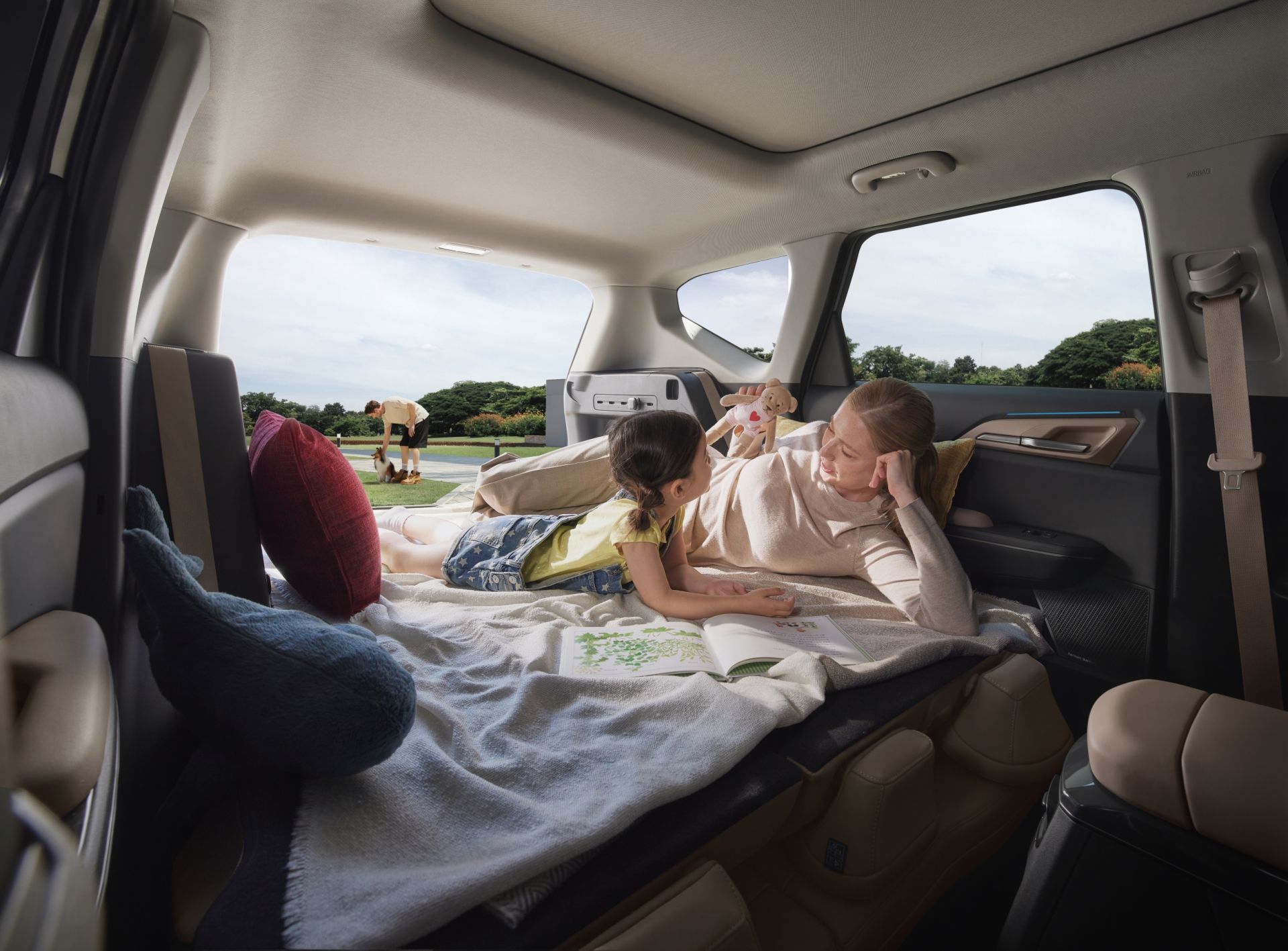
As a family car, the EV5's interior features stand out for their family-oriented convenience. The second row is equipped with a foldable table similar to those found on airplanes, enhancing practicality for light meals or snacks. The second row also features a full-flat function, allowing the seats to be fully flattened for comfortable rest during car camping or long-distance trips. There is a display theme where Disney characters appear on the in-car screen, and a 'pet mode' that automatically adjusts the cabin temperature for pets when the driver steps away.
However, the refrigerator feature, which first appeared in the 2023 Chinese model and drew attention in Korea, has been omitted. While the lower part of the center console in the Chinese version houses a built-in refrigerator with cooling and heating functions ranging from 5 to 50 degrees Celsius, the domestic EV5 features an expandable storage space in the center console instead. Son explained, "Unlike in China, the domestic market requires stricter quality and performance standards, so the refrigerator feature did not meet local criteria and was therefore designed differently."
-

Reporter Jun Youngjoo ange@asiae.co.kr
-
Edit Kim Hyunhee faith100@asiae.co.kr
© The Asia Business Daily(www.asiae.co.kr). All rights reserved.
!["Please Help Us": How Much Do Those Bowing 90 Degrees These Days Actually Earn? [Data Pick]](https://cwcontent.asiae.co.kr/asiaresize/323/2026052010120870131_1779239528.png)