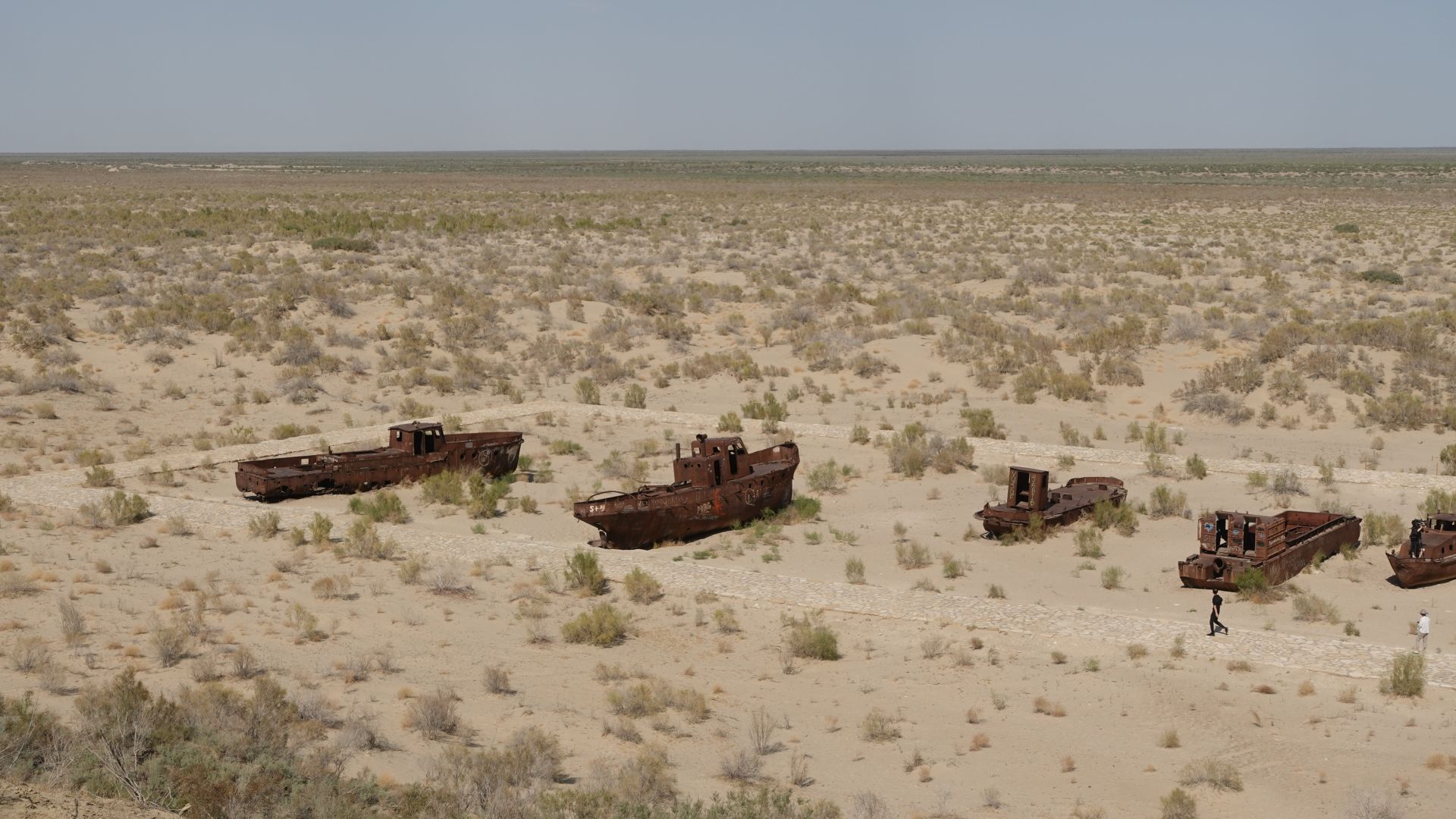
A vast sandy desert where the sun beats down so fiercely that it's difficult to even open your eyes. More than a dozen ships, their hulls rusted and scorched red after years under the blazing sun, are scattered incongruously across the landscape. The ground is completely parched. When you sift through the sand, you find tiny seashells mixed in. Here and there, you also spot dried, hardened salt crystals. These are the traces that show this place was once a lake as vast as the sea.
Aral Sea, 112 Times the Size of Seoul Due to Reckless Water Resource Development The World's 4th Largest Lake Turns into a Desert Collapse of Fisheries and Factory Closures... Residents Displaced Residents Losing Livelihoods Become Refugees
'A Super-Large Lake 112 Times the Size of Seoul Turns into Desert in Just Over 60 Years... The Tragedy of the Aral Sea'
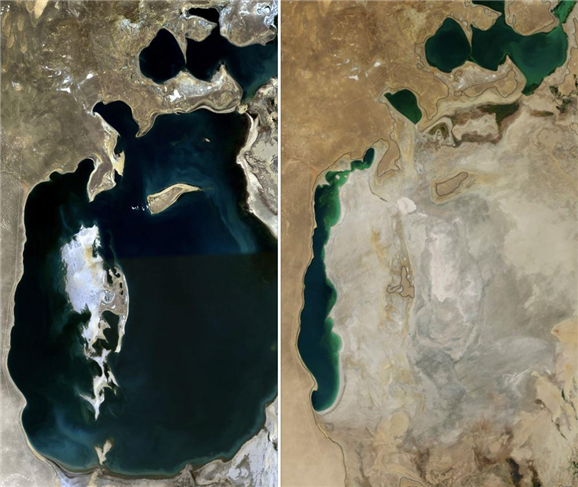
On August 12, 2025 (local time), we visited the Aral Sea located in Moynaq, an autonomous republic of Karakalpakstan in western Uzbekistan, bordering Kazakhstan. The Aral Sea was once the world's fourth largest inland lake, covering about 68,000 square kilometers-112 times the size of Seoul. However, since the 1960s, due to climate change and reckless water resource development, the water level has plummeted, and now only about 10% remains. The desertification has progressed to such an extent that the term "sea" is no longer appropriate, making it a symbolic site of climate crisis damage. The salt left behind by the dried-up Aral Sea is carried by sandstorms, spreading damage throughout Central Asia.
Shadinov Ali Orazbayevich, a 74-year-old lifelong resident of Moynaq, told reporters, "When I was a child, most of the local residents worked in the fishing industry," adding, "Moynaq was an island surrounded by water, and the air was so fresh that you could smell the sea even at home." He recalled, "We used to stack barrels with sturgeon and could even eat caviar."
In fact, Moynaq was once a thriving fisheries hub in landlocked Uzbekistan. According to Orazbayevich, it was so prosperous that caviar-a luxury ingredient-was distributed, and there were so many fish that three canning factories operated actively. However, as the Aral Sea dried up and salinity increased, nearly all fish except for a few microorganisms disappeared. Rapid desertification brought even worse droughts and heatwaves, turning the land into a barren area where not only fishing but even farming became difficult. All the canning factories closed after 1976, leading to a mass exodus. Both water and people vanished from the region.
Initially, about 1,100 ships were left stranded as the water level dropped, but as livelihoods became unsustainable, local residents dismantled and sold even the steel frames of the ships. The remaining dozen or so ships are now preserved by the Uzbek government. Orazbayevich also lost his livelihood and retired early; he now lives on a pension. However, since he sold the papers documenting his employment to a recycling company when he was younger, he does not receive the full pension he should for his years of work. These stories illustrate just how harsh life has become for residents who lost their homes to climate change.
KOICA and GGGI, 8.2 Billion Won Aid Project Developed and Spread Eco-Friendly Farming Methods Drip Irrigation System... Overcoming Water Shortage Mono Center as an Agricultural Education Hub Green Bond Issuance to Ensure Sustainability
Life Continues on Parched Land... Korea's ODA Project Supports 'Sustainable' Agricultural Technology
The Korea International Cooperation Agency (KOICA) has been running an aid project worth a total of 5.9 million dollars (about 8.2 billion won) since July 2021, in cooperation with the Global Green Growth Institute (GGGI), to support local residents who lost their livelihoods due to the desertification of the Aral Sea. The project develops and disseminates eco-friendly farming methods that use water as efficiently as possible and offers capacity-building programs for local farmers. In particular, the 'drip irrigation' system, which delivers water directly to desired spots through holes at regular intervals in irrigation pipes, has been a great help to the Aral Sea region, which suffers from severe water shortages. In Nukus, about three hours by land from the Aral Sea, the 'Mono Center'-an agency under the Ministry of Employment and Poverty Reduction of the Republic of Karakalpakstan-uses climate-smart agricultural training materials developed by GGGI.
Kundiz Kidirniyazova, who is engaged in agriculture with KOICA support at the Uzbekistan Mono Center, is being interviewed by the Ministry of Foreign Affairs press corps. [Joint coverage by the Ministry of Foreign Affairs]
Kundiz Kidirniyazova, a 37-year-old woman who learned agricultural technology such as greenhouse management and drip irrigation at the Mono Center, said, "I used to just water the crops and grow vegetables, but I learned about irrigation systems at the Mono Center. My farm used to be just a small plastic greenhouse, but now it's one hectare (about 3,025 pyeong), and my income has increased." Previously, she only took care of household chores and was merely interested in agriculture, but now she runs a company with 80 employees and exports tomatoes, cucumbers, and other produce to Russia.
The official development assistance (ODA) project funded by KOICA was carried out over four years and concluded in June 2025. Since ODA support can only be a temporary measure, GGGI supported the issuance of a total of 1.4 trillion won in commercial bonds by local banks in Uzbekistan to ensure the sustainability of the Aral Sea's eco-friendly restoration project. Lee Seungyeon, head of the GGGI Uzbekistan office, said, "Green bond issuance is the most important and innovative achievement," adding, "This capital will be invested long-term in green sectors, including eco-friendly agriculture, in Uzbekistan."
![Kundiz Kidirniyazova, who is engaged in agriculture with KOICA support at the Uzbekistan Mono Center, is being interviewed by the Ministry of Foreign Affairs press corps. [Joint coverage by the Ministry of Foreign Affairs]](http://www.asiae.co.kr/news/img_view.htm?img=2025082713493398642_1756270172.jpg)