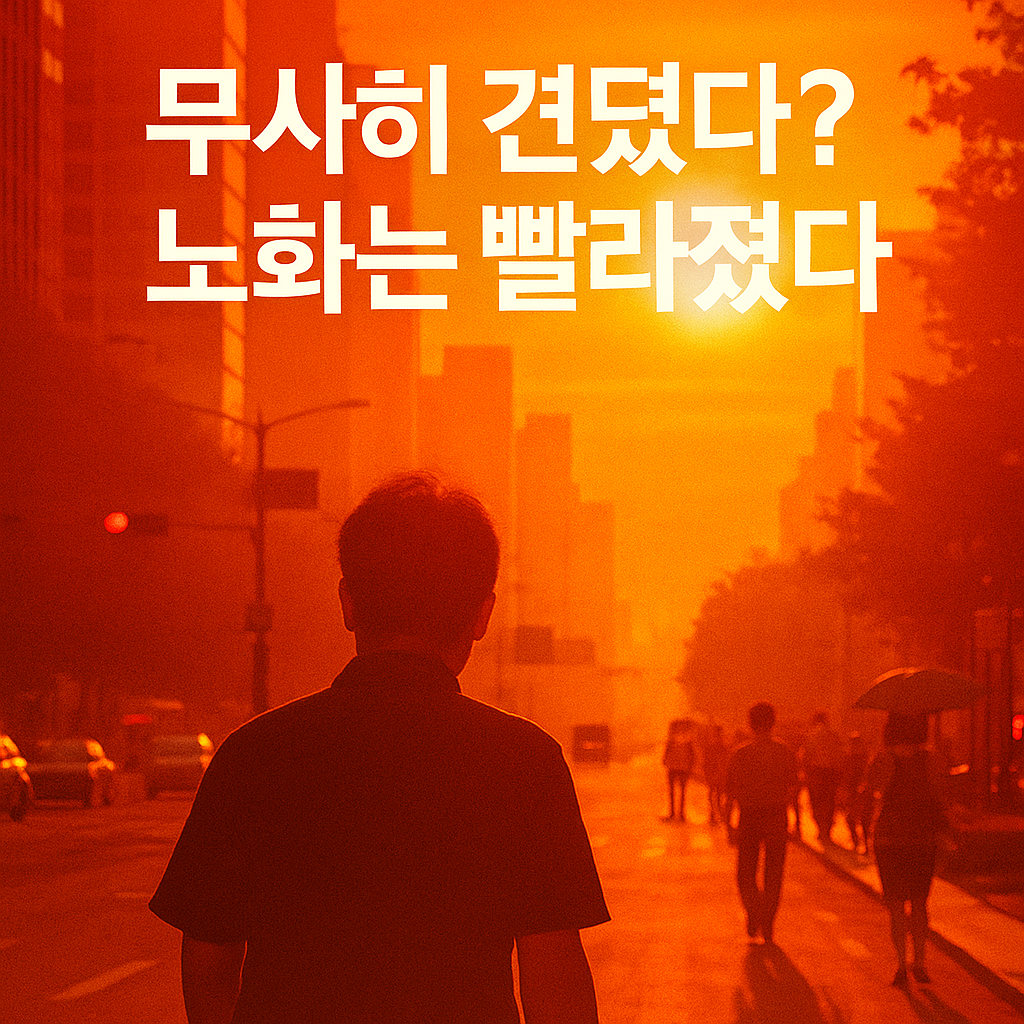

According to research, repeated exposure to heat wavesA heat wave is a phenomenon in which temperatures are significantly higher than the annual average for an extended period. According to the Korea Meteorological Administration, a "heat wave advisory" is issued when the maximum temperature is expected to remain at or above 33℃ for more than two days, and a "heat wave warning" is issued when the maximum temperature is expected to remain at or above 35℃ for more than two days. can cause the human body to experience 'accelerated agingAccelerated aging refers to a phenomenon in which biological aging progresses faster than normal due to repeated exposure to environmental factors such as heat waves. In other words, the decline in physical function occurs more rapidly than expected for one's actual age.'. This means that, beyond the immediate risks of shortness of breath and heatstroke, heat waves can have devastating effects on lifelong health.
Professor Guo Cui's research team at the University of Hong Kong
A large-scale study tracking 20,000 people over 15 years
The team found that when the period of heat wave exposure increased by the interquartile range (IQR), participants' biological age increased on average 8 to 11 days faster.
*Interquartile range: The range representing the middle 50% of data values

In particular, the researchers explained that for those whose number of heat wave days increased by just 4 days over two years, their biological age accelerated by an average of 9 days. But that's not all.
Outdoor workers
Regions with fewer air conditioners installed
Rural residents

Experts view these findings as more than just the immediate damages of heat waves. Since heat waves can lead to a decline in physical function and accelerate aging, they are interpreted as a long-term health risk.
Professor Guo Cui's warning
Evaluation by Professor Paul Beggs of Macquarie University, Australia
"Last year, a study found that childhood exposure to heat waves could harm brain development. This time, we've directly confirmed accelerated aging in adults," he said. "The effects of heat waves can impact people throughout their entire lives, regardless of age."
*Limitations of the study

Korea is no exception. This summer, with record-breaking heat waves and severe tropical nightsA phenomenon in which the minimum temperature stays at or above 25℃ overnight., the nation has seen a surge in heat-related illnesses and emergencies.
'Record-breaking heat wave' hits Korea
22 consecutive tropical nights in Seoul
Surge in illnesses caused by heat waves
-
Edit Maeng Jiae mjiae@asiae.co.kr
-

Reporter Park Eunseo rloseo8@asiae.co.kr
© The Asia Business Daily(www.asiae.co.kr). All rights reserved.
!["Please Help Us": How Much Do Those Bowing 90 Degrees These Days Actually Earn? [Data Pick]](https://cwcontent.asiae.co.kr/asiaresize/323/2026052010120870131_1779239528.png)