"Will You Take Responsibility If the Child Dies?"... Pediatric Emergency Rooms Only Admit After Outcry
Collapsing Small-Child Medical Care
"Will You Take Responsibility If the Child Dies?"... Pediatric Emergency Rooms Only Admit After Outcry
by Choi Taewon
by Choi Yujeong
Published 27 Aug.2025 14:28(KST)
Updated 28 Aug.2025 09:06(KST)
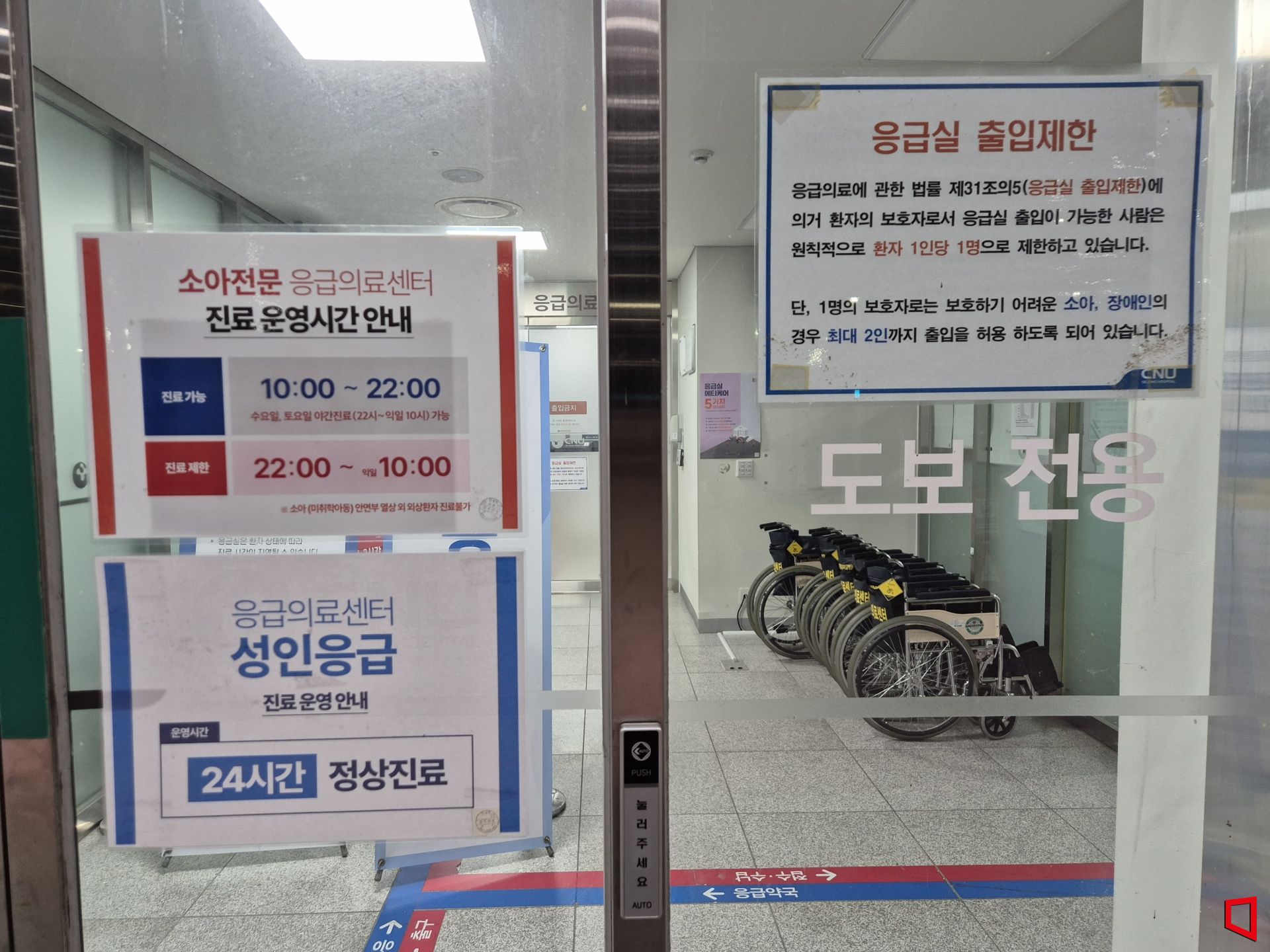
Around 1 a.m. on the 5th, at the entrance of the emergency room of Sejong Chungnam National University Hospital in Dodam-dong, Sejong. A notice states that night treatment is only available on Wednesdays and Saturdays. Photo by Choi Taewon
Editor's NoteAlthough it is expected that the medical residents who left hospitals in protest against the expansion of medical school admissions in February last year will resume their training after a year and a half, the situation in essential departments handling critical and emergency patients remains precarious. In particular, for pediatrics, residents are avoiding applications due to low birth rates, an unreasonable fee structure, and increasing legal risks, while existing specialists are leaving the field. As disparities in medical services between regions widen, the care system for sudden pediatric emergencies and severe pediatric illnesses requiring specialized intensive treatment is also being shaken. There are fewer children being born, but even fewer doctors to care for them. Asia Economy will examine the current state of the pediatric medical system and directions for improvement in a six-part series.
At 10 p.m. one night in April, a four-year-old girl who had lost consciousness due to a febrile seizure was carried into a pediatric hospital in Daejeon that offered night treatment. The doctor administered an antipyretic, but the child's condition did not improve even after 20 minutes, prompting the hospital director, Mr. A, to urgently request a transfer to a larger hospital via 119. However, the only response was that all nearby hospital emergency rooms were unable to accept patients. For young children, prolonged seizures can result in aftereffects or, in the worst case, death, making every second critical. Ultimately, it was only after Mr. A personally called a major hospital's emergency room and shouted, "Will you take responsibility if the child dies?" that the emergency room staff responded, called in medical personnel, and allowed the transfer.
Across the country, there is a severe shortage of pediatric specialized emergency medical centers, and it is difficult to recruit pediatricians, resulting in repeated situations where it is hard to respond to pediatric emergency cases. This is especially true in regions far from Seoul, where it is often impossible to secure medical staff, so pediatric emergency rooms only operate during the day, or even if night treatment is available, there is no backup care.
Severe shortage of pediatric specialized emergency medical centers Difficult to recruit pediatric specialists Repeated situations unable to handle emergency patients
No pediatric specialized emergency medical centers in 22 regions including Gangwon, Chungbuk, Gyeongbuk, and Jeonnam
Two centers in the Chungcheong area operate night shifts only twice a week Unable to operate normally due to lack of medical staff
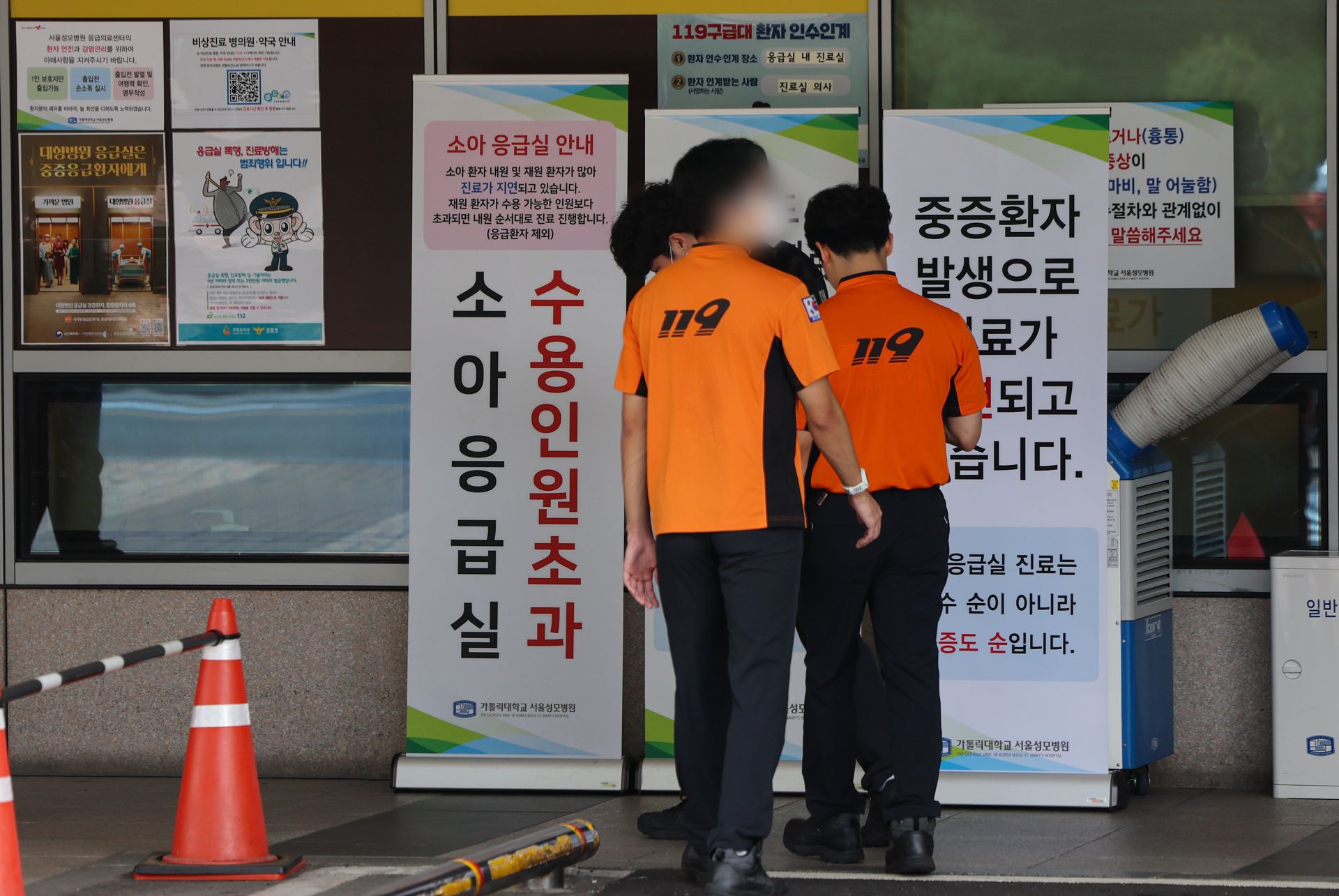
A banner related to the pediatric emergency room is displayed at the emergency medical center of a university hospital in Seoul. Photo by Yonhap News
According to data received by the office of Seo Myeongok, a member of the National Assembly's Health and Welfare Committee from the Ministry of Health and Welfare on August 27, as of January this year, only seven out of 29 emergency medical regions nationwide have pediatric specialized emergency medical centers.
In particular, the pediatric emergency medical environment in regional areas was found to be extremely poor. By region, there are a total of 12 pediatric specialized emergency medical centers: three in Seoul, two in Gyeonggi, two in Incheon, and one each in Chungnam, Daegu, Gyeongnam, Sejong, and Jeonbuk. In contrast, 22 emergency medical regions, including Gangwon, Chungbuk, Gyeongbuk, and Jeonnam, do not have a single pediatric specialized emergency medical center.
There are also significant differences in the number of pediatric specialists assigned. As of March, pediatric emergency medical centers in the Seoul metropolitan area, such as Inha University Hospital and Severance Hospital, have a relatively large number of pediatricians, with 10 and 7, respectively. In contrast, Soonchunhyang University Cheonan Hospital in Chungnam and Sejong Chungnam National University Hospital in Daejeon each have only three. In particular, for pediatric radiology specialists, it is known that there is only one in the entire Chungcheong region, working at Sejong Chungnam National University Hospital. Even that doctor is a professor who has already retired but is still working at the earnest request of the hospital.
Some pediatric specialized emergency medical centers are unable to operate normally due to a lack of medical staff. Currently, the two pediatric specialized emergency medical centers in the Chungcheong region each provide night treatment only two days a week. A medical staff member at Sejong Chungnam National University Hospital's pediatric emergency medical center said, "At least six doctors are needed to even consider sustainable 24-hour operation," and added, "Even if emergency care is provided at night, there is also a shortage of doctors from other departments, so we often transfer patients to hospitals in the southern Gyeonggi area or other metropolitan hospitals where there is relatively more capacity." A representative from Soonchunhyang University Cheonan Hospital said, "More doctors are needed for 24-hour operation, but recruitment is not easy," and added, "We will resume normal operations as soon as additional staff are secured."
To fill the gap in pediatric night treatment, the government is running the "Moonlight Children's Hospital" project, which allows outpatient treatment of mild pediatric patients at night and on holidays, instead of in the emergency room. The core of the program is to provide additional support, such as increased fees, to pediatric hospitals and clinics that offer night treatment until 11 p.m. However, when a severe pediatric patient who cannot be treated at a Moonlight Children's Hospital appears, there are no hospitals available to accept them, causing significant difficulties. Mr. A said, "When a severe patient arrives, I have to provide minimum emergency care and search for a hospital to transfer the patient to, which means I cannot treat other mild patients in the meantime," and added, "Sometimes, other sick children and their guardians have to wait an hour or more for treatment."
This year, the government budget for pediatric specialized emergency medical centers is 9.1 billion won. The government provides 100 million won in labor costs per dedicated specialist, and for patients under six years old, pays 15% more for emergency care specialist consultation fees compared to regional centers. Emergency medical management fees, observation fees for critical emergency patient care areas, and intensive care unit management fees dedicated to emergencies are also compensated at a 30% higher rate. However, the government says that due to budget constraints, it is difficult to provide the additional support desired by medical professionals on the ground.
Song Youngjo, director of the Emergency Medical Division at the Ministry of Health and Welfare, said, "The pediatric specialized emergency medical center project is still in its early stages and is gradually being expanded, with plans to cover larger regions than the existing emergency medical areas," and added, "We hope the situation will improve somewhat when the resigned residents return next month."


![[Collapsed Pediatric Care]②Four Hours by Express Bus for Chemotherapy: Seonghyun's Journey to Seoul for Treatment](https://cwcontent.asiae.co.kr/asiaresize/251/2025070114103328920_1751346633.jpg)
![[Collapsed Pediatric Care]③Residents Abandon Training: "Better to Be a General Practitioner Than Go Into Pediatrics"](https://cwcontent.asiae.co.kr/asiaresize/251/2023032914541571185_1680069255.jpg)
![[Broken Pediatric Care] ④ How Did Pediatrics Become the Most Avoided Specialty?](https://cwcontent.asiae.co.kr/asiaresize/251/2025082709330197977_1756254782.png)
![[Collapsed Pediatric Care]⑤The Only Pediatric Dialysis Unit Nationwide: Why It Can't Be Established in Regional Areas](https://cwcontent.asiae.co.kr/asiaresize/251/2025063021122427798_1751285544.jpg)
![[Collapsed Pediatric Healthcare]⑥ "Rebuilding Requires New Laws and a Dedicated Government Department"](https://cwcontent.asiae.co.kr/asiaresize/251/2025072816092462381_1753686563.jpg)



![[Reportage]"It Only Leads to Arguments"... Chungnam's True Sentiments Hide Deeper After Martial Law](https://cwcontent.asiae.co.kr/asiaresize/304/2026051223490460082_1778597344.jpg)