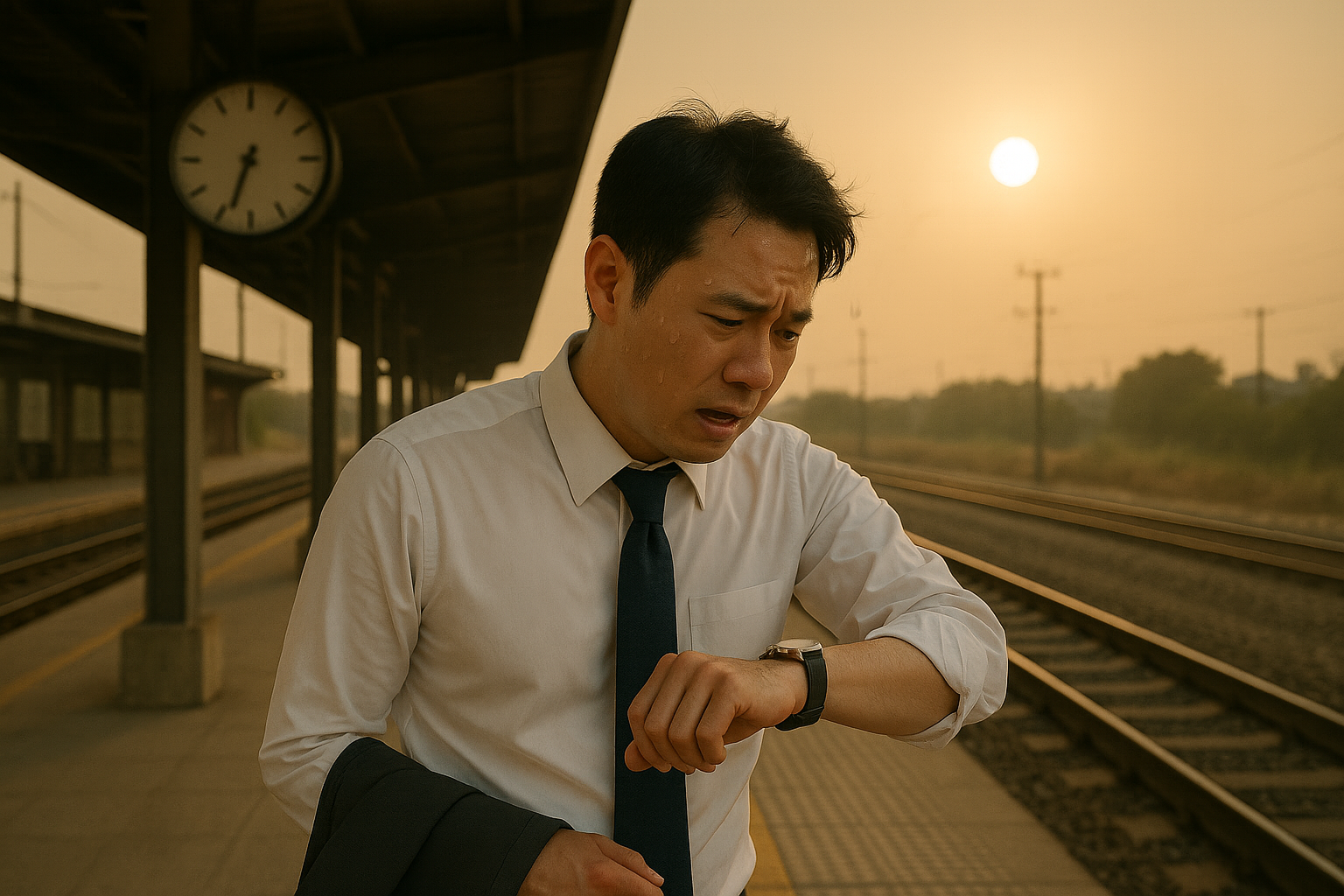
Mr. A, an office worker who commutes from a provincial city to Seoul by high-speed train, was recently late for work unexpectedly. Although he arrived at the station as usual, the train was delayed by 20 minutes because the tracks overheated due to the heat wave. Mr. A said, "After this incident, I have been leaving for work 30 to 40 minutes earlier than usual during the summer to prepare for possible delays."

The number of train delays caused by heat waves has surged this year, leading to ongoing inconvenience for passengers. However, since heat waves are classified as natural disasters, even compensation for these delays is difficult to obtain.
According to data received by Democratic Party lawmaker Yoon Jongkun's office from Korea Railroad Corporation (KORAIL) on August 22, there were no train delays due to heat waves from June to September last year, but this year, there were 67 such cases in July alone. The statistics are based on cases where high-speed trains were delayed by 5 minutes or more and regular trains by 10 minutes or more, with heat waves being the reason for at least 5 minutes of the delay.
During periods of heat waves, the temperature of the tracks can rise, causing track deformation, so train speeds must be reduced. High-speed trains must operate at speeds below 230 km/h when the temperature of ballast track sections is between 55 and less than 64 degrees Celsius, or when the temperature of concrete track sections is between 65 and less than 68 degrees Celsius. If the temperature of ballast track sections reaches 64 degrees Celsius or higher, or the temperature of concrete track sections reaches 74 degrees Celsius or higher, train operations must be suspended. For regular trains, when the track temperature is between 60 and less than 64 degrees Celsius, trains must slow down to below 60 km/h, and operations are suspended if the temperature exceeds 64 degrees Celsius.

High-speed trains were delayed 30 times just last month, with a total delay time of 4 hours and 25 minutes. The most frequent delays occurred on the Gajwa~Susaek section (9 times). Among these, the longest delay was 20 minutes on July 8 for a high-speed train traveling from Busan to Haengsin. During the same period, regular trains arrived late 37 times, with a total delay time of 6 hours and 26 minutes. Notably, there were 21 delays on the Anyang~Sungkyunkwan University section, and the longest delay was 19 minutes for a regular train heading from Mokpo to Yongsan on July 26.
As delays have become more frequent, passengers are increasingly calling for compensation. However, Article 15 of the Passenger Transportation Terms and Conditions includes regulations on compensation for train delays, but exceptions are made for delays caused by natural disasters such as heat waves. Measures to minimize delays have not been sufficiently established. Korea Railroad Corporation has installed automatic watering devices at 457 locations from 2019 to this year, which spray water when the track temperature exceeds 48 degrees Celsius, and plans to add 142 more locations in the future.
Lawmaker Yoon said, "When trains arrive late due to heat waves, passengers experience inconvenience and cannot receive compensation," adding, "In a situation where train delays are becoming more frequent, it is necessary to either implement measures so that passengers can be compensated or establish effective strategies to minimize delays."
-

Reporter Park SeungUk ty1615@asiae.co.kr
-
Edit Kim Boram kbram6457@asiae.co.kr
© The Asia Business Daily(www.asiae.co.kr). All rights reserved.
!["Please Help Us": How Much Do Those Bowing 90 Degrees These Days Actually Earn? [Data Pick]](https://cwcontent.asiae.co.kr/asiaresize/323/2026052010120870131_1779239528.png)