Main Firepower of Army and Navy Completed in Changwon
The Only Company Producing Ground and Naval All-Directional Artillery
Core of K-Defense Export, Concentrated 'Artillery' Technology
*A Visit to Hyundai Wia's Changwon Factory*
Ground weapons such as the K-9 self-propelled howitzer and the K-2 tank are recognized as top-tier exports of the K-Defense industry. In addition, naval weapons are also gaining attention as the Trump administration enters its second term. The core of these weapons is artillery. The artillery mounted on ground weapons is called a howitzer, while that mounted on naval vessels is called a naval gun. Hyundai Wia, located in Changwon, Gyeongnam Province, produces all artillery for both ground and naval weapons. In 1979, the company even independently developed a 155mm howitzer. The 155mm howitzer is known as the KH179. "KH" stands for Korea-type (Korea) Howitzer, "1" signifies the first or the beginning, and "79" means that in 1979, Korea rejected a U.S. proposal and embarked on independent development. This can be considered a declaration of independence in artillery development. To see the current state of artillery in the Korean military, we visited Hyundai Wia in Changwon, Gyeongnam Province.
Reduced Weight, Enhanced Firepower and Mobility
Responding to Supersonic Missile Threats with Domestic CIWS-II
Secured Naval Gun Technology Produced by Only Eight Countries Worldwide
Developed Hydraulic Shock Absorber Handling 250t Recoil
Dramatically Reduced Operating Personnel and Launch Preparation Time
Precision Machining Technology Mastering Both Rifled and Smoothbore Guns
Declared Independent Development in 1979, Now Among the World's Best
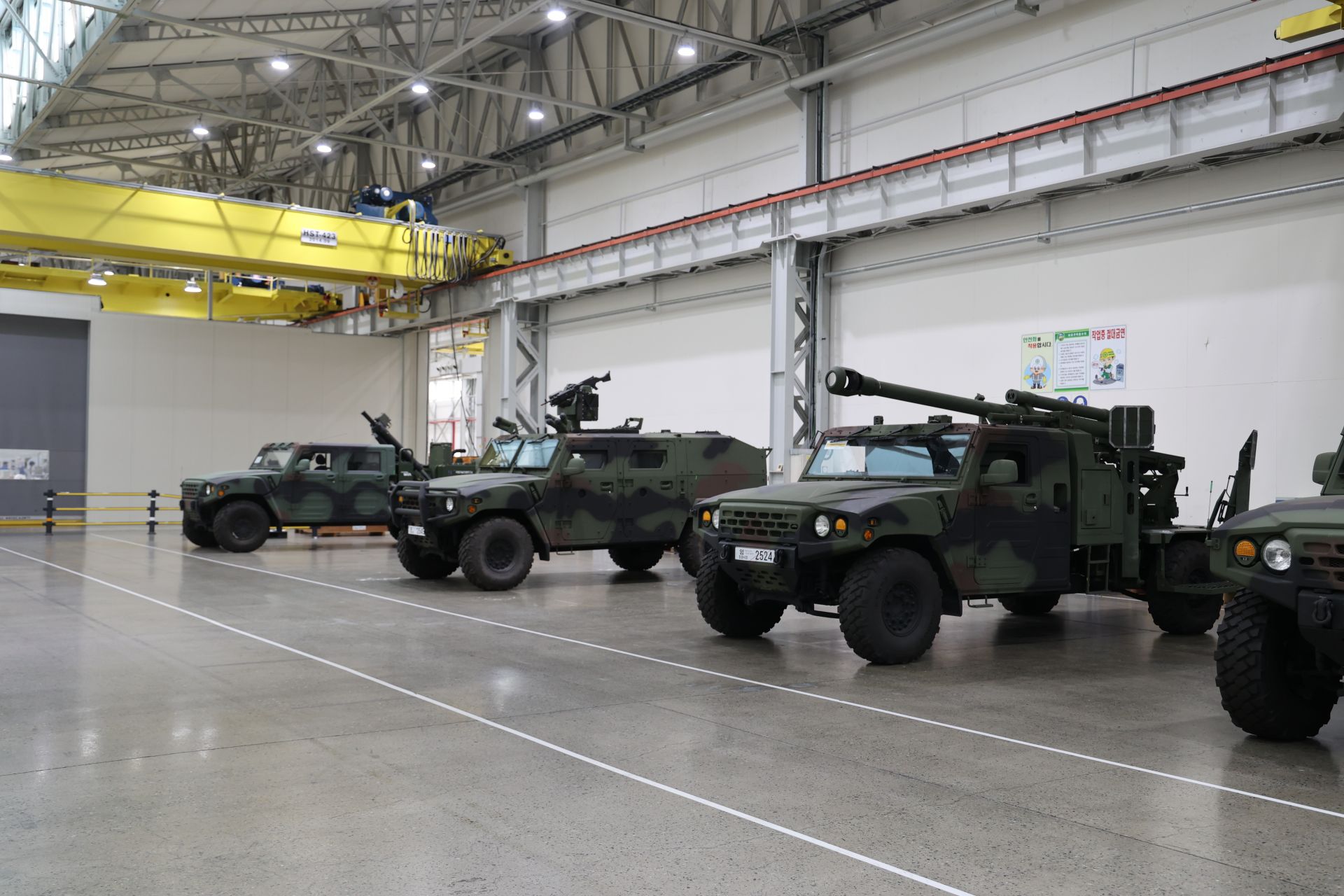
Upon entering Plant 1, the scene resembled a weapons exhibition. Naval guns for warships, as well as howitzers mounted on the K-2 tank and K-9 self-propelled howitzer, were lined up. The first thing that caught my eye was the 76mm naval gun to be mounted on the Navy's guided-missile patrol boat (PKG). The number "#○○" indicated which unit of the naval gun it was. The naval guns for the new high-speed boats to be deployed starting next year have become even more powerful. They can fire 76mm armor-piercing high-explosive shells, which are designed to penetrate enemy vessels and explode inside. On the opposite side, assembly was underway for the shipborne Close-In Weapon System (CIWS-II). The CIWS, which serves as the last line of air defense on a warship, is used to intercept anti-ship missiles at close range in case other air defense systems, such as ship-to-air missiles, fail. It mainly uses autocannons to intercept incoming missiles. The Navy's current CIWS includes the Phalanx system by Raytheon (USA) and the Goalkeeper by Thales (Netherlands). However, the need for performance upgrades and localization has emerged to counter the threat of North Korea's supersonic cruise missiles. The shipborne CIWS-II is being developed in collaboration with LIG Nex1, with the goal of completing development by 2027.
Hyundai Wia also performs depot maintenance, which refers to the overhaul and repair of naval guns. In 2003, Hyundai Wia equipped the "Chungmugong Yi Sunshin," Korea's first Aegis destroyer known as the "Shield of God," with the first domestically produced medium- and large-caliber naval gun. This is the 127mm "KMK 45" naval gun. After 12 years of service on the Yi Sunshin, it has returned to its hometown for an overhaul. The KMK 45 boasts a range of 24 km, the longest in its class. Only about eight countries in the world, including the United States, Japan, and Italy, are capable of independently producing medium- and large-caliber naval guns.
Lee Jihong, manager of the Special Projects Team, said, "Unlike the howitzers for ground weapons, naval guns are much more complex in design. They typically weigh over 20 tons and use an automatic loading system, so they inevitably have many parts."
On one side of the assembly area, small tactical vehicles equipped with artillery were lined up. Recently, the key to artillery development has been reducing the number of operators and shortening firing preparation time. Previously, artillery units would tow a 105mm howitzer with a 2.5-ton truck for firing, but it took a long time to prepare for live fire. Hyundai Wia has reduced the weight of the 105mm self-propelled howitzer. While reducing the weight, firepower remains unchanged. The system maintains the same level of performance as the conventional 105mm howitzer, with a maximum rate of fire of 10 rounds per minute and a maximum range of 14.7 km. The main challenge is the recoil generated during firing. Each time a 105mm howitzer is fired, it generates a recoil force equivalent to 250 tons. To reduce this impact, Hyundai Wia developed its own recoil buffer system. The hydraulic shock absorber reduces the 250-ton recoil force to less than 5 tons.
![From K-9 and K-2 to Naval Guns... Everything About Artillery [Yang Nakgyu's Defence Club]](http://www.asiae.co.kr/news/img_view.htm?img=2025081308254481604_1755041144.jpg)
This also prevents damage to the vehicle. Vehicles equipped with the 105mm howitzer are operated alongside command vehicles and ammunition vehicles. Weighing 7 tons, the vehicle can be airlifted by a CH-47 Chinook transport helicopter. Reducing the weight has also reduced the number of operators, from six to four. The same applies to the vehicle-mounted 81mm mortar. By reducing the weight and mounting it on a vehicle, the time required for live fire has been shortened. Previously, it took five minutes to set up and fire an 81mm mortar on the ground. However, by applying an inertial navigation system, electric actuators, and controllers, the preparation time has been reduced to 10 seconds. The number of operators has also decreased from five to three. The tactical vehicle is also equipped with a Remote Controlled Weapon Station (RCWS), allowing machine gun fire from inside the vehicle. The Lock-on function, which provides ballistic correction, tracking, and stabilization, enables accurate firing even while the vehicle is moving. The monitor for the rear-seat remote control system displays the forward situation clearly.
![From K-9 and K-2 to Naval Guns... Everything About Artillery [Yang Nakgyu's Defence Club]](http://www.asiae.co.kr/news/img_view.htm?img=2025081308194381576_1755040783.jpg)
The reason for mounting artillery on wheeled rather than tracked vehicles is faster mobility. Immediate movement after firing is possible, increasing the survivability of troops. According to the Agency for Defense Development, among the self-propelled howitzers deployed in the Russia-Ukraine war, tracked 52-caliber guns had a damage rate of 27.8%, while wheeled 52-caliber guns had a damage rate of 8.8%.
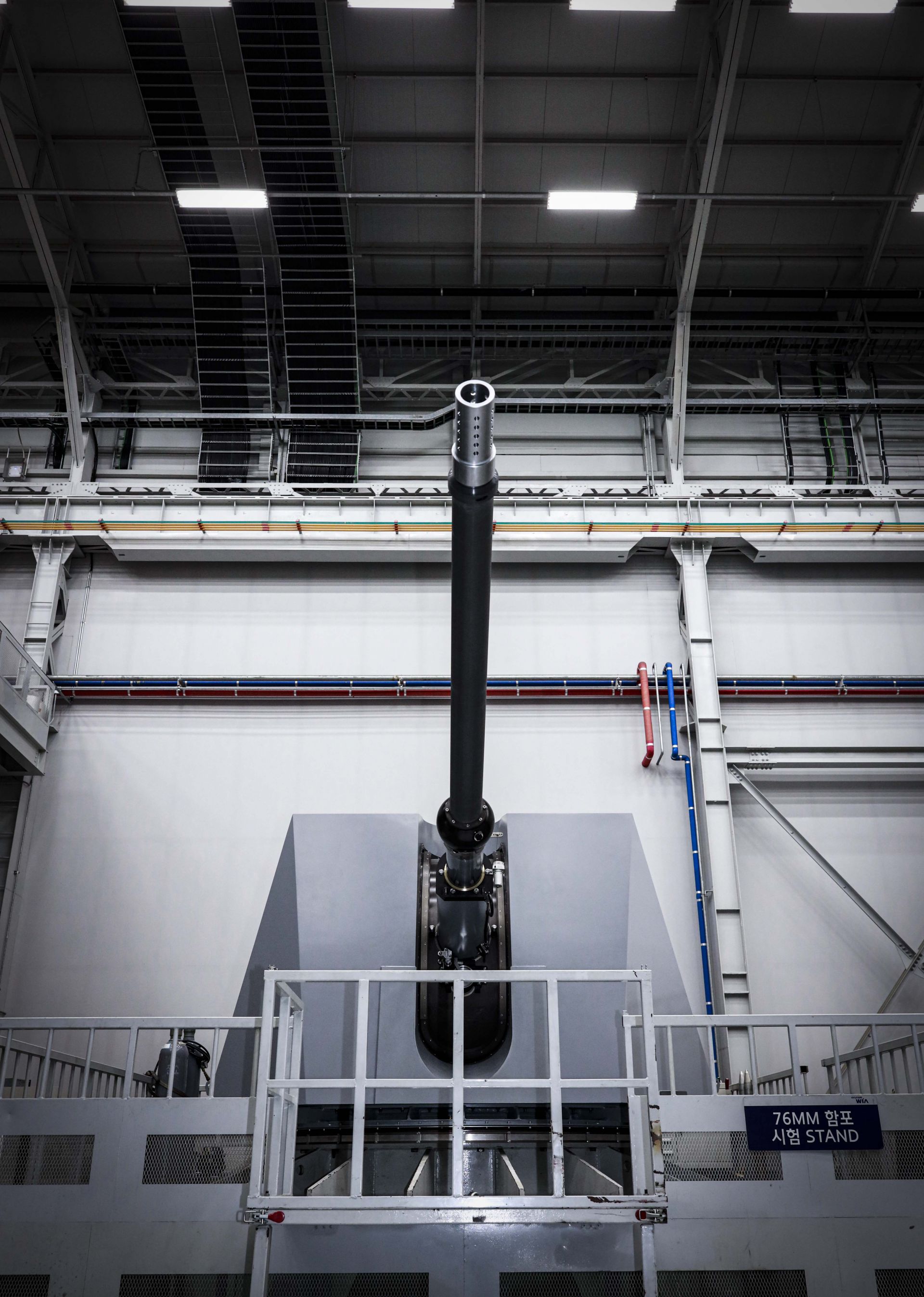
Production of artillery was also in full swing at Plant 2. At the entrance of the plant, a 76mm naval gun, a 105mm K-1 tank gun, and a 120mm K-2 tank gun were on display. As the caliber increases, so does the length of the gun. The 105mm K-1 tank gun is a rifled gun with a length of 5.3 meters. The inside of the barrel is grooved in a spiral pattern, causing the shell to spin as it is fired, which increases accuracy. The 120mm K-2 tank gun is a smoothbore gun with a length of 6.6 meters. There are no grooves inside, so the shell uses its kinetic energy for higher muzzle velocity. While rifled guns are declining, smoothbore guns have become mainstream due to the development of advanced fire control systems that enhance accuracy.
The gun is made from high-strength special steel in a cylindrical shape, and the inside is bored out using a straw-shaped deep-hole device. It takes more than three hours to bore each gun. For the 120mm K-2 tank gun, the original cylinder weighs 5 tons, and 3 tons are removed during machining. The bored gun is then heat-treated to make it even stronger, enabling it to withstand high temperatures and pressures.
Lee Young, executive director of the Special Propulsion Office, said, "If there is even a 0.05mm error inside the barrel or a 0.1mm deviation in the straightness, it is considered defective. The 120mm 55-caliber barrel is a unique technology possessed only by Germany and Korea."
-

Reporter Yang Nakgyu if@asiae.co.kr
-
Edit Kang Dongwon kangdw76@asiae.co.kr
© The Asia Business Daily(www.asiae.co.kr). All rights reserved.
!["Please Help Us": How Much Do Those Bowing 90 Degrees These Days Actually Earn? [Data Pick]](https://cwcontent.asiae.co.kr/asiaresize/323/2026052010120870131_1779239528.png)