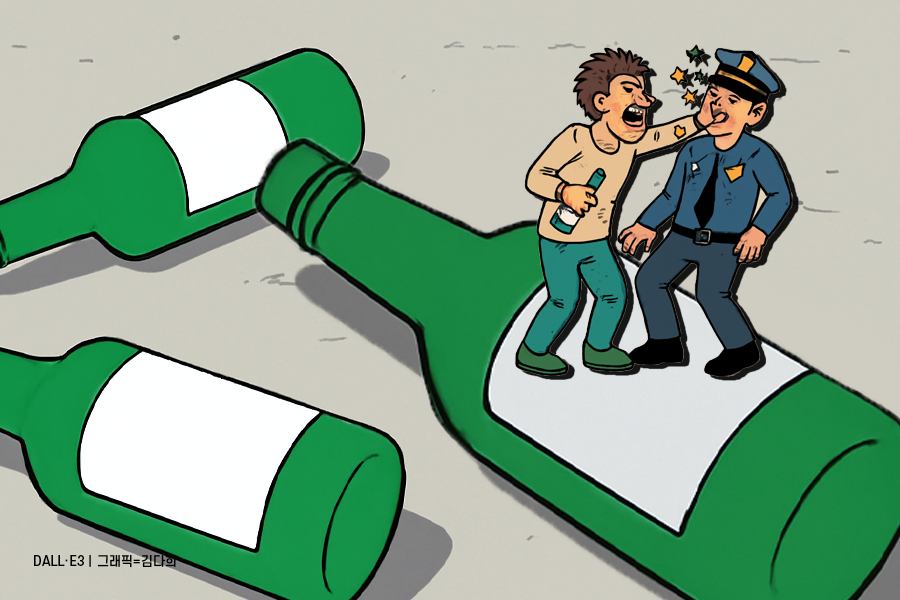
In Jungnang-gu, Seoul, an intoxicated person who was reported for 'trying to destroy a store' verbally abused the police officers who arrived at the scene. When the police tried to stop the intoxicated person from running onto the road and move him toward the sidewalk, he punched an officer in the chest.
Even When Drunk Individuals Cause Trouble for Police... Only 2 Prison Sentences, 3.2%, Issued This Year
"Why are you treating me like this?"
In January this year, in Jungnang-gu, Seoul, an intoxicated individual hurled insults at police officers who responded to a report that he was attempting to damage a store. When the police tried to prevent him from running into the street and attempted to move him to the sidewalk, he punched a police officer in the chest. He was prosecuted for obstruction of official duties and sentenced to one year in prison, suspended for three years. Just three months after the end of his probation period, he committed the same offense again.
On July 28, an analysis of 61 court rulings containing the keyword "intoxicated individual" from obstruction of official duties cases at district courts nationwide this year, accessed via the Supreme Court’s verdict viewing service, found that only 2 cases (3.2%) resulted in actual prison sentences, such as six months or one year and two months. The remaining 59 cases resulted in either fines or suspended sentences.
A man who entered a study cafe in Giheung-gu, Yongin City refused the police's request to go home and threw his cellphone at the patrol car window, resulting in a six-month prison sentence.
An intoxicated person at an apartment community center in Mapo-gu, Seoul, who ignored the police's request to leave and struck an officer on the back of the head with a fist, was fined 6 million won.
In Eunpyeong-gu, Seoul, an intoxicated person who verbally abused the police and kicked an officer in the groin was sentenced to six months in prison with a one-year probation period.
Among the fines (30 cases, 49.1%), the most common amount was 5 million won in 13 cases, followed by 3 million won (7 cases), 6 million won (6 cases), 4 million won (3 cases), and 10 million won (1 case). For suspended sentences (29 cases, 47.5%), 2 years was the most common (18 cases), followed by 1 year (9 cases), and 3 years (2 cases).
Article 136 of the Criminal Act stipulates that those who obstruct official duties may be punished by up to five years in prison or a fine of up to 10 million won. However, actual prison sentences were mostly limited to cases where the offender had repeated similar offenses or the violence was particularly severe.
Prison Sentences Limited to Cases of Repeated Offenses or Severe Violence
In November last year, a man entered a study cafe in Giheung-gu, Yongin-si while intoxicated, refused the police’s request to go home, and threw his mobile phone at a patrol car window, resulting in a six-month prison sentence. This individual had ten prior convictions for crimes involving interference with others' work while intoxicated. In April last year, at a hotel in Seogwipo-si, Jeju-do, another man kicked a police officer in the abdomen and bit his wrist, causing a disturbance and receiving a one year and two months prison sentence.

When the violence was deemed minor or there was no prior record, the courts were lenient, issuing fines or suspended sentences. Fines were usually imposed in cases involving shoving with the palm or minor contact, while suspended sentences were given in cases involving punching or repeated assaults.
In April last year, an intoxicated individual at a community center in an apartment complex in Mapo-gu, Seoul, refused a police request to go home and struck a police officer on the back of the head once with his fist, resulting in a fine of 6 million won. In December of the same year, in Eunpyeong-gu, Seoul, an intoxicated person hurled insults at the police while being restrained and kicked a police officer in the groin, receiving a six-month prison sentence suspended for one year.
Lim Juntae, a professor at the Department of Police Administration at Dongguk University, said, "The punishment for obstruction of official duties by intoxicated individuals is so lenient that police cannot properly respond," adding, "In some cases, suspects file counter-charges against the police if they get scratched or bruised while being subdued during a disturbance. To enable proper response to intoxicated individuals, punishment for assaulting police officers should be strengthened, distinguishing it from ordinary assault cases."
"Even Cases Like 'The Neighbor Didn't Say Hello' Must Be Investigated If Reported"
The structure requiring repeated explanations even for legitimate official duties is also increasing police fatigue. The number of complaints about illegal acts or repeated complaints filed with the Audit Office of the National Police Agency increased by 24%, from 77,175 in 2022 to 95,629 in 2023. In addition, with the abolition of the system for rejecting unreasonable complaints or accusations, the burden of having to accept and investigate even frivolous cases has increased. In the past, cases could be rejected if they did not meet formal requirements or if there was no clear suspicion of a crime. Now, in principle, all cases must be accepted. A police officer at a local police station in Seoul said, "There are many times when we have to investigate absurd cases, such as someone filing a complaint because their neighbor didn’t say hello or looked at them," adding, "We have to initiate investigations even for matters that are difficult to consider crimes, which is increasing the workload."
Experts point out that strengthening institutional responses is urgently needed. Lee Woonghyuk, a professor at the Department of Police Studies at Konkuk University, emphasized, "The police organization must come up with measures to strictly protect police authority so that police officers can perform their duties in accordance with the law and principles." Lee Geonsu, a professor at the Department of Police Administration at Baekseok University, also stated, "It is necessary to consider a system in which a third-party neutral body can review and close habitual false accusations or malicious complaints in advance."
-

Reporter Park SeungUk ty1615@asiae.co.kr
-
Edit Yang Hyejin adoretj@asiae.co.kr
© The Asia Business Daily(www.asiae.co.kr). All rights reserved.
!["Please Help Us": How Much Do Those Bowing 90 Degrees These Days Actually Earn? [Data Pick]](https://cwcontent.asiae.co.kr/asiaresize/323/2026052010120870131_1779239528.png)