Major Seoul Subway Stations
Measured at 8 AM, 3 PM, and 6 PM
Measured at 8 AM, 3 PM, and 6 PM
by Seo Jiyeong
by Choi Yujeong
Published 29 Jul.2025 15:02(KST)
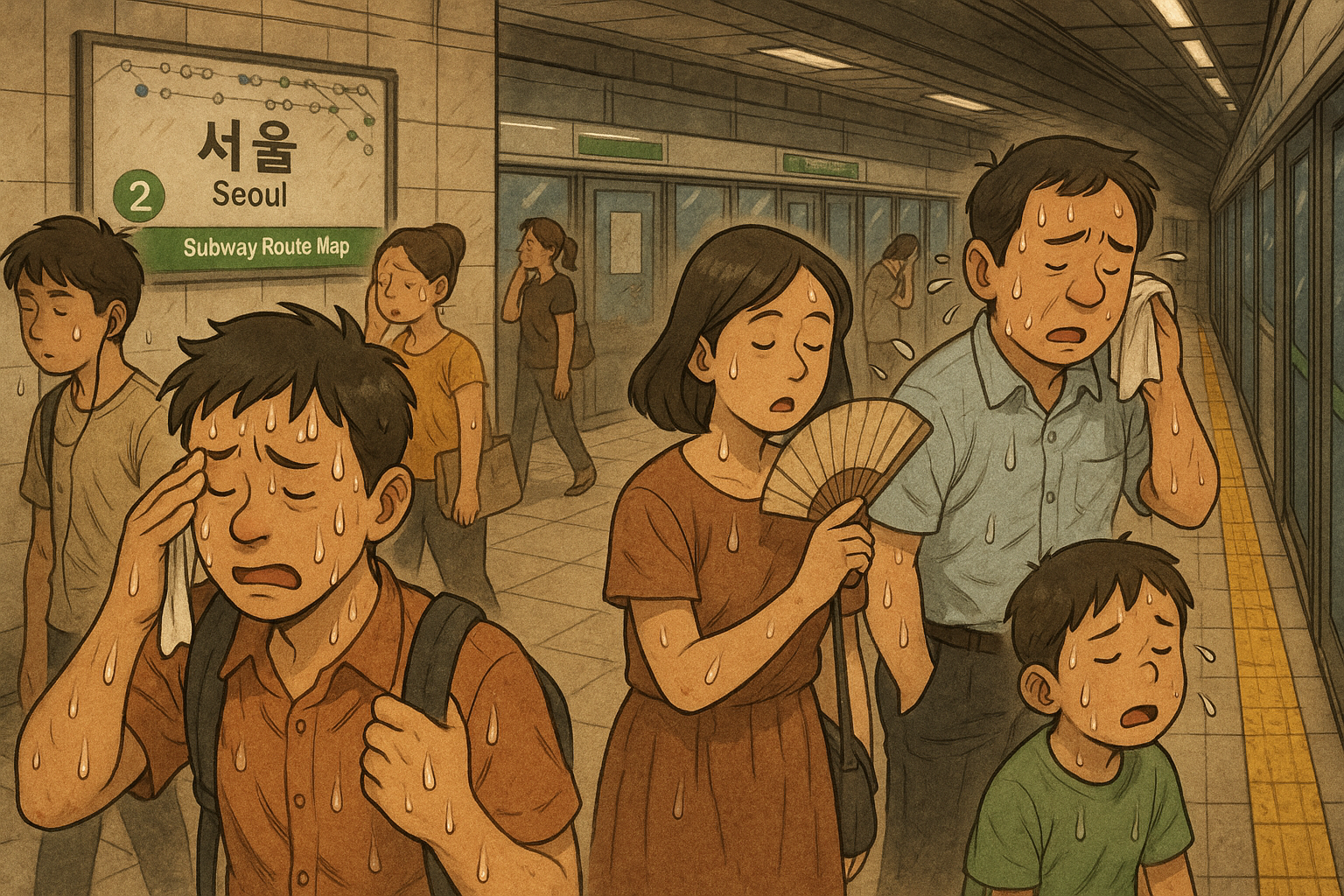
The internal temperature of some Seoul subway station concourses has been found to approach 40 degrees Celsius. In particular, stations without air conditioning facilities have essentially turned into "steam boxes."
On July 28, Seoul Metropolitan Council member Kim Jihyang of the People Power Party released the "Temperature Sample Measurement Data from 17 Major Subway Stations on Lines 1 to 8," which was submitted by Seoul Metro. This data was compiled based on standard temperatures measured at 8 a.m., 3 p.m., and 6 p.m. at major Seoul subway stations from July 22 to July 24. The survey covered six above-ground stations and eleven underground stations.
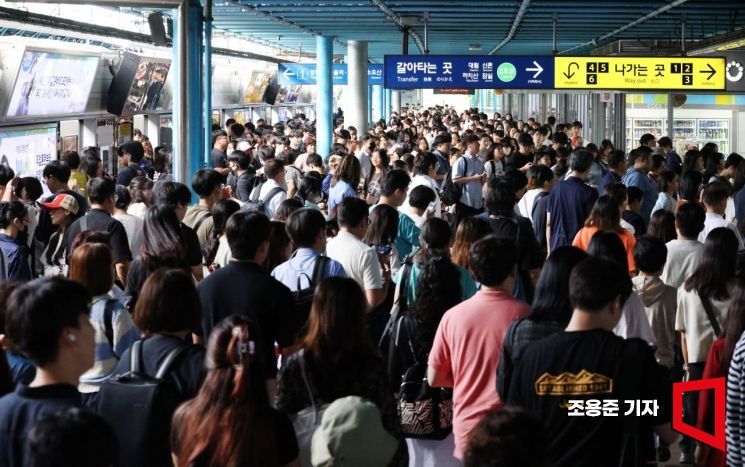
Seoul Metro has set the standard for activating air conditioning at 29 degrees Celsius, but the measured temperatures far exceeded this threshold. The highest temperature during this period was recorded at Oksu Station. At 3 p.m. on July 24, the temperature reached 39.3 degrees, and it remained at 38.1 degrees even at 6 p.m. At the same time, Seongsu Station on Line 2 also soared to 39 degrees. Both stations are above-ground and lack air conditioning facilities. On July 23, Oksu Station recorded 38.1 degrees and Seongsu Station 37.1 degrees, both far surpassing the standard temperature of 29 degrees.
The situation was not much different at underground stations without air conditioning. Ahyeon Station and Hansung University Station each recorded 31 degrees at 3 p.m. on the same day. Even large underground stations equipped with air conditioning, such as Seoul Station, showed 30.2 degrees at 3 p.m. on July 24. Among underground stations, Konkuk University Station reached 31.6 degrees, and Amsa Station 31.5 degrees, both approaching 32 degrees. Although the figures were relatively lower than those at above-ground stations, underground stations are enclosed structures where external air inflow is limited, making it easier for heat to accumulate. As a result, the perceived temperature can feel much higher than the measured temperature. While there is no direct sunlight underground, air circulation is difficult and humidity is high.
Kim Jihyang stated, "The heat inside subway stations is not just an inconvenience; it is at a level that threatens citizens' health," and added, "Since extreme heat is clearly a disaster, the Seoul Metropolitan Government should mobilize disaster management funds and reserve funds to establish emergency cooling measures at all stations."
According to the Korea Disease Control and Prevention Agency, prolonged exposure to high temperatures sharply increases the risk of heat-related illnesses such as heatstroke and heat exhaustion. In particular, enclosed spaces where ventilation is difficult can be even more dangerous for vulnerable groups such as the elderly, pregnant women, and those with cardiovascular diseases.

Seo Jiyeong zo2zo2zo2@asiae.co.kr
Choi Yujeong yjchoi@asiae.co.kr
© The Asia Business Daily(www.asiae.co.kr). All rights reserved.

!['WHO Declares International Public Health Emergency' Why the Untreatable 'Variant Ebola' Is More Deadly Than COVID-19 [Reading Science]](https://cwcontent.asiae.co.kr/asiaresize/323/2026052110164072055_1779326201.png)
!["Please Help Us": How Much Do Those Bowing 90 Degrees These Days Actually Earn? [Data Pick]](https://cwcontent.asiae.co.kr/asiaresize/323/2026052010120870131_1779239528.png)