AI Talent Skipping Domestic Companies and Heading Straight to the US
"At major US big tech companies, even new hires can earn annual salaries of 600 to 700 million won. Given the significant technology gap, I want to join a company where I can further develop my skills."
Seoul National University Hosts First US Big Tech Career Seminar with Over 200 Attendees "New Graduates Earn 600 to 700 Million Won" Students Stunned by Salary Gap Apple and Meta Employees Speak as Panelists in Lively Q&A Session
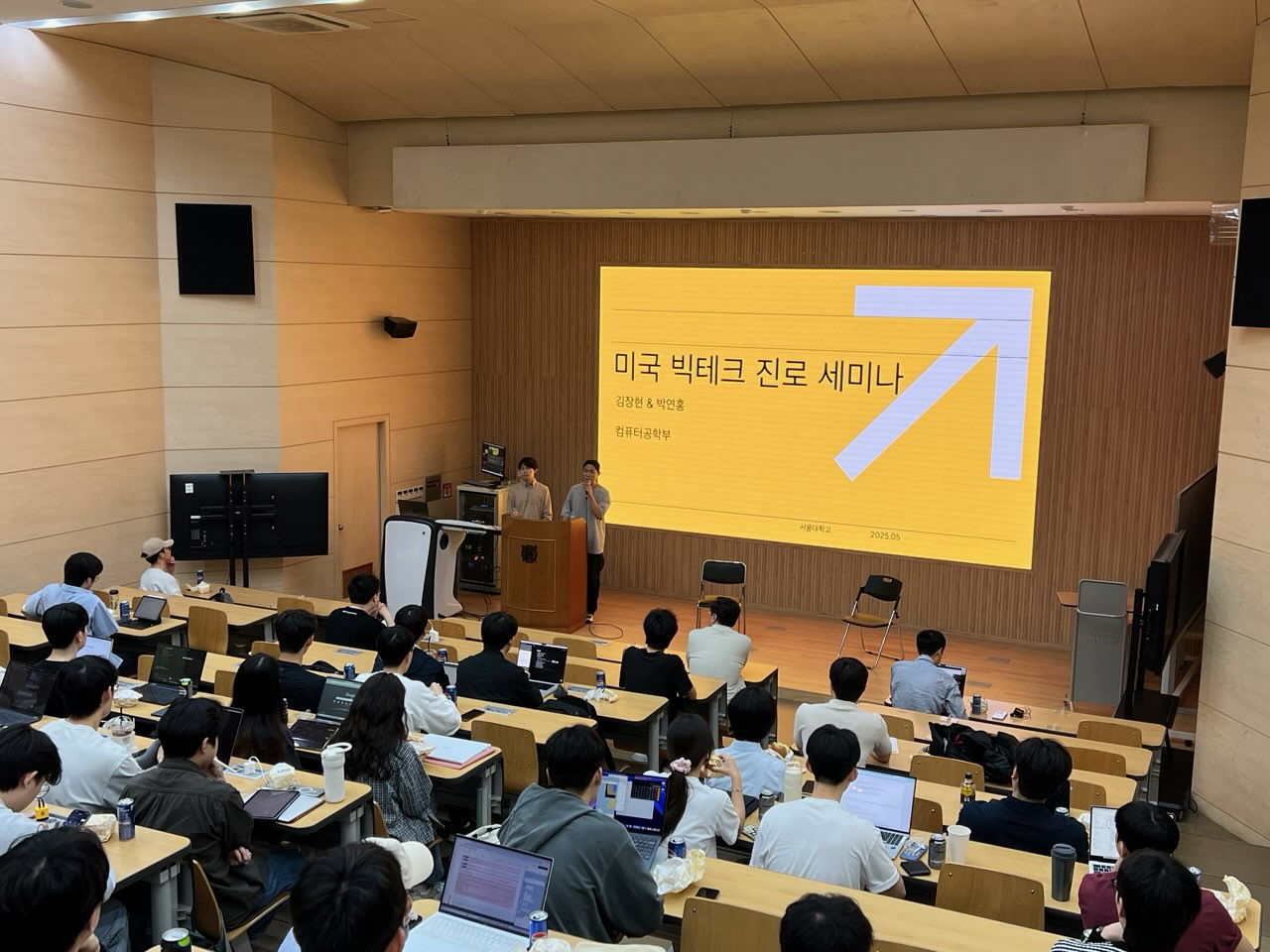
Recently, a US big tech career seminar held for undergraduate students at the Department of Computer Science at Seoul National University has become a hot topic. The event was organized for students who wish to work at US big tech companies after graduation, and it was the first time Seoul National University held a career seminar specifically targeting overseas big tech firms. More than 200 undergraduate students from the university attended, surprising the organizers. Typically, unless it is a large-scale recruitment seminar timed with the open recruitment season of major domestic conglomerates such as Samsung Electronics, LG, or SK, career seminars in specific fields usually attract no more than 60 to 70 attendees. The nearly two-hour event featured a soon-to-be PhD graduate and a postdoctoral researcher, both of whom recently secured positions at Apple and Meta, respectively. They participated as speakers, and students engaged in a lively Q&A session.
This career seminar drew particular attention because it clearly demonstrated the trend of top AI talent from Korea's leading university favoring US big tech companies over domestic firms. As the global AI boom intensifies competition for talent among nations, concerns are growing that the surge in job seekers heading directly to US big tech will accelerate the shortage of AI talent in Korea.
"Want to Build a Career by Experiencing Leading Technologies"
AI Research Environment and Performance Reward System Are Reasons for Choosing to Go to the US Seoul National University Computer Science Graduates Prefer Global Opportunities Over Domestic Ones "MZ Generation Familiar with Generative AI No Longer Chooses Korean Companies"
The main interests of students were salary and research environment. Park Yeonhong, a postdoctoral researcher at the Department of Computer Science who participated as a speaker, said, "Korean companies have fixed and uniform starting salaries, but US big tech firms offer differentiated salaries based on performance, and there is a significant difference in pay and treatment compared to domestic companies." Park is set to join Meta AI Research in the US in August. In an interview with Asia Economy after the event, Park explained that his motivation for seeking employment was his strong desire to experience leading-edge technologies and build his career in the US, where AI is mainstream and the research environment is well established.
It has been reported that Apple and Meta offered Seoul National University graduates annual compensation packages, including stock options, worth 600 to 700 million won. This is at least five to six times higher than what is offered by leading Korean tech companies such as Naver. Kim Janghyun, a soon-to-be PhD graduate from Seoul National University who is set to join Apple, also said, "I was attracted to the corporate culture where even new hires are recognized for their abilities based on performance, not seniority."
The preference for big tech companies marks a clear shift from the previous employment patterns of Seoul National University's Department of Computer Science. In the past, it was common for graduates to join domestic conglomerates such as Samsung or LG. According to Seoul National University, the number of graduates employed by US big tech companies has been increasing over the past five years. A representative from the Department of Computer Science said, "Out of 20 to 30 PhD graduates each year, at least two to three go straight to US big tech companies such as Google, Meta, Microsoft (MS), and Apple. The MZ Generation (Millennials and Generation Z), who have become familiar with generative AI like OpenAI's ChatGPT, are increasingly bypassing Korean companies and heading to global big tech firms."
Lee Jaehui, a professor at the Department of Computer Science at Seoul National University, said, "Although this was the first internal recruitment event targeting US big tech companies, it was impressive to see so many students flocking in and asking endless questions, showing great interest. In the past, only a small number of PhD graduates aimed for such jobs, but now, master's and PhD students as well as undergraduates are preparing to pursue careers at US big tech companies whenever opportunities arise. This is a significant change."




!["Please Help Us": How Much Do Those Bowing 90 Degrees These Days Actually Earn? [Data Pick]](https://cwcontent.asiae.co.kr/asiaresize/323/2026052010120870131_1779239528.png)