Real wages of wage earners have decreased
Income tax taxable income brackets adjusted
No significant changes since the 2008 reform
Income tax taxable income brackets adjusted
No significant changes since the 2008 reform
by Lee Eunjoo
by Choi Yujeong
Published 11 Jul.2025 14:31(KST)
Updated 11 Jul.2025 14:53(KST)
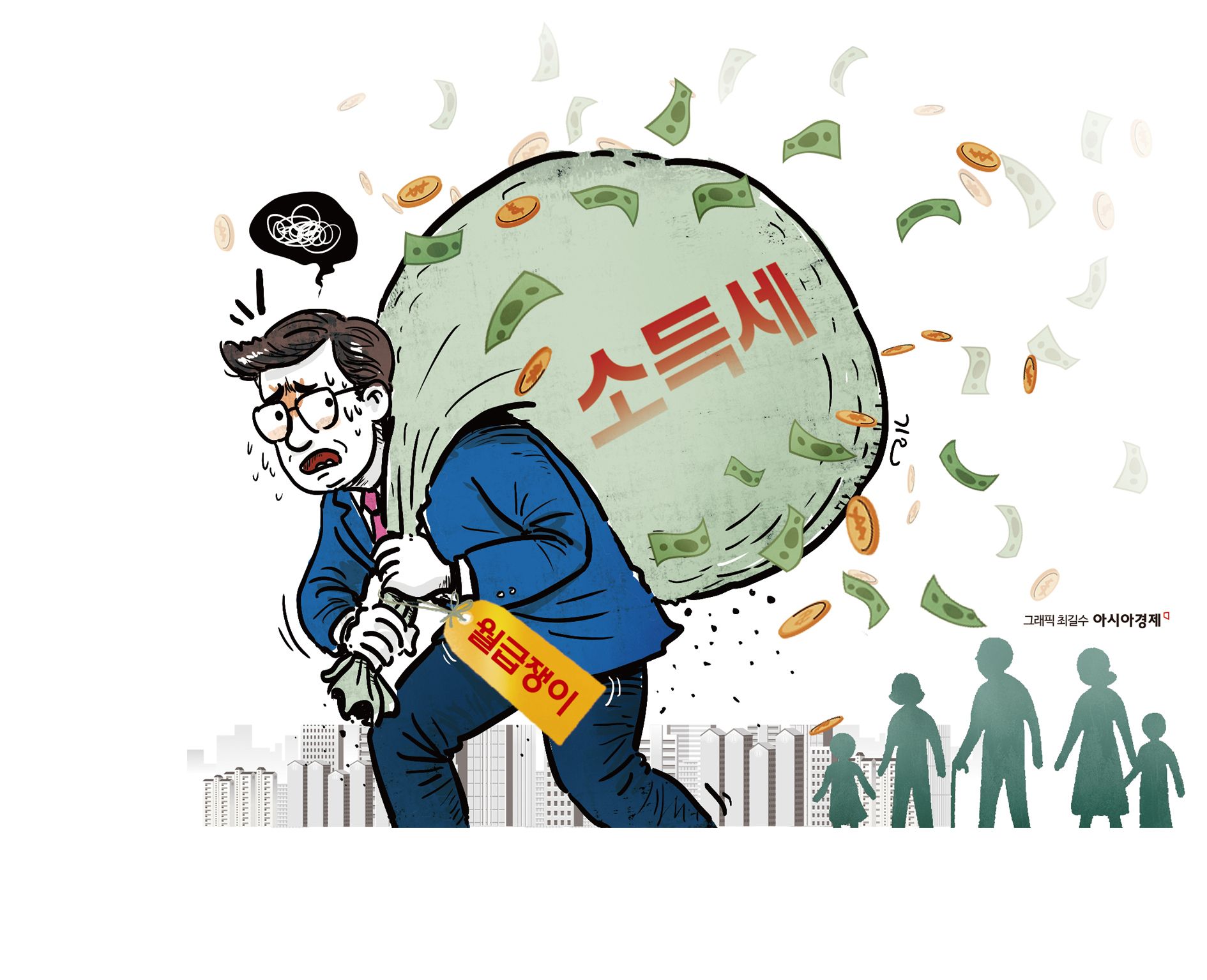
As the share of wage income tax in total tax revenue has surpassed that of corporate tax, there are growing concerns that the tax burden on salaried workers is excessive. This is because, despite rising prices, the taxable income brackets and deduction amounts for income tax have remained largely unchanged, resulting in an increased real tax burden for wage earners. There are calls to expand the basic deduction, which has remained unchanged for 16 years, and to revise the income tax brackets through tax reform.
According to the National Tax Service on July 11, wage income tax revenue reached 64.2 trillion won last year, surpassing corporate tax revenue (62.5 trillion won) for the first time. This means that the tax contribution of salaried employees has exceeded that of corporations. Although nominal wage increases have not kept pace with inflation, resulting in a decline in real wages for wage earners, the income tax burden has continued to rise. When nominal wages increase but the taxable income brackets remain fixed, higher tax rates are applied, leading to an increased tax burden.
According to annual statistics from the National Tax Service, from 2005 to 2023, the tax burden increased 6.1 times, outpacing the 1.5-fold rise in prices. According to Chae Eundong, a research fellow at the Democratic Research Institute, inflation nearly doubled the effective tax rate from 3.5% in 2009 to 6.5%. This is because, under the progressive income tax system based on nominal wages, wage earners have been subject to higher tax rates in higher income brackets than before. As a result, even though the actual take-home pay has not increased significantly, the numbers make it appear as if salaries have risen, leading to higher taxes being paid.

On the other hand, the basic income tax deduction has been frozen for 17 years. The basic deduction for income tax is 1.5 million won per person, which was raised from 1 million won in 2009 and has remained unchanged since then. During the same period, consumer prices rose by nearly 40% from January 2009 to January 2025. While prices increased by almost 40%, the deduction remained unchanged, resulting in a "silent tax increase."
Income tax brackets have also seen little change since the 2008 reform. In 2008, under the Lee Myung-bak administration's tax cut policy, the entire taxable income bracket was raised from ▲10 million won or less, over 10 million to 40 million won, over 40 million to 80 million won, and over 80 million won to ▲12 million won or less, over 12 million to 46 million won, over 46 million to 88 million won, and over 88 million won. The following year, in 2009, the tax rate for 12 million won or less was lowered from 8% to 6%, for over 12 million to 46 million won from 17% to 16%, and for over 46 million to 88 million won from 26% to 25%. The rate for over 88 million won remained at 35%. In 2010, the tax rate for 12 to 46 million won was reduced from 16% to 15%, and for over 46 to 88 million won from 25% to 24%.
Fifteen years after the overall bracket increase, in 2023, the minimum threshold was raised from 12 million won to 14 million won (6% tax rate), and the 15% tax rate bracket was raised from 46 million won to 50 million won, but there were no changes to other brackets. Lim Jaebum, a researcher at the National Assembly Research Service, explained at a forum on rationalizing wage income tax held in the National Assembly in April, "At that time, only about one-third to two-thirds of the cumulative inflation rate of 25.5% was reflected, and other tax brackets were left unchanged." He added, "Prices have risen by 39.8% compared to 2008, but this inflation has not been properly reflected in the income tax system, resulting in an increased tax burden."
In response to these concerns, during the last presidential election, there were calls from the political sphere to adjust the taxable income brackets and expand the basic deduction simultaneously. The Democratic Party of Korea even pushed for an amendment to the Income Tax Act to raise the 6% tax rate bracket from 14 million won to 15 million won, the 15% bracket from 50 million won to 53 million won, and the basic deduction to 1.8 million won. At the time, Democratic Party lawmaker Lim Kwanghyun stated, "Party leader Lee Jaemyung emphasized the urgent need for policies to increase the take-home pay of salaried workers by making the basic deduction for wage income more realistic," and added, "We must prevent forced tax increases on salaried workers and promote fair and rational taxation." President Lee Jaemyung also stressed during the presidential campaign that "salaried workers are not scapegoats," highlighting the need to reform the wage income tax structure. The People Power Party went even further by proposing an inflation-indexed income tax system. There were also suggestions to align the lower brackets with larger numbers, such as 15 million / 50 million / 90 million won, similar to the previous thresholds of 10 million / 40 million / 80 million won.
However, after the presidential election, related discussions have subsided. This is because, in the current fiscal situation, such measures could lead to a significant reduction in tax revenue. At the time, lawmaker Lim estimated that "the expected annual decrease in tax revenue would be about 1.1 trillion won for wage income tax and 800 billion won for comprehensive income tax, totaling about 1.9 trillion won." However, he also assessed that "this is a manageable amount compared to the cumulative increase of 61 trillion won in wage income tax revenue over the past four years."
If a comprehensive upward adjustment of all income tax brackets is difficult, some argue that changes should at least be made to the lower brackets. While it is true that the income tax burden in Korea has increased, it still falls short of the average effective tax rate among OECD member countries, suggesting that adjustments should start with the lower brackets. Rather than changing all six brackets, it is suggested to first raise the 6% tax rate bracket (taxable income over 14 million won) and the 15% bracket (50 million won). There are also calls to expand the basic deduction. Chae Eundong argued at the forum that the deduction should be raised from the current 1.5 million won to 1.7 to 1.8 million won. Raising it to 1.7 million won would require a total fiscal expenditure of 2 trillion won, including 1.5 trillion won for wage income tax and 500 billion won for comprehensive income tax.

Lee Eunjoo golden@asiae.co.kr
Choi Yujeong yjchoi@asiae.co.kr
© The Asia Business Daily(www.asiae.co.kr). All rights reserved.



![[Culture Interview] "Unifying the Fragmented Music Market... Super Fans Are the Next Competitive Edge"](https://cwcontent.asiae.co.kr/asiaresize/304/2026042817051344090_1777363513.jpg)

![Price Indexation for Earned Income Tax? It Must Be Viewed Within the Entire Tax Law Framework [Tax Reform, Let's Change This]](https://cwcontent.asiae.co.kr/asiaresize/251/2022060311043391515_1654221873.jpg)