BYD 'Super e-Platform' Charging Experience
Verifying heat generation and durability, which raised doubts in the market
Achieving 1000 kW-class ultra-fast charging even in extreme heat
4 minutes and 49 seconds to charge from 15 km to 400 km
Durability test with over 3,000 charge and discharge cycles
'400 km of range with just 5 minutes of charging.'
When BYD unveiled its next-generation electric vehicle platform, the 'Super e-Platform,' in March, the global automotive industry responded with both surprise and skepticism. The system drew attention for its high output of up to 1000 kW and a maximum voltage of 1000V, enabling charging speeds comparable to refueling internal combustion vehicles. However, there were doubts as to whether such performance could actually be achieved.
On June 24, at a BYD electric vehicle charging station in Longhua District, Shenzhen, China, I personally charged an electric vehicle using the 1000 kW-class ultra-fast charging system. This was the first time that a Korean media outlet, Asia Economy, directly demonstrated charging an electric vehicle based on the 'Super e-Platform,' which was launched in April, at a local site in China.

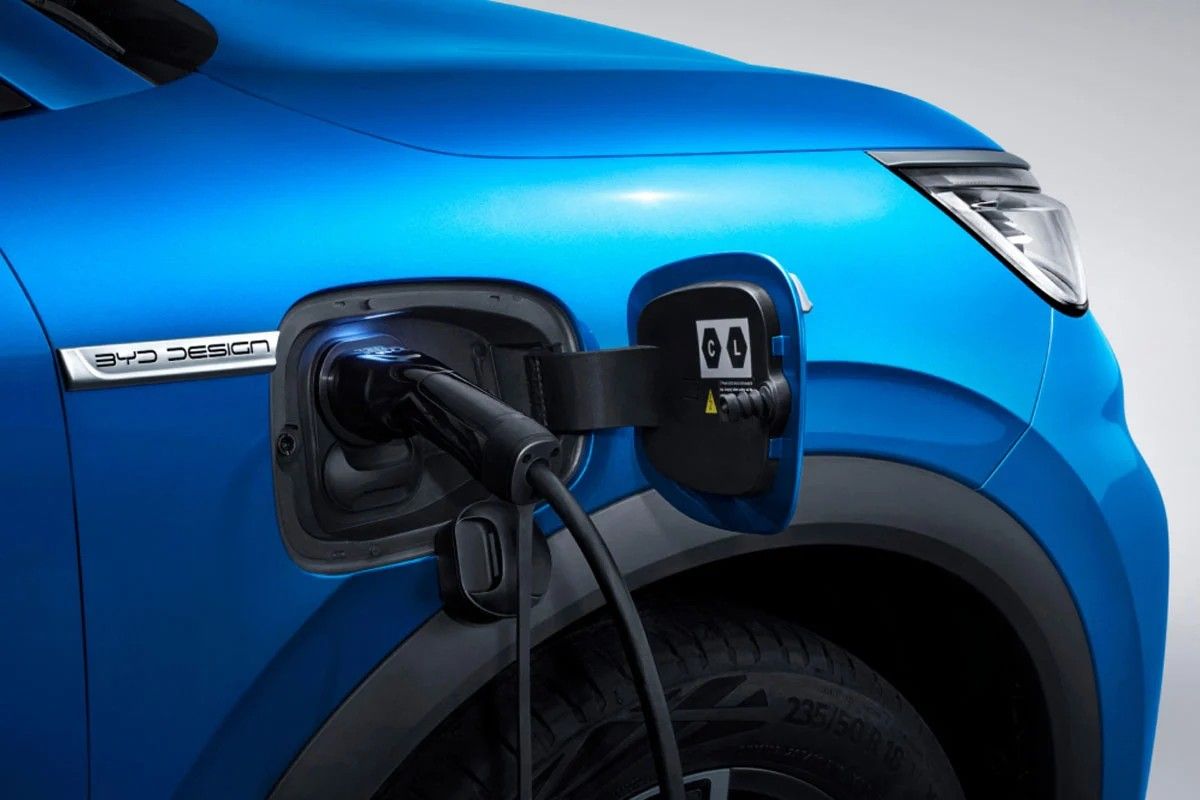
An electric vehicle 'HanL' based on BYD's Super e-Platform being charged at ultra-fast speed. Photo by Su Yeon Woo
원본보기 아이콘I opened the charging port of BYD's flagship electric sedan, the Han L, and connected the charger. With only about 2% battery remaining, the electric vehicle absorbed power at an astonishing speed. The vehicle display showed the phrase 'MW Flash Charging' and displayed a charging power of '1000 kW.' The available driving range instantly increased from 15 km (2% remaining) to 400 km (57%). The total time taken was 4 minutes and 49 seconds. This confirmed that BYD's claim of '400 km of range with 5 minutes of charging' was not just a slogan.
When BYD announced its '10C' technology, which enables ultra-fast charging at ten times the battery capacity, the industry raised concerns about heat management during charging and battery durability. However, at 3 p.m. that day, under the scorching Shenzhen sun with temperatures exceeding 33 degrees Celsius, the BYD charger continued ultra-fast charging in direct sunlight without any shade. A BYD official explained, "To adapt to the vast climate differences across China, we needed to expand the charging temperature range," adding, "The system is designed to allow charging at any temperature from minus 40 degrees Celsius to plus 50 degrees Celsius."
Regarding durability, the official stated, "We have conducted more than 3,000 full charge and discharge tests," and added, "We have also applied our self-developed power semiconductor (SiC semiconductor) in addition to the battery thermal management system, elevating the overall vehicle system to a new level." In the electric vehicle industry, more than 3,000 full charge and discharge tests is considered a very high standard. The heat dissipation efficiency of the battery cells has also improved by more than five times compared to conventional batteries. BYD launched its Super e-Platform-based electric vehicles, the Han L and Tang L, in China in April this year and plans to install more than 4,000 ultra-fast charging systems across the country.

An electric vehicle Han L based on BYD's Super e-Platform is being fast charged. The vehicle display shows a charging output of 1000 kW. Photo by Woo Suyeon
원본보기 아이콘Before BYD introduced its '10C' technology, Hyundai Motor Company boasted the fastest charging technology in the industry. In 2021, Hyundai introduced the 'E-GMP' electric vehicle platform, supporting up to 350 kW and 800V output and voltage, to its mass-produced vehicles. E-GMP electric vehicles require 18 minutes to charge the battery from 10% to 80%.
However, with the commercialization of BYD's 'Super e-Platform,' BYD has overtaken Hyundai. In June this year, Tesla also introduced its fourth-generation Supercharger (V4), capable of charging at up to 500 kW, in select regions and models. As a result, it has become difficult for Hyundai to claim technological superiority until it releases a new next-generation platform. However, some point out that how quickly the latest technology is accepted by the market and consumers is a separate issue, as system stability and the establishment of charging infrastructure will require time.
![[Report] "400 km of Range with 5-Minute Charge"… Firsthand Experience Charging a Chinese Electric Vehicle](http://www.asiae.co.kr/news/img_view.htm?img=2025070115595529251_1751353195.jpg)
Nevertheless, by reducing electric vehicle charging times to levels comparable to gasoline refueling, BYD has demonstrated its technological prowess. In China's fiercely competitive electric vehicle market, the ultimate solution for securing market share and survival is, in the end, 'technological capability.'
In particular, BYD is focusing on technology marketing that showcases its technology in an intuitive and emotionally appealing way. BYD's premium electric vehicle brand Yangwang's supercar model U9 is widely known as a "dancing electric car." This is thanks to its self-developed intelligent body control system, which controls the vehicle's movements in real time, allowing it to move in sync with music. The Yangwang sport utility vehicle (SUV) U8 is famous on social media as a "car that floats on water." In emergencies, this vehicle can float on water for up to 30 minutes using its buoyancy mode. A BYD official emphasized, "To win over Chinese consumers, an intuitive message that can be understood at a glance is more effective than detailed technical explanations."
-

Reporter Woo Sooyoun yesim@asiae.co.kr
-
Edit Kong Sumin hyunhj@asiae.co.kr
© The Asia Business Daily(www.asiae.co.kr). All rights reserved.
!["Please Help Us": How Much Do Those Bowing 90 Degrees These Days Actually Earn? [Data Pick]](https://cwcontent.asiae.co.kr/asiaresize/323/2026052010120870131_1779239528.png)