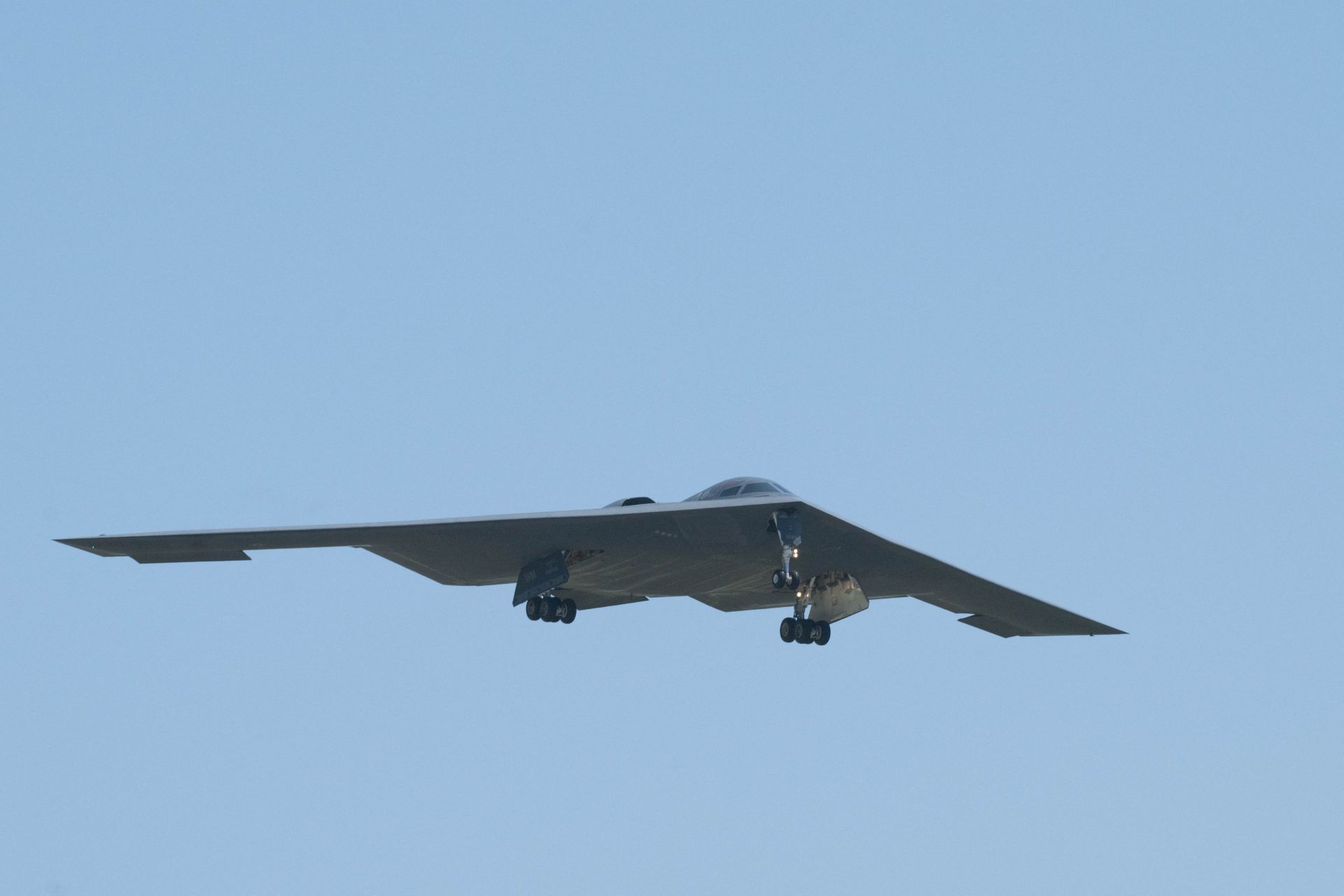

The U.S. Air Force B-2 stealth bomber is returning to Whiteman Air Force Base in Missouri on the 22nd after carrying out the "Midnight Hammer" operation to attack Iran's nuclear facilities. / Photo by Reuters Yonhap News
원본보기 아이콘As the United States launches airstrikes on Iran's nuclear facilities and becomes directly involved in the Israel-Iran conflict, attention is focused on how this situation might affect the security landscape on the Korean Peninsula.

A view of the Fordow nuclear facility in Iran, photographed on the 22nd (local time) by private satellite company Magsa Technology. Six holes and debris can be seen at the presumed location where the US bunker buster bomb was dropped. / AFP Yonhap News Photo
원본보기 아이콘Some analysts predict that, since the United States has made it clear through this airstrike that it will not tolerate Iran's development of nuclear weapons, North Korea could be the next target. Previously, both the Bill Clinton administration and the first Donald Trump administration considered preemptive strikes against North Korea as part of efforts to resolve the North Korean nuclear issue.
However, experts point out that the situations in North Korea and Iran are fundamentally different, making such a scenario difficult to realize. While Iran does not possess nuclear weapons, North Korea is believed to have succeeded in developing nuclear arms and is estimated to possess about 50 nuclear warheads. North Korea has also made significant progress in developing delivery systems, with the US Defense Intelligence Agency (DIA) recently assessing that North Korea possesses more than 10 intercontinental ballistic missiles (ICBMs). Unlike Iran, which cannot pose a substantial threat to Israel, North Korea has the capability to retaliate against South Korea, Japan, and even US territories such as Guam, depending on the situation.

Satellite image of the Fordow nuclear facility area in the mountainous region of Qom Province, Iran, taken on the 19th by the US commercial satellite company Maxar Technologies. A total of 16 cargo trucks are lined up along the access road leading to the nuclear facility. / Photo by AFP Yonhap News
원본보기 아이콘Domestic and international circumstances are also markedly different. While Israel and Iran are separated by about 1,700 kilometers across Iraqi territory, North and South Korea face each other directly across the Demilitarized Zone. In addition, China and Russia are not directly supporting Iran, but North Korea has signed both the China-North Korea Treaty of Friendship, Cooperation and Mutual Assistance and the Comprehensive Strategic Partnership Treaty with Russia. In the event of a conflict, there is a possibility of direct intervention by China and Russia.

US President Donald Trump is sitting in the White House Situation Room, known as the "War Room," on the 21st (local time). / Courtesy of the White House, AFP Yonhap News Photo
원본보기 아이콘While most analysts agree that a preemptive strike on North Korea is unlikely, some argue that the recent US intervention will have a significant impact on North Korea's foreign policy. Lim Eulchul, a professor at Kyungnam University, stated, "This situation will further deepen North Korea's distrust of the United States, which was solidified by the US withdrawal from the Iran nuclear deal (JCPOA) in 2018 and the breakdown of the Hanoi North Korea-US summit in 2019," adding, "In particular, it is highly likely to serve as a catalyst for further strengthening military cooperation with Russia."

North Korean State Affairs Commission Chairman Kim Jong Un held an expanded meeting of the 12th plenary session of the 8th Central Committee of the Workers' Party from the 21st to the 23rd, reviewing the first half of the year and discussing policy directions for the second half, according to the Korean Central News Agency on the 24th.
원본보기 아이콘Meanwhile, this situation is also expected to have a considerable impact on South Korea. In the event of an escalation, there is a high possibility that some US military assets stationed in South Korea could be rotationally deployed to the Middle East as part of efforts to enhance so-called "strategic flexibility." In particular, as previously stated by the US side, there are expectations that pressure will intensify on South Korea and other allies to increase their defense budgets in order to strengthen their own defense capabilities.
-

Reporter Yoo Jaehoon kalamal@asiae.co.kr
-
Edit Sung Kiho kihoyeyo@asiae.co.kr
© The Asia Business Daily(www.asiae.co.kr). All rights reserved.