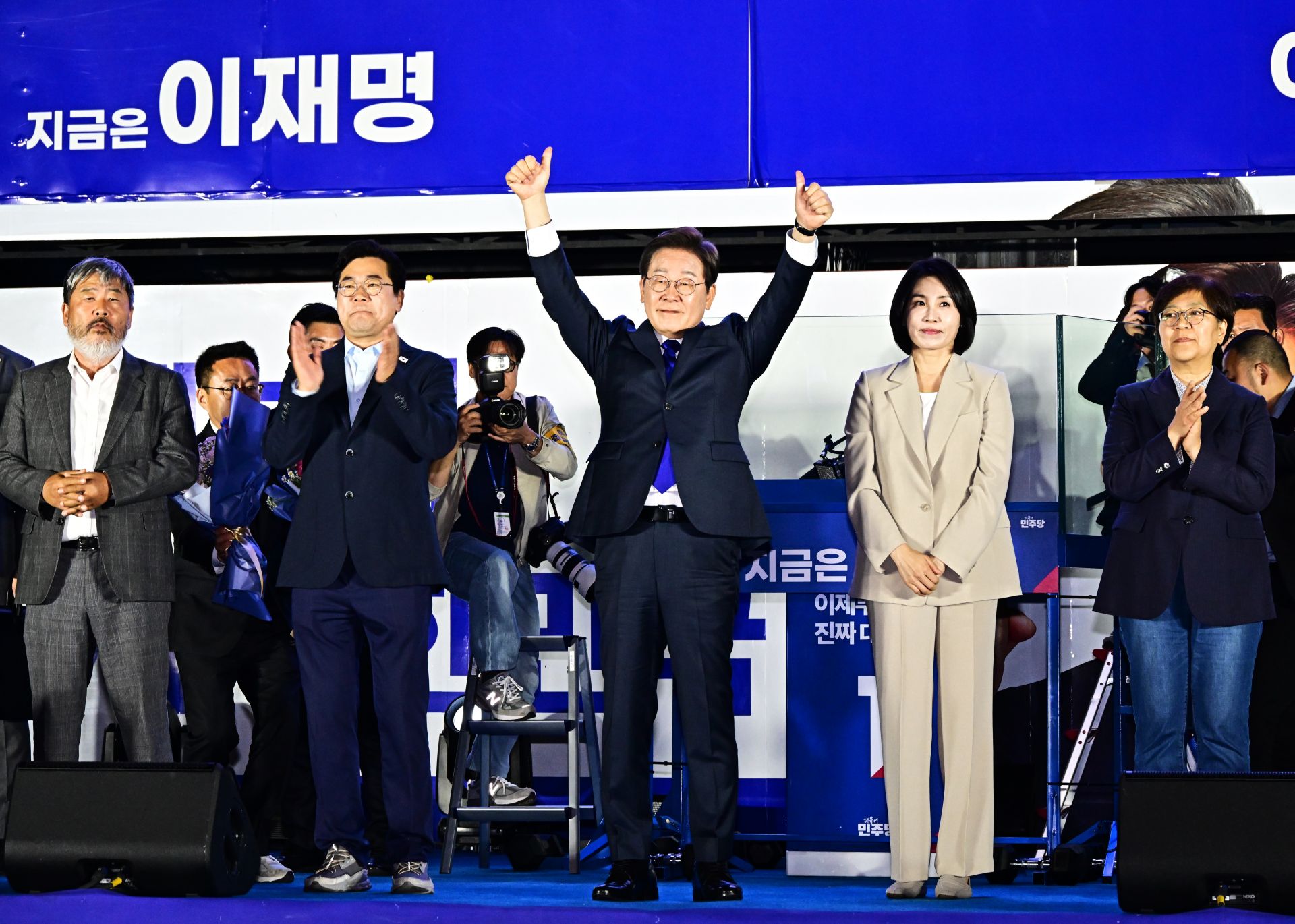
Lee Jae Myung: Defining Moments in His Presidential Victory
The opposition faced turmoil with the replacement of Kim Moonsoo and Han Deoksu as candidates
The appeal trial was postponed until after the presidential election

Lee Jae Myung, leader of the Democratic Party, is giving a statement after the resolution to lift the emergency martial law was passed in the National Assembly early on the 4th. President Yoon Suk Yeol declared the emergency martial law in an urgent statement on the night of the 3rd. Photo by Kim Hyun Min
원본보기 아이콘The Night of Martial Law: Lee Jae Myung Rushed to the National Assembly
Lee Jae Myung's victory in the 21st presidential election was closely tied to the unique circumstances of the early election triggered by the 12·3 emergency martial law incident. Many voters resonated with President Lee's political justification, which was centered on "judgment for insurrection" and "restoration of democracy."

The conservative bloc, which had already experienced the impeachment of former President Park Geun Hye and now faced the impeachment of former President Yoon Suk Yeol, was divided during this election process. The divisions were between pro-Yoon (pro-Yoon Suk Yeol) and non-Yoon factions, as well as between those supporting and those opposing the impeachment of former President Yoon. The turmoil caused by the attempt to unify candidates also led to public disappointment, which further solidified President Lee's dominance.

Lee Jae Myung, leader of the Democratic Party, is voting on the impeachment motion against President Yoon Suk Yeol during the 4th plenary session of the 419th National Assembly (extraordinary session) held at the National Assembly on the 14th. Photo by Kim Hyun Min
원본보기 아이콘The most decisive moment that led to President Lee's victory was the 12·3 emergency martial law incident. Although Han Dong Hoon, the former leader of the People Power Party, was the first party leader to arrive at the National Assembly plenary chamber immediately after former President Yoon declared martial law, it was Lee Jae Myung, then leader of the Democratic Party, who led the largest group of lawmakers. At the time, there was also an assessment that the seeds of anti-authoritarianism and democratic activism sown by Lee, then mayor of Seongnam, during the Gwanghwamun candlelight rallies in the 2016 Park Geun Hye administration's corruption scandal, had come to full bloom with the lifting of martial law.

Lee Jae Myung, the Democratic Party presidential primary candidate, is delivering an acceptance speech on the afternoon of the 27th at the joint speech meeting for the selection of the 21st presidential election candidate of the Democratic Party, held at Kintex in Goyang, Gyeonggi Province. 2025.04.27 Photo by National Assembly Press Photographers Group
원본보기 아이콘Early Election Turmoil in the People Power Party... In Contrast, a Smooth Path for Lee Jae Myung
Even after narrowly losing to former President Yoon in the 20th presidential election, Lee served as leader of the Democratic Party and persistently held the Yoon Suk Yeol administration accountable for three years. Although he was criticized at the time for obstructionism, after the declaration of martial law, Lee actively used slogans such as "overcoming insurrection," "restoration of democracy," and "the true Republic of Korea," keeping the call for regime judgment alive and securing a landslide victory from the Democratic Party primary through to the presidential election.

Even as calls for judgment against the People Power Party intensified following a second presidential impeachment, internal strife and the collapse of a "big tent" coalition worked in Lee's favor. Immediately after the martial law incident, the People Power Party forced Han Dong Hoon, who had led efforts to lift martial law and called for the impeachment and expulsion of former President Yoon, to resign. In doing so, the party trapped itself in the "insurrection apologist" frame asserted by the Democratic Party and other progressive groups. During the impeachment trial of former President Yoon, the party continued to expose intense internal conflicts, with anti-impeachment forces prevailing but still clashing with pro-impeachment factions.

Kim Moonsoo, the People Power Party presidential candidate, and Han Deoksu, the independent preliminary candidate, are meeting at the National Assembly Riverside Library on the 8th to discuss unification. 2025.5.8 Photo by Kim Hyunmin
원본보기 아이콘The turmoil over candidate unification also drew public criticism. Kim Moonsoo, the People Power Party presidential candidate, pledged to unify with former Prime Minister Han Deoksu during the party's primary, but the attempt fell apart after disputes over the rules between Kim and Han. The party leadership then tried to forcibly replace Kim with Han as the candidate, but failed, leading to disappointment among some conservative and centrist voters. Notably, the People Power Party adopted "anti-Lee Jae Myung" as its campaign strategy, focusing on controversies involving Lee's family and legal risks. However, the party failed to show sincere reflection on the martial law incident and its internal conflicts, resulting in a failed unification with Lee Jun Seok, the Reform New Party presidential candidate, and ultimately influencing Lee's victory.

Chief Justice Choi Heedae and other Supreme Court justices are entering the Supreme Court in Seocho-gu, Seoul, on the afternoon of May 1st to deliver the verdict on the appeal trial of Lee Jaemyung, the Democratic Party presidential candidate, regarding the violation of the Public Official Election Act. 2025.05.01 Photo by Joint Press Corps
원본보기 아이콘Supreme Court Remand Ruling Rallied Support Base
As the presidential race began, President Lee faced a crisis on the 1st of last month when the Supreme Court remanded his case with a guilty verdict. Paradoxically, this was perceived as judicial intervention in the election and oppression of the opposition by the Yoon Suk Yeol administration, which rallied the progressive base. In particular, after the remand, the 7th Criminal Division of the Seoul High Court, which was in charge of Lee's appeal, postponed the hearing to the 18th of this month, after the presidential election. This partially alleviated his legal risks and gave new momentum to his campaign.