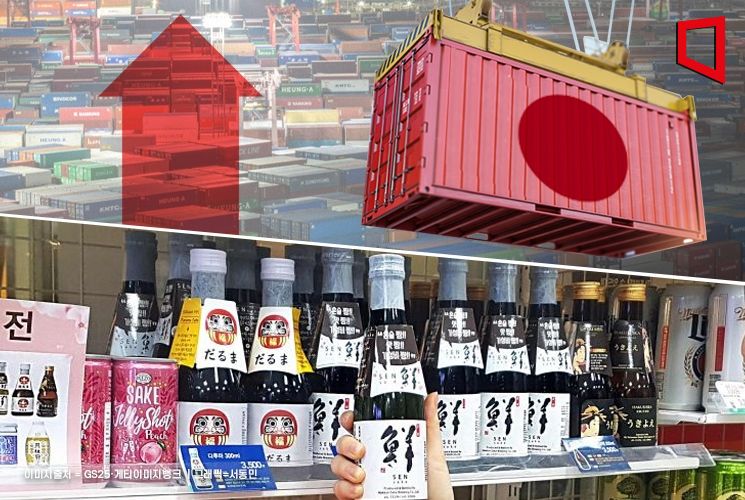
Amid sluggish domestic consumption due to the economic downturn, the local alcoholic beverage market remains stagnant, yet imports of sake (Nihonshu, Japanese-style rice wine) are rising sharply. Sake is captivating consumers by leveraging its high quality and diversity, supported by the strong popularity of Japanese culture and cuisine.
Sake Import Value Up 20% Year-on-Year as of April
According to export-import trade statistics from the Korea Customs Service on April 30, the value of sake imports this year reached $10.69 million (approximately 15 billion won) as of April, marking a 19.4% increase compared to the same period last year ($8.95 million). Sake imports, which stood at $11.74 million in 2020 when the home-drinking trend began during the COVID-19 pandemic, have continued to rise annually. Notably, even last year, when most imported alcoholic beverages struggled, sake imports continued to grow, reaching a record high of $26.35 million. This year, the figure is expected to surpass $30 million for the first time.

The increase in import volume is even steeper. By April this year, the volume of sake imported into Korea reached 2,385 tons, up 22.6% from the same period last year (1,949 tons). The import volume, which was 2,379 tons in 2020, exceeded 3,000 tons in 2021 and 4,000 tons in 2022, reaching 5,684 tons last year?an increase of about 2.5 times over four years. This year, imports are expected to exceed 6,000 tons.
As sake imports rise, importers are also seeing improved performance. Nihonshu Korea, the largest sake importer in Korea, recorded sales of 24.9 billion won last year, up 14.7% from the previous year. Operating profit during the same period also rose 7.6% to 7.1 billion won. Nihonshu Korea imports and sells brands with high recognition among Korean consumers, such as Dassai, and Dassai sales last year grew about fivefold compared to 2020. The company explained that sales have been increasing by 30?40% annually.

Strong Interest and Experience in Japanese Culture Drives Sake Consumption
The recent increase in sake demand in the domestic market is largely attributed to heightened interest in and experience with Japanese culture. In particular, as more travelers visit Japan, they tend to seek out Japanese food and sake they experienced there upon returning home, leading to steady growth in demand through repeat consumption. According to the Korea Tourism Organization, 8.82 million Koreans visited Japan last year, a 26.7% increase from the previous year and the highest figure ever recorded. In the first quarter of this year, 2.51 million Koreans visited Japan, up 7.2% from the same period last year, and the annual total is expected to surpass last year’s record.

Travelers visiting Gimpo International Airport are waiting to check in their luggage for Japan. Photo by Jin-Hyung Kang aymsdream@
원본보기 아이콘Improved accessibility to sake is also contributing to the expansion of demand. A representative from Nihonshu Korea stated, "With the increase in sake specialty stores and the rise of online sales through smart ordering, it has become easier to access sake domestically than before. In addition, information about sake varieties, production processes, and flavors is spreading through various channels, reinforcing the perception of sake as a premium beverage."
Furthermore, the fact that sake is a category with a high proportion of consumption in entertainment venues such as bars and restaurants is another reason importers are increasing their imports. Generally, alcoholic beverages yield higher profit margins when sold in entertainment venues. For importers, a high proportion of home market sales helps expand overall revenue, but due to relatively lower margins, they prefer sales in high-margin entertainment channels. The recent surge in sake’s popularity has prompted importers to engage more actively in sake sales and marketing, which is also related to the high proportion of sales through these high-margin channels.

Synergy with Japanese Beer in Japanese-Style Bars
The fact that many Japanese-style izakayas and omakase restaurants (chef’s choice multi-course meals) serve only Japanese alcoholic beverages to create the optimal pairing and atmosphere is also boosting the frequency of sake consumption. Recently, the rising demand for Japanese beer has further created synergy between Japanese beer and sake, according to industry sources.
The popularity of sake in the domestic alcoholic beverage market is expected to continue for the time being. Although the absolute market size still lags behind major categories, there is ample room for growth, and gradually diversifying consumer preferences are expected to drive incremental demand. In particular, the domestic food service industry’s strong preference for Japanese cuisine is seen as a factor supporting stable demand expansion, according to the general industry consensus.
However, some point out that a mass-market hit product is necessary for continued market growth. An industry insider said, "Although sake is gaining popularity in Korea, it remains a minor category with a low overall market share. For further expansion, a product that enjoys broad popular appeal will be needed to sustain its popularity." The insider added, "To preserve the unique flavors of sake types such as Namazake (unpasteurized sake), which require strict cold-chain distribution, importers must also address the challenge of fierce competition for refrigerator showcase space with other alcoholic beverages."
-

Reporter gooeunmo@asiae.co.kr
-
Edit Kim Inwook kiminuki@asiae.co.kr
© The Asia Business Daily(www.asiae.co.kr). All rights reserved.
!["Please Help Us": How Much Do Those Bowing 90 Degrees These Days Actually Earn? [Data Pick]](https://cwcontent.asiae.co.kr/asiaresize/323/2026052010120870131_1779239528.png)