The private education market is worth 30 trillion won. The anxiety and ambition of parents who do not want their children to fall behind others, combined with inconsistent education policies that have led to the dismantling of public education, have fueled the expansion of private education, epitomized by the phenomenon of the "age 7 exam."
School-age population continues to decline... Yet household spending on academies has increased by 10 trillion won in four years

According to Statistics Korea and the Ministry of Education, the amount spent by Korean households on academy fees increased from 19.4 trillion won in 2020 to 29.2 trillion won in 2024, a rise of about 10 trillion won. Considering the trend of nearly 2.5 trillion won being added each year, it is expected that by the time this year's statistics are released, the total will far exceed 30 trillion won and approach 32 trillion won. These are only the figures captured by official statistics; parents who have experienced their children's entrance exams know firsthand that there is much more money hidden outside the statistics.
The phenomenon of more than 30% of the nation's total education budget?about 100 trillion won?being spent on private education has led to a vicious cycle of low birth rates, avoidance of marriage, and decreased consumption.
However, we are faced with a perplexing question: Why does spending on private education continue to rise even as the school-age population keeps shrinking? The Asia Economy reporting team investigated the realities of the academy industry and analyzed data in cooperation with a member of the National Assembly to find the answer.
Splitting by subject, age, day of the week, and level

According to Statistics Korea, the number of elementary, middle, and high school students decreased from 5,346,000 in 2020 to 5,132,000 in 2024, a drop of 214,000. During the same period, household spending on academy fees rose from 19.4 trillion won to 29.2 trillion won, an increase of about 10 trillion won. Every year, a new record is set. Looking at private education spending per student, the amount increased from 3.63 million won in 2020 to 5.67 million won in 2024. This year, it is expected to surpass 6 million won per student.
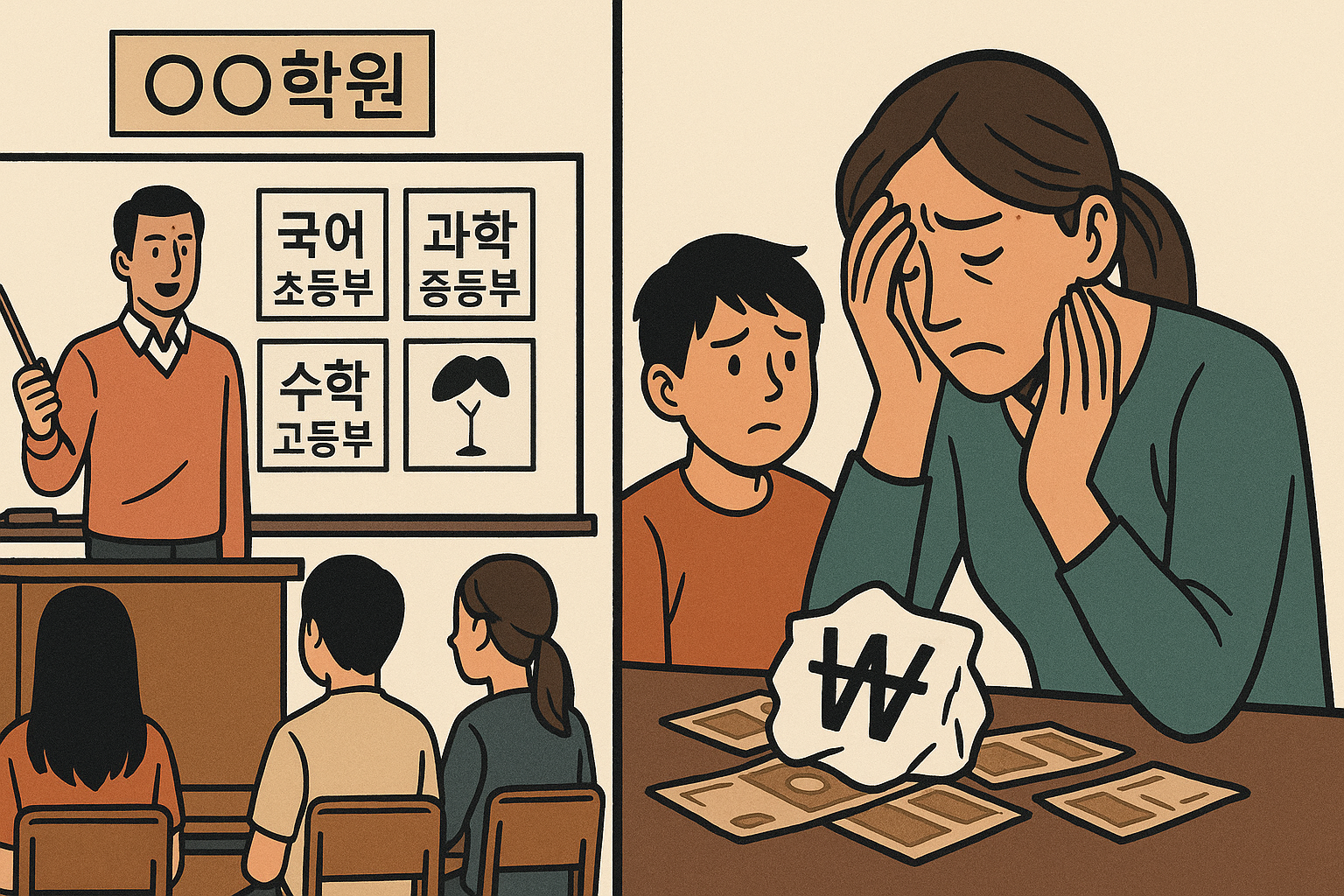
What is the secret? The answer lies in the academies' strategy of "splitting." Just as living organisms grow through cell division, private academies have been splitting subjects, and further subdividing classes by age, day of the week, and student level, thereby expanding the market share.

According to an analysis by Asia Economy and the office of lawmaker Kang Kyungsook of the Progressive Innovation Party, as of the beginning of this year, there were 28,063 academies and tutoring centers registered across the 25 districts of Seoul.
Specifically, there were 14,796 academies and 13,267 tutoring centers. The number of subjects offered by these institutions reached a staggering 339,535. This means that, on average, each academy offers instruction in about 12 subjects.
For example, in the case of English academies, whereas reading comprehension or speaking were previously the main focus, now phonics classes and grammar enhancement classes have been added. Within the same subject, classes are further subdivided by difficulty, such as "enhancement classes" or "intensive classes," or new classes are created for specific target groups, leading to what can be described as "subject cell division."
Nowadays, math academies routinely divide their curriculum into basic math, school math, common math, and immersive math. As more academies allow students to enroll in two or three classes simultaneously, the system of subject-specific elective lectures, once seen only in large test-prep academies for college entrance exams, has now spread to the majority of academies for all age groups.
One academy class for every two students in Seoul

As of last year, there were 766,206 elementary, middle, and high school students in Seoul, and 86.1% of them (according to the 2024 private education spending statistics) were receiving private education. Given that about 340,000 subjects are being offered by academies and tutoring centers in Seoul, this means there is roughly one academy class for every two students in the city.
While there may be rare cases where only two students take a class, in most academies the minimum number of students per class is four or more. In other words, each student is taking two or more private academy subjects. There is no other "private education republic" quite like this.
This inevitably leads to an increase in both the time and money devoted to private education. According to the Ministry of Education's 2024 statistics on private education spending for elementary, middle, and high school students in Seoul, the participation rates are 93.1% for elementary students, 85.1% for middle school students, and 74.7% for high school students. These students spend an average of 9.0, 9.8, and 9.2 hours per week, respectively, on private education (an average of 9.3 hours). Given that most academy classes are held every other day, it is reasonable to assume that each student is taking two or three classes.
The 86.1% of Seoul students who participate in private education spend an average of 782,000 won per month on private education. According to the Seoul Metropolitan Office of Education, the average fee per subject is 345,845 won for academies and 196,319 won for tutoring centers (excluding the top and bottom 10% of outliers). This also supports the conclusion that each student is taking two to three private education subjects.
Every-other-day and twice-a-week classes instead of daily classes... More profit per hour than longer lectures

On the 23rd, various academies are located in a building in the academy district of Mokdong, Yangcheon-gu, Seoul. Photo by Kang Jinhyung
원본보기 아이콘To maximize profits by expanding the private education market, academies employ "special" methods. Most notably, they operate every-other-day or twice-a-week classes instead of daily classes. This allows them to charge a higher average fee per hour compared to daily classes. In addition, parents and students can fit in other subjects in between, and academies see no downside. As a result, a single student can end up taking five or six subjects per week.
Kim, a 45-year-old parent of a high school student, said, "When my child was in elementary school, they attended science experiment classes, worksheet classes, English academy, math academy, and music lessons. Even though it seems like a lot to attend five or six academies, it's possible because, except for English and math, the other subjects are only once a week."
The target age for private education continues to expand. The age at which children start attending English academies is dropping to the infant and toddler years, and as the number of repeat test-takers increases, the consumer base for entrance exam academies is also growing.
Gu Bonchang, director of the Policy Alternatives Research Center at World Without Worries About Private Education, said, "The private education market is becoming more expensive and targeting younger ages. Now, private education spending is becoming as essential as food expenses." Kim Daewook, a professor of early childhood education at Gyeongsang National University, said, "Some academies split a two-hour class into three 40-minute sessions and charge 200,000 won per session, so a two-hour class can cost as much as 600,000 won."
Private education costs contribute to low birth rates

On the 23rd, students are moving to academies after finishing school classes in the academy district of Mokdong, Yangcheon-gu, Seoul. Photo by Kang Jinhyung
원본보기 아이콘According to the Household Income and Expenditure Survey for the fourth quarter of 2024, the average monthly household expenditure was 3.91 million won, with consumption expenditure (excluding non-consumption items such as interest and taxes) at 2.903 million won. Given that the average monthly private education spending for elementary, middle, and high school students is 474,000 won, this means that 16.3% of consumption expenditure is spent on academy fees. Considering that 14% of households do not participate in private education, the actual proportion is likely even higher.
Private education costs are a significant burden on households and contribute to the low birth rate. The Organisation for Economic Co-operation and Development (OECD) cited "high private education spending" as a cause of Korea's low birth rate in April.
Jung Jaehoon, professor at Seoul Women's University and head of the Gyeongbuk Happiness Foundation, described private education spending as a kind of "pressure cost" that leads to low birth rates. Professor Jung said, "Private education costs have already become a 'pressure cost' that cannot be reduced or resolved through policy support alone and require structural reform. The competitive structure of education that developed in Korean society as part of a talent-centered growth strategy has led to the emergence of pressure costs." He added, "To eliminate pressure costs, not only does the industrial ecosystem need to be restructured, but educational reform is also necessary."
-
Reporter Oh Jooyean moon170@asiae.co.kr
-
Reporter Kim Youngwon forever@asiae.co.kr
-
Edit Kim Boram kbram6457@asiae.co.kr
© The Asia Business Daily(www.asiae.co.kr). All rights reserved.